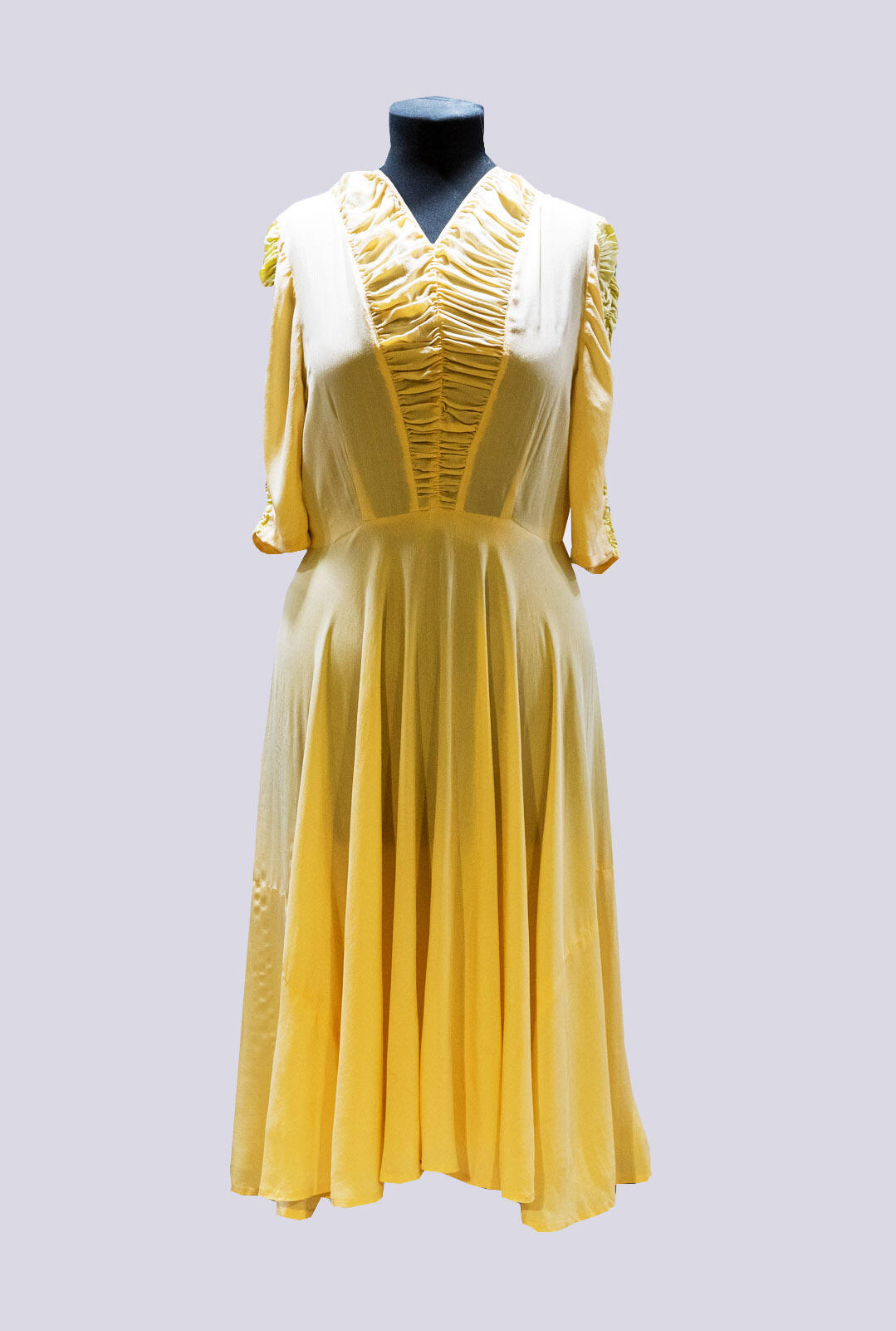


An elegant women’s dress of the first post-war years against the background of a photograph with beautiful goods makes one think about the essence of ‘Stalin’s abundance’. The things acquired before the war were altered, reworked, repaired many times. The best factory workers for shock work could be rewarded with a piece of fabric — most often it was dense American fabric of the “Boston” type. The award also included the right to sew a dress or suit in a city atelier without waiting in line.
In 1945, the soldiers returning from the front brought the first cuts of captured German materials to the city. Some of the girls made dresses from white parachute silk. The first cuts of fabric went on sale in the shops of Molotovsk (as Severodvinsk was then called) a few months after the end of the war. Of course, the greatest demand was for cheap and necessary cotton fabrics in everyday life. Not everyone could afford expensive silk, crepe de Chine, wool. This dress belonged to a young girl — a technician of the main enterprise of the city – shipbuilding yard No. 402.
During the war, industrial goods practically disappeared from the shops of Molotovsk. Shoes, clothing, knitwear and textiles could not be found on the market. A piece of cream crepe de Chine for this dress was stocked on a manufactured goods card in the shop of the factory workers’ supply department. Then it was time to wait for a long queue with a familiar dressmaker, who in the evening illegally worked at home as a sewing craft. The dressmaker valued her future work not with money — then little could be bought with them, but with bread cards.
The fashionable style of the dress with draped sleeves was borrowed from a fashion magazine, it was in such dresses that the heroines of the movies popular at that time went. To make a flared skirt from a narrow cut, the dressmaker had to sew a diagonal wedge along the hem of the product. Its owner took great care of the elegant crepe de Chine dress — the dress was worn only a few times. It was kept in the Severodvinsk family as a memory of youth and post-war years.
In 1945, the soldiers returning from the front brought the first cuts of captured German materials to the city. Some of the girls made dresses from white parachute silk. The first cuts of fabric went on sale in the shops of Molotovsk (as Severodvinsk was then called) a few months after the end of the war. Of course, the greatest demand was for cheap and necessary cotton fabrics in everyday life. Not everyone could afford expensive silk, crepe de Chine, wool. This dress belonged to a young girl — a technician of the main enterprise of the city – shipbuilding yard No. 402.
During the war, industrial goods practically disappeared from the shops of Molotovsk. Shoes, clothing, knitwear and textiles could not be found on the market. A piece of cream crepe de Chine for this dress was stocked on a manufactured goods card in the shop of the factory workers’ supply department. Then it was time to wait for a long queue with a familiar dressmaker, who in the evening illegally worked at home as a sewing craft. The dressmaker valued her future work not with money — then little could be bought with them, but with bread cards.
The fashionable style of the dress with draped sleeves was borrowed from a fashion magazine, it was in such dresses that the heroines of the movies popular at that time went. To make a flared skirt from a narrow cut, the dressmaker had to sew a diagonal wedge along the hem of the product. Its owner took great care of the elegant crepe de Chine dress — the dress was worn only a few times. It was kept in the Severodvinsk family as a memory of youth and post-war years.

