Font
Color
Graphics
Изображение точки

To see AR mode in action:

1. Install ARTEFACT app for iOS or Android;

2. Find the exhibition «Northern Civilization: The Khanty»

3. Push the «Augmented reality» button and point your phone's camera at the exhibit;

Скрыть точки интересаПоказать точки интереса
Показать в высоком качестве

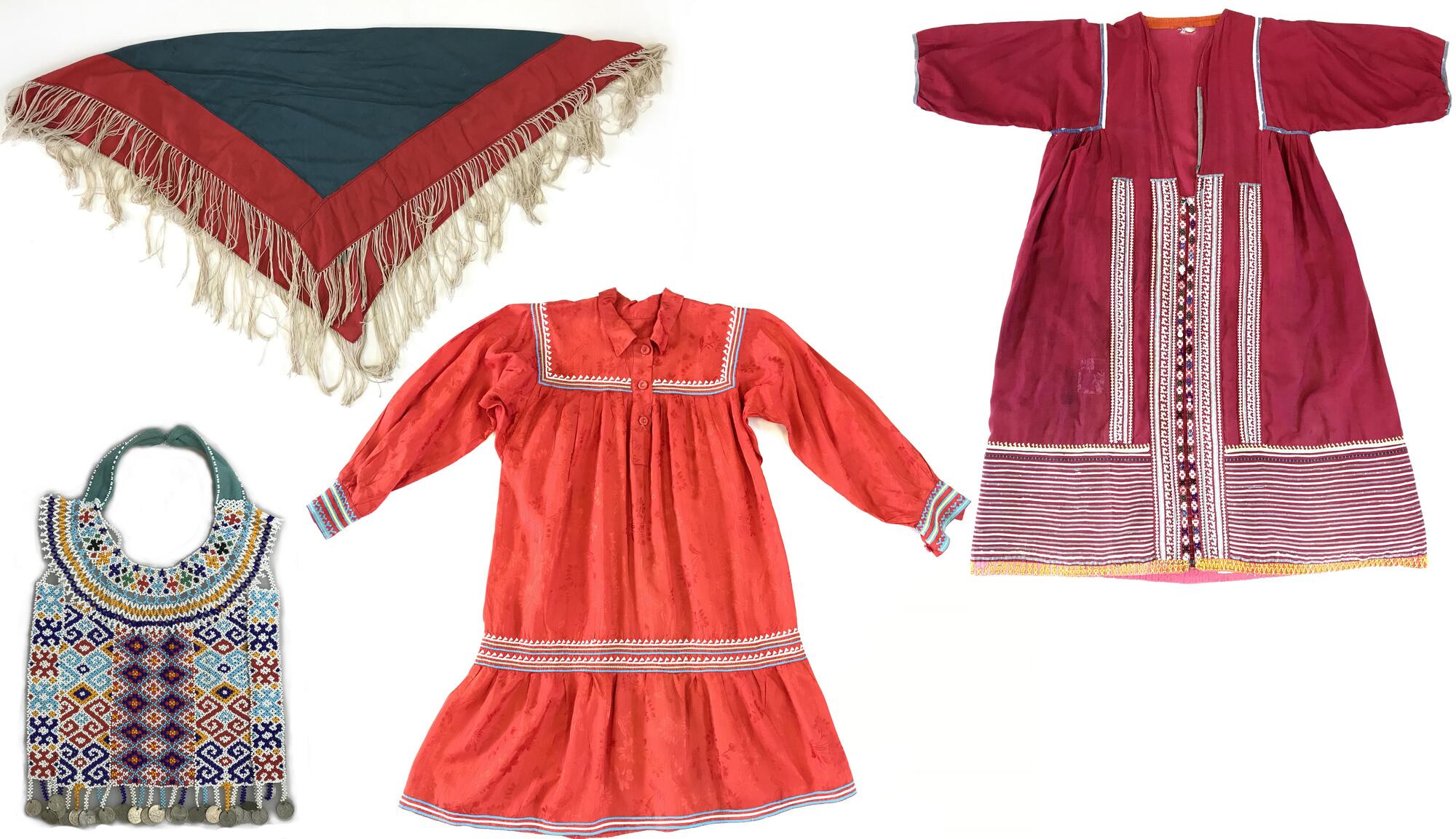
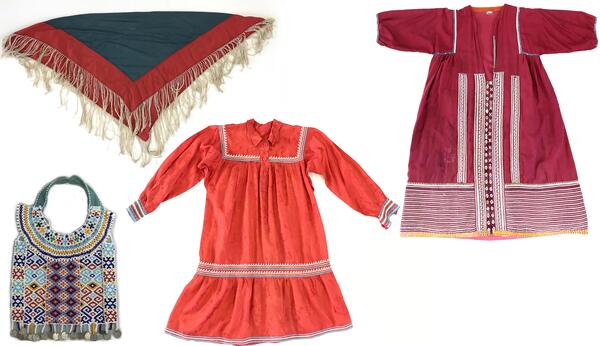
Dress, Khalat, Women’s bib, Headscarf

0
Open in app
#1
Dress, Khalat, Women’s bib, Headscarf
#14
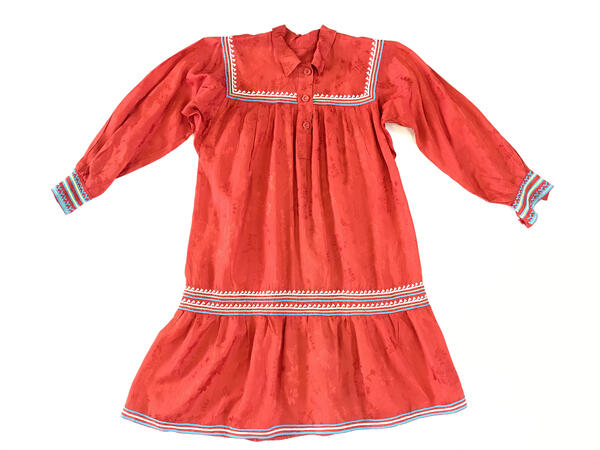
Dress
#13
The traditional women’s costume of the Khanty people is not only practical, but also beautiful. The national dress, which is called “yernas” in the local dialect, is sewn from a plain fabric, for example, from chintz, satin, or flannel.
 
In the old days, northern craftswomen wove cloths from nettles. The plant was picked and dried in autumn, when leaves fell from trees. After that, the nettle was divided into fibers and crushed with a mallet to make them elastic. Threads were woven, from which the fabric was then made.
 
National dresses are decorated with monochromatic strips of fabric made of different materials. They are sewn on the dress closely to each other — so the cuffs, flaps, and hemline have colored borders. According to legend, this trimming marks the border between a person and the outside world and protects from the spirits of diseases. Between the strips is a patterned ribbon with a small ornament made in the application technique. All parts of the dress are decorated with some pattern and strips of fabric and only then sewn together.

To create a traditional dress, craftswomen mostly use white, red, green, yellow, and blue. Each of them has a symbolic meaning. White symbolizes snow, red symbolizes fire, yellow is a symbol of life, green means taiga, and blue symbolizes water and sky.
 
The production time of one yernas depends on the talent and experience of the craftswoman. One of the beliefs of the Khanty people says that when a woman is busy with handicraft, her thoughts are “sewn” into the seams and ornaments of the future thing. Therefore, the craftswomen try to think only about the good things while working. 

The dress is traditionally worn with a necklace. It is made from beads, decorated with Khanty geometric ornaments. Such a necklace is an amulet for its owner and additional protection from evil spirits.
 
In the museum, you can see a traditional national dress (yernas). It is a so-called shirt dress with a wide ruffle at the hemline and a turn-down collar, sewn without shoulder seams. There is a cut on the chest that is fastened with three buttons. The collar, hem, and cuffs are decorated with white, light turquoise and blue stripes in the technique of applique fabric.
#12
Полное наименование: National Khanty dress (Yernas)
Дата создания: 2006
Техника: applique fabric
Размеры: 91×142 cm
Правообладатель изображений: MAIC “Ethnocultural Center”
Автор: Olga Ilyinichna Kostina
Коллекция: MAIC
Место создания: Kazym village, Beloyarsky district
#11
Khalat
#10
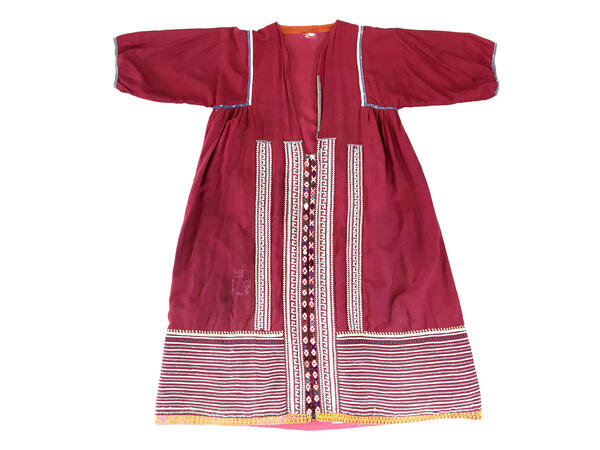
The exhibition presents a traditional Khanty women’s khalat, which was created by the People’s Master of Russia Aksinya Yernykhova in 2006.
 
Khanty women wear khalats like this over a calico dress, most often on festivities. It is sewn from a plain smooth fabric, for example, from satin, usually of burgundy color. The khalat consists of a yoke, a back and flaps. A yoke is a cut-off part of the fabric that is sewn to the back, and short tapering sleeves are called flaps.

The khalat flares to the bottom, it does not have a collar. First, each detail of the future dress is embroidered with an ornament and only then they are sewn together. Sometimes they are additionally decorated with beads.
 
The hem, edges and sleeves are decorated with traditional patterns — narrow strips of white and blue fabric. It is created in the applique technique. The simplest geometric pattern is a straight line, a strip or a ribbon — it means a road, a life path for the Khanty people.
 
The hem of the craftswoman’s khalat is also embroidered with horizontal stripes of white, blue, and yellow. Such a pattern is considered by the Khanty to be a protection against evil spirits that bring troubles and diseases from the Lower World. Along the very edge of the bottom, a strip embroidered with beads is sewn with small stitches that are visible only on the inner side.
 
The ornament on the sleeves, also performed in the applique technique, provides protection from witchcraft and the evil eye, according to ancient beliefs. The Khanty believe that the thoughts of the craftswoman will be sewn into the seams and patterns, so the woman should think only about good things while working.
 
According to the Khanty beliefs, clothes can be worn only if the ornament on is fully completed.
 
The craft of making clothes was traditionally considered a women’s job. Women who know all the secrets of this craft do not use special sewing patterns, stencils or rulers. They can measure all the details just by looking at them.
 
In the old days, the creation of even one piece of clothing was a long and time-consuming process: craftswomen usually worked in winter with poor lighting. For example, the process of embroidery of a shirt or dress could take one or even two years.
#9
Полное наименование: Khanty women’s khalat
Автор: Aksinya Grigoryevna Yernykhova
Дата создания: 2006
Техника: fabric applique
Размеры: 101.5×98 cm
Правообладатель изображений: MAIC “Ethnocultural Center”
Коллекция: MAIC “Ethnocultural Center”
Место создания: Kazym village, Beloyarsky district

#8
Women’s bib
#7
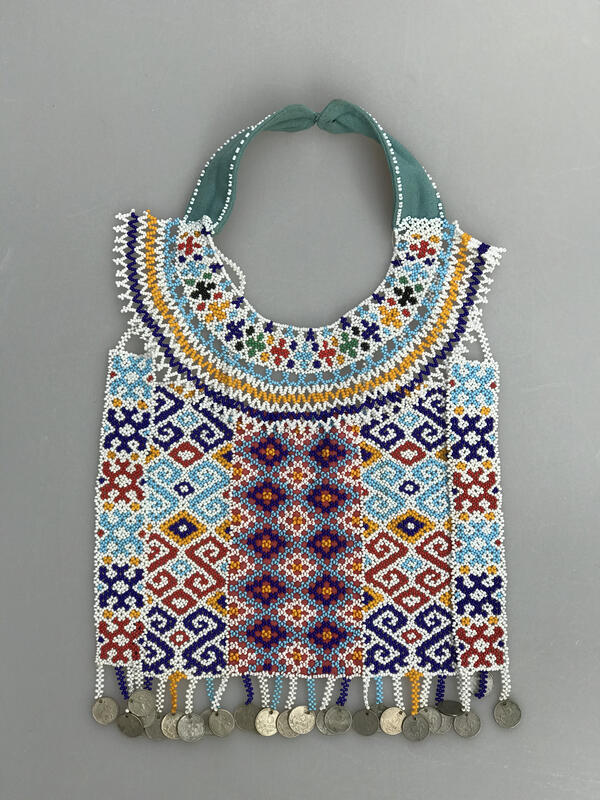
The women’s bib of the early 20th century, that is exhibited in the museum, was made in the traditional bead weaving technique in the village of Kazym, Beloyarsky district of Yugra. The craftswoman Zinaida Kaksina created this piece using blue, orange, white and blue beads. In addition, the bib is decorated with five-kopeck coins.

In the culture of the Ob-Ugrians, women’s jewelry could be either decorative or ritualized. Decorative jewelry did not have any sacred meaning, since these pieces were not decorated with sacred ornaments. Such jewelry was worn with a festive costume. According to the beliefs of the northern peoples, ritual accessories performed a protective function as they protected the owner from evil spirits. For example, if someone wore a sacred decoration on his chest, it covered and protected the heart.
 
Detachable breast ornaments woven from beads were called “mavlops”. This word translates from the Khanty language as a “breast keeper”. The neck accessory was called “turlops” which means “flap at the throat”.
 
In the past, the indigenous northern peoples decorated their clothes only with natural materials: shells, stones, teeth and vertebrae of animals, balls of clay. Beads appeared in the decorative arts of the Khanty people only with the development of trade routes in the North.
 
The process of stringing beads on a fishing line was called “sak karatty” in the northern dialect of the Khanty language, which means “placing beads one by one”. The eastern Khanty called this craft “suk pulte”, which translates as “harnessing pebbles”.
 
To create jewelry, the Khanty and Mansi preferred to use bright colored beads, for example, blue, light blue, orange, green, and yellow ones. The artisans tried to put the beads of contrasting shades one after another.
 
Two ancient techniques of working with beads still remain nowadays. They are embroidery and weaving. The methods of knitting beads differ in the number of threads: there can be up to thirty of them in one item. In ancient times, craftswomen used threads made from deer tendons or horsehair. Nowadays, they have been replaced by thin wire or fishing lines. They weave beaded jewelry by hand, alternating geometric, stylized plant, and zoomorphic patterns.
#6
Полное наименование: Women’s bib (Mev Lopas)
Дата создания: the middle of the 20th century
Техника: bead weaving
Размеры: 46×86 cm
Правообладатель изображений: MAIC “Ethnocultural Center”
Коллекция: MAIC Ethnocultural Center”
Автор: Zinaida Semyonovna Kaksina
Место создания: Kazym village, Beloyarsky district
#3
Headscarf
#5
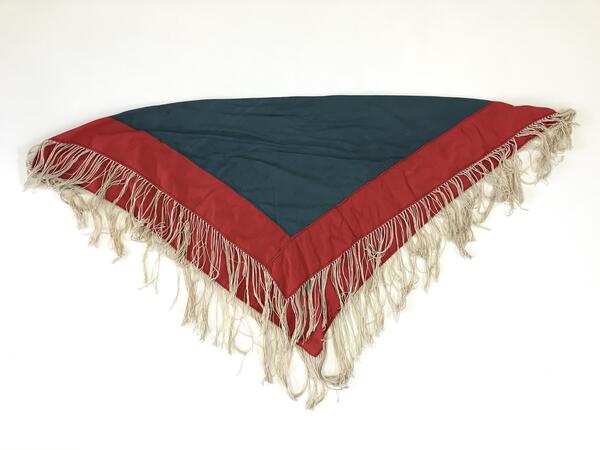
In the past, women of the Khanty and Mansi peoples did not wear hats. The most common female headdress was a headscarf. In frosty winters, several headscarves were tied on the head at once, inside each other. On holidays, a headband was worn under the headscarf, sewn from a strip of fabric, decorated with multicolored beads.
 
The headscarf was an essential part of a woman’s costume. In the Khanty culture, it had a sacred meaning. It was considered a symbol of protection, a talisman against evil spirits, and an offering to patron spirits.
 
The headscarf is used in various rituals of the Khanty people. For example, during matchmaking, the groom’s parents sent a headscarf to the bride’s family. It became a symbol of engagement, and the girl could no longer marry another man. During the wedding, the bride wore two headscarves if both of her parents were alive. If she had only one parent, she wore only one headscarf.
 
The Khanty also had the custom of “avoidance”: unfamiliar men should not be able to see a married woman’s face. That is why after the wedding, the wife put the headscarf upon her face if strangers were around.
 
The Northern peoples living in different territories wore the headscarf in different ways. For example, the eastern Khanty tied it under the chin, while on the Vasyugan river (the lower tributary of the Ob), the ends of the headdress were tied behind, covering the forehead to the eyebrows. Indoors, when a woman did not need to hide her face, she fixed a headscarf on the back of her head.
 
Sewing headscarves has traditionally been a women’s craft. In the old days, the Khanty took an arshin (slightly more than 70 centimeters) of fabric for making this headdress. They also trimmed it along the edge. It symbolized the border that protected the woman from the hostile outer world.
 
Among the eastern Khanty, the headscarf could only be quadrangular, while among the southern and northern Ob Ugrians, it was popular to wear triangular headscarves decorated with embroidery.
 
The Khanty scarves often cane in two colors: they were either red and blue or red and green. The headdresses were decorated with beaded pendants, bells, fringes, and tassels.
 
The headscarf displayed at the exhibition was sewn manually in the middle of the 20th century in the village of Kazym, Beloyarsky district of Tyumen Oblast.
#4
Полное наименование: National headscarf for women
Дата создания: the middle of the 20th century
Техника: applique fabric
Размеры: 118×111 cm
Правообладатель изображений: MAIC “Ethnocultural Center”
Коллекция: MAIC “Ethnocultural Center”
Автор: Iraida Grigoryevna Nettina
Место создания: Kazym village, Beloyarsky district
#2
read morehide
00:00
00:00
1x

Dress, Khalat, Women’s bib, Headscarf

0
Point your smartphone camera to open in the app
Share
VkontakteOdnoklassnikiTelegram
Share on my website
Copy linkCopied
Copy
Open in app
To see AR mode in action:
  1. Install ARTEFACT app for 
  2. iOS or Android;
  3. Find and download the «Paintings in Details» exhibition
  4. Push the «Augmented reality» button and point your phone's camera at the painting;
  5. Watch what happens on your phone screen whilst you flip through the pictures.
 
We use Cookies
Cookies on the Artefact Website. We use cookies to ensure that we give you the best experience on our website. If you continue without changing your settings, we'll assume that you are happy to receive all cookies on the Artefact website. However, if you would like to, you can change your cookie settings at any time.
Learn more about useHide
Content is available only in Russian

X

Нашли опечатку?...

%title%%type%