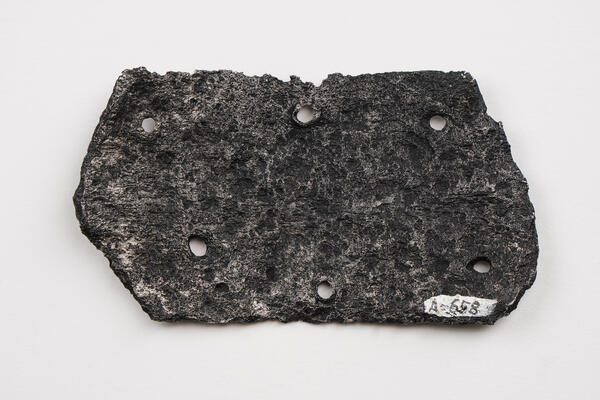
Chain mail is a form of protective armor woven from metal rings and used as protection against edged weapons. The process of creating chain mail required a number of operations. Usually more than twenty thousand rings of more than six hundred meters of wire were used. Weaving began with the collar and ended with the hem; the back and chest parts were reinforced with stronger rings. Usually the weight of chain mail was 9 or 10 kilograms. The classical principle of chain mail weaving was the following: four rings were connected by the fifth — this resulted in seamless weaving and chain mail was easily repaired after being damaged.
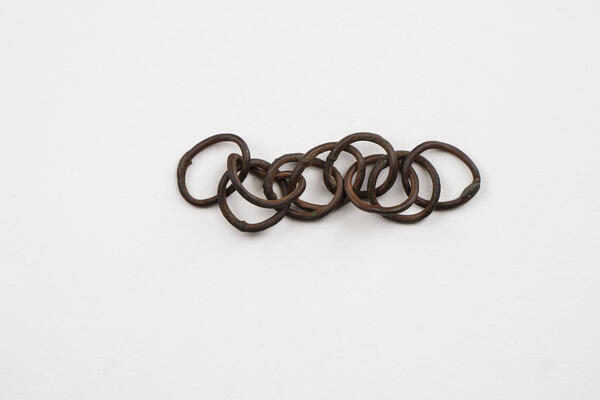
The permanent exhibition the State Museum-Reserve “Kulikovo Field” includes a part of the chain mail armor of the 14th century in the form of a chain of nine sealed and interconnected rings. The rings are deformed; their diameter varies from 1.27 to 1.32 cm. The wire, which was used to assemble the rings, has traces of drawing. In places of soldering or welding, the rings are thicker.
The metal of the rings was studied in the X-ray spectral laboratory of the Department of Geochemistry, Faculty of Geology, Moscow State University using the method of non-destructive X-ray fluorescence energy dispersive analysis. Studies have shown that the rings are made of double brass (copper-zinc alloy) with a medium content of zinc.
The find was discovered in 2002 in excavations conducted by the military-historical detachment of the Upper Don archaeological expedition of the State Historical Museum and the State Museum-Reserve “Kulikovo Field” on the watershed of the Verkhodub and Orzhevik ravines. Presumably, it was there that the main part of the battle took place.
It is known that during the Battle of Kulikovo there were two types of mail armor. Those were chain mail and a jazerant — the type of armor, where chain mail was sewn into a quilted coat. In our case, a non-ferrous metal trim indicates that we have a fragment of a separate armor — chain mail.
The permanent exhibition the State Museum-Reserve “Kulikovo Field” includes a part of the chain mail armor of the 14th century in the form of a chain of nine sealed and interconnected rings. The rings are deformed; their diameter varies from 1.27 to 1.32 cm. The wire, which was used to assemble the rings, has traces of drawing. In places of soldering or welding, the rings are thicker.
The metal of the rings was studied in the X-ray spectral laboratory of the Department of Geochemistry, Faculty of Geology, Moscow State University using the method of non-destructive X-ray fluorescence energy dispersive analysis. Studies have shown that the rings are made of double brass (copper-zinc alloy) with a medium content of zinc.
The find was discovered in 2002 in excavations conducted by the military-historical detachment of the Upper Don archaeological expedition of the State Historical Museum and the State Museum-Reserve “Kulikovo Field” on the watershed of the Verkhodub and Orzhevik ravines. Presumably, it was there that the main part of the battle took place.
It is known that during the Battle of Kulikovo there were two types of mail armor. Those were chain mail and a jazerant — the type of armor, where chain mail was sewn into a quilted coat. In our case, a non-ferrous metal trim indicates that we have a fragment of a separate armor — chain mail.