#1
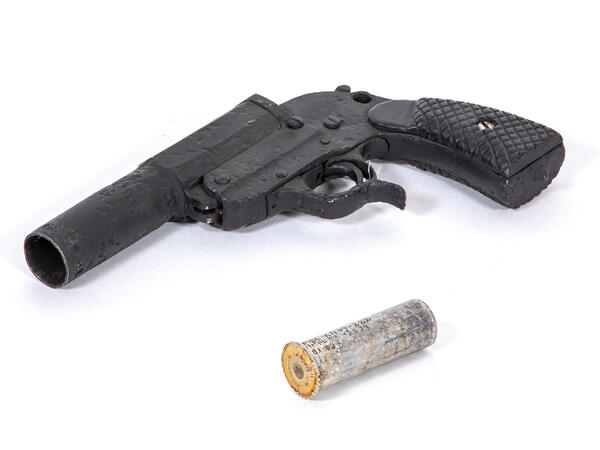
Flare Gun, Signal cartridge case
#3
#4
#5
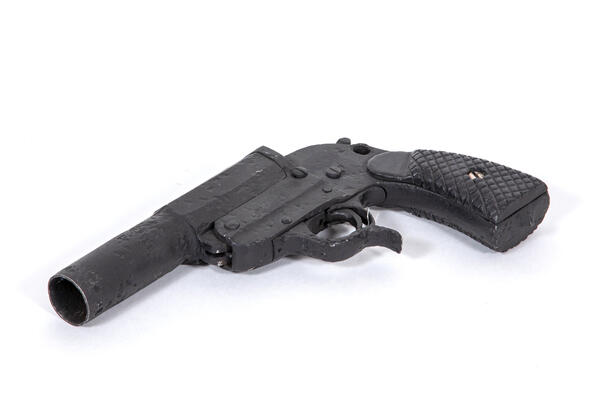
Before and during World War II, the German Army used signal and flare pistols, or flares, which were produced separately for the Wehrmacht, the Luftwaffe, and the Kriegsmarine — the navy. Wehrmacht soldiers used the Walther Leuchtpistole 28 (Leu.P-28), a manual non-automatic pistol developed by gunsmith Fritz Walther back in 1928, to produce signals.
The Leu.P-28 was a signal weapon, designed only to produce light, smoke, or sound signals. Since the ballistic requirements for pyrotechnic projectiles were not as demanding as those for bullets, buckshot, or shotguns, the signal pistol was quite simple. The Leu.P-28 had a short, smooth hinge barrel with no rifling inside and a bolt with a lever at the bottom in front of the trigger guard.
By pulling the lever, the shooter separated the barrel and the bolt, manually loaded one signal cartridge, and returned the barrel to its place. The pistol was locked with the lever mounted above the pistol grip.
At the top of the frame was a hole for attaching a removable stock. Grip jaws were secured with a bolt and nut. A diagonal notch in the form of quadrangles prevented the gun from sliding in the hand. The main parts of the signal pistol — the frame and barrel — were made of steel. The flare gun weighed about 1.3 kilograms.
When shot, the pyrotechnic projectile moved down the barrel with either a larger or smaller gap. Elastic felt wadding was used for obturation — the action of blocking the barrel by a projectile in such a way, that the powder gases expand behind it and give it velocity. Due to this wadding, the shot was safe, and the pistol did not require additional polishing of the inside of the barrel.
In 1942, German gunsmiths developed the Kampfpistole (combat pistol) and the Sturmpistole (assault pistol) based on the Leu.P-28 flare gun. To shoot live ammunition, a rod was inserted into the barrel; without it signal cartridges could also be used. Such weapons were marked with the letter Z on the left side of the breechloader.
#6
Full name: Leu.P-28 Flare Gun. Wehrmacht
Date: before 1945
Technique: factory-made
Place: Germany
Copyright: Museum Resource Center of Noyabrsk
Dimensions: 15,5×24,5×3,5 cm; caliber — 26 mm
Goskatalog Number: 16663681
Date: before 1945
Technique: factory-made
Place: Germany
Copyright: Museum Resource Center of Noyabrsk
Dimensions: 15,5×24,5×3,5 cm; caliber — 26 mm
Goskatalog Number: 16663681
#7
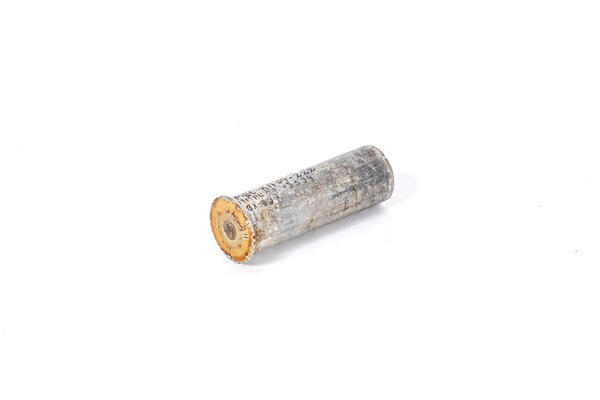
Signal cartridge case
#8
#2
During military engagements, promptly transmitted information could determine the outcome of an operation. The German military used signal pistols and flare guns to produce different distress signals. The most common was the Leuchtpistole, or the Leu.P-28 pistol, by the German firearm manufacturer Walther, adopted by the Reichswehr in 1928.
The pistol had a smoothbore hinged barrel. Below the breechblock, a lever was located in front of the trigger guard. The cartridge was locked in the chamber by a special wedge, which could be controlled with the lever above the grip. The main parts of the signal pistol — the frame and the barrel — were made of steel.
To fire the Leu.P-28, 18 types of 26 mm flare, signal, smoke, and sound cartridges were used. Each cartridge had an aluminum case, which was marked with the branding of the manufacturer, the city, the manufacturing date, the expiration date, and the cartridge type. Sometimes the full name of the manufacturer or the city was replaced with a 3-4 letter abbreviation.
Each cartridge had a small amount of paint in it, the color of which indicated what exactly was needed at the moment. Thus, the white signal indicated the front line, the red signal ordered barrage fire, and the green signal ordered its suspension. The smoke cartridge signaled the approach of enemy tanks, and the sound cartridge meant the beginning of a gas attack.
The signal cartridges were marked with the corresponding color at the bottom of the case and along the rim on the side of the cartridge. The multi-star signal cartridges were marked with stars or dots, the sound cartridges were marked with a blue ring, and the parachute cartridges, which were used for measuring the strength and direction of the wind, were completely white and smooth. The cartridges also differed in the shape of the bottom and the rim. They could be smooth, half-notched, or fully notched.
The flare cartridges were activated at an altitude of 25 m, the maximum flight height was 80 m, and the duration of the burning was 6 to 15 seconds. In daytime in good weather conditions, a flare cartridge could be seen at a distance of up to 2.5 km. At nighttime, a flare could illuminate an area with a radius of at least 100 m.
#9
Full name: Cartridge case for the Leu.P-28 signal pistol. Wehrmacht armament during the Second World War
Date: before 1945
Technique: factory-made
Place: Germany
Copyright: Museum Resource Center of Noyabrsk
Dimensions: 3×8,3×3 cm
Goskatalog Number: 16663710
Date: before 1945
Technique: factory-made
Place: Germany
Copyright: Museum Resource Center of Noyabrsk
Dimensions: 3×8,3×3 cm
Goskatalog Number: 16663710
#10
Ministry of Culture of the Russian Federation
read morehide
00:00
00:00
1x
Flare Gun, Signal cartridge case
Collection
Exhibition
0
 Point your smartphone camera to open in the app
Open in app
Share