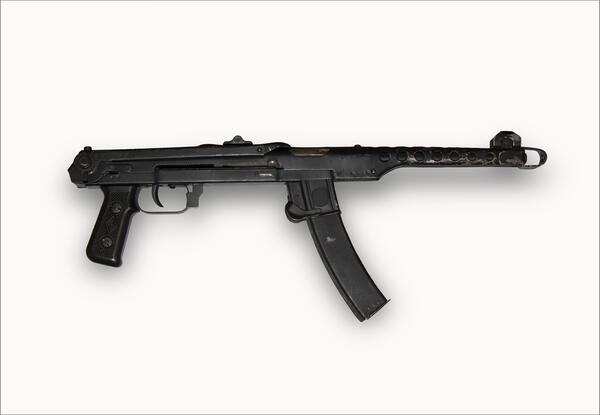
The new submachine gun chambered for a 7.62 mm cartridge was developed by the Soviet firearm designer Alexey Ivanovich Sudayev in 1942. He was assigned the task of designing a gun that would be just as efficient as the Shpagin submachine gun, but would also be simpler, smaller, and cheaper.
The PPS-43 was made from sheet metal with the use of welding and riveting. Additional processing was required only for the bolt. The Sudayev submachine gun used fewer materials than the model designed by Georgy Semyonovich Shpagin.
The main advantage of the new design was that the production could be launched even in the besieged Leningrad. During the first months of production in 1942, tens of thousands of guns were manufactured. In 1943, a modified version, the PPS-43, was presented, which had a shorter buttstock, and its barrel housing and receiver were combined. Other changes included a new shape of the latch on the shoulder piece, an updated safety thumb catch, and a new cocking handle.
Even though the PPS was superior to the PPSh, it did not replace its predecessor completely. The problem was that enterprises had already been producing the Shpagin submachine gun for a long time and it was inefficient and unreasonable for them to change the technological process during the war. As a result, less than half a million Sudayev submachine guns were produced.
The PPS remained in service until the mid-1950s. In 1944, Finland started producing a modified PPS-43 for the 9mm Parabellum caliber. The production of the Sudayev submachine gun was also established in West Germany, Poland, North Korea, and China.
The PPS with all the accessories (six full magazines and a maintenance kit) weighed only 6.72 kg. The PPS-43 fully complied with the terms of reference — it was compact, low-maintenance, easy to produce, maintain, and repair — however, there were some problems associated with the poor build quality.
The large dispersion when firing in bursts did not allow soldiers to shoot precisely. Nevertheless, the PPS-43 was used not only by regular units but also by partisan parties, as well as other allied formations on the territory of the Soviet Union.
The PPS-43 was made from sheet metal with the use of welding and riveting. Additional processing was required only for the bolt. The Sudayev submachine gun used fewer materials than the model designed by Georgy Semyonovich Shpagin.
The main advantage of the new design was that the production could be launched even in the besieged Leningrad. During the first months of production in 1942, tens of thousands of guns were manufactured. In 1943, a modified version, the PPS-43, was presented, which had a shorter buttstock, and its barrel housing and receiver were combined. Other changes included a new shape of the latch on the shoulder piece, an updated safety thumb catch, and a new cocking handle.
Even though the PPS was superior to the PPSh, it did not replace its predecessor completely. The problem was that enterprises had already been producing the Shpagin submachine gun for a long time and it was inefficient and unreasonable for them to change the technological process during the war. As a result, less than half a million Sudayev submachine guns were produced.
The PPS remained in service until the mid-1950s. In 1944, Finland started producing a modified PPS-43 for the 9mm Parabellum caliber. The production of the Sudayev submachine gun was also established in West Germany, Poland, North Korea, and China.
The PPS with all the accessories (six full magazines and a maintenance kit) weighed only 6.72 kg. The PPS-43 fully complied with the terms of reference — it was compact, low-maintenance, easy to produce, maintain, and repair — however, there were some problems associated with the poor build quality.
The large dispersion when firing in bursts did not allow soldiers to shoot precisely. Nevertheless, the PPS-43 was used not only by regular units but also by partisan parties, as well as other allied formations on the territory of the Soviet Union.