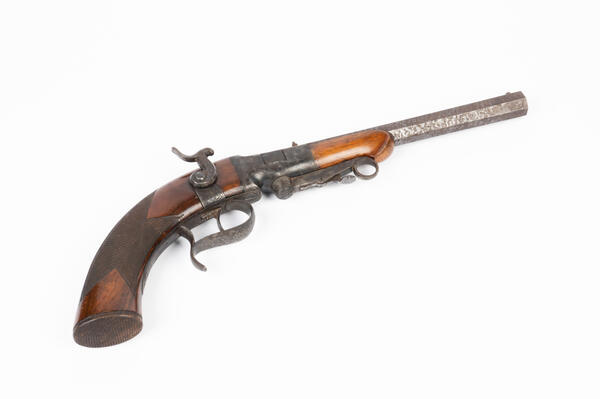
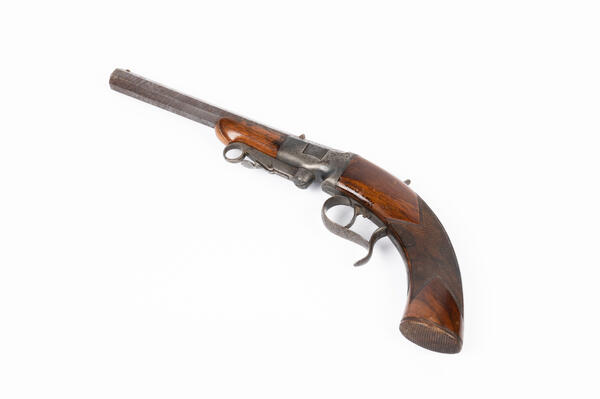
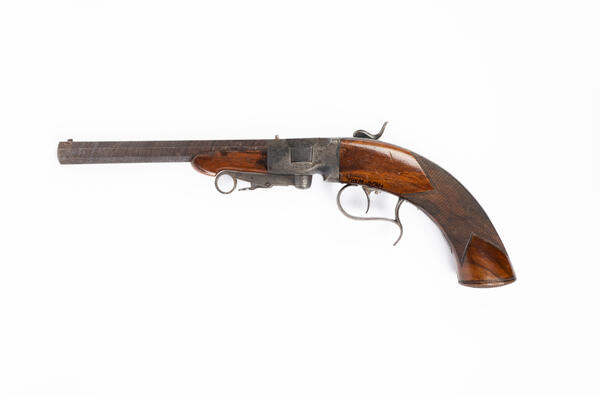
One of the most valuable exhibits in the Unecha Local Lore Museum is a dueling pistol. It was donated to the museum by Alexander Vladimirovich Kazarinov, a native of Unecha, Honorary Citizen of the Unecha District, and a devoted patron of arts.
Dueling pistols were the weapon of choice for personal duels throughout the 18th and 19th centuries. Among the most celebrated makers of such firearms was the French gunsmith Jean Lepage, whose elegant and precise pistols were reportedly used by Alexander Sergeyevich Pushkin.
Initially, English dueling pistols set the standard for craftsmanship and reliability. They were later rivaled — and in some regions surpassed — by French and German models. Unlike military sidearms, dueling pistols featured lighter frames, longer barrels, and flintlock mechanisms. Moreover, they were not merely functional — they were also exquisite works of decorative art, often adorned with fine engravings, inlaid metals, and intricately carved stocks.
To ensure equal conditions, dueling pistols were always made and used in matching pairs, stored together in a single case. In the Russian Empire, the minimum accepted distance for a duel was three steps, though six or eight steps were more commonly observed. Duels remained a fixture of military and aristocratic culture, especially among officers, well into the early 20th century.
The pistol on display features a stock crafted from fine hardwood, intricately carved with a diagonal lattice pattern. Its shaped trigger guard has survived intact, though time has left its mark: the grip shows signs of wear, the barrel bears minor chips, and the trigger mechanism is slightly damaged. Yet it is precisely these traces of use that give antique weapons their unique value — they carry the weight of history and seem to breathe with the spirit of a bygone era.
Notably, it was with pistols of this type that one of the most dramatic duels in Russian history unfolded. In 1817, a four-person duel erupted over the famed ballerina Avdotya Istomina in St. Petersburg. The principal opponents were Vasily Sheremetev, a cavalry guardsman, and Count Alexander Zavadovsky — son of Pyotr Vasilyevich Zavadovsky, a native of the Unecha region and the first Minister of National Education of the Russian Empire.
During the exchange, Sheremetev was mortally wounded. The conflict quickly escalated: the seconds joined the fray, turning the encounter into a four-person duel. On Sheremetev’s side stood Alexander Yakubovich, a future Decembrist; opposing him was the celebrated poet, playwright, and diplomat Alexander Griboyedov.