For almost five centuries, starting from 1460, the Alexander Oshevensky Monastery remained one of the largest spiritual centers of the Kargopol region. However, in 1928–1931 the monastery was deserted; by the mid-20th century the cathedral church was looted and destroyed. It was only in the late 1960s that the issue of its restoration was raised, but not yet resolved. Around that time, in 1967, in the vicinity of the monastery, an expedition of the Moscow State University studied dialects of the Kargopolsky district.
A member of the expedition, Elena Mikhailovna Smorgunova recalled that in the ruined courtyard of the monastery, scientists found monastic archives thrown out of the lower floor of the bell tower. Those included documents, property inventories, accounting books, imperial decrees, and letters. All of them were in a deplorable state, “there were a lot of torn and dirty pieces of paper… the collections of documents lacked the initial and final pages, on many sheets there were visible traces of… wheels and ripple sole boots.” Smorgunova managed to select several dozen sheets, which later, in 1999, she donated to the collection of the Kargopol State Museum of History, Architecture and Art. A few days later, the documents remaining on the territory of the monastery were burned.
The documents collected by Elena Smorgunova revealed interesting information about the peculiarities of local oral speech, toponymy and inhabitants, and helped to determine the names of hegumens, hieromonks, treasurers and novices.
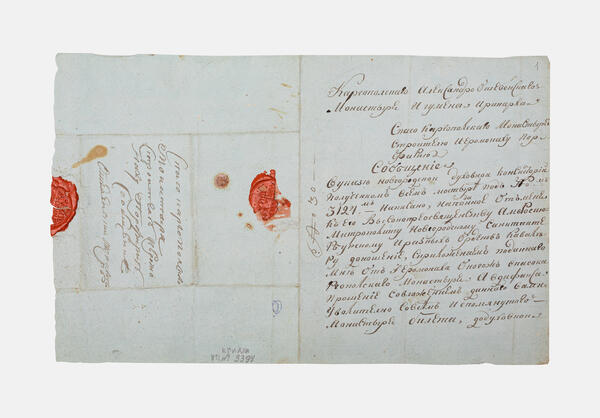
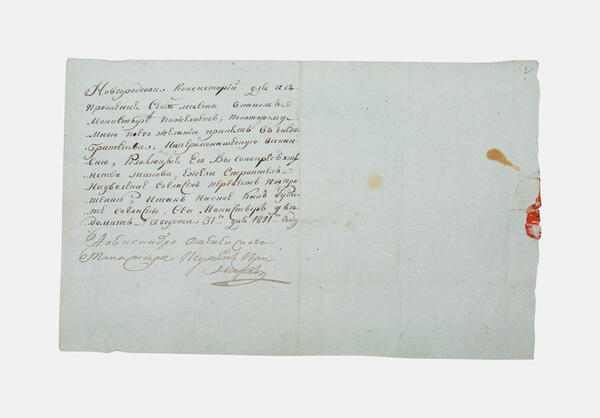
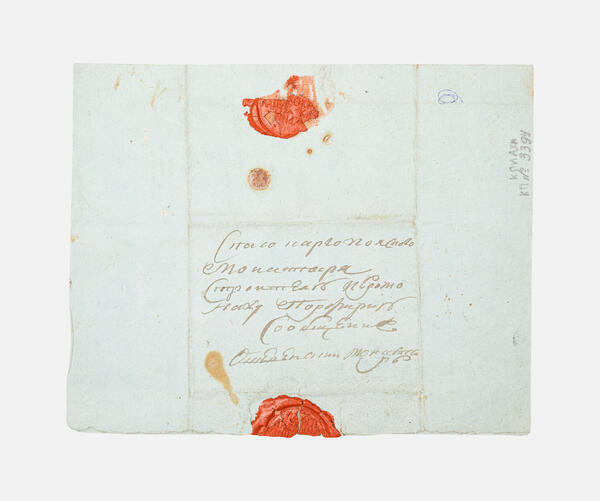
The presented letter is addressed to the hegumen (abbot) of the monastery, Father Irinarch, and concerns an ongoing litigation process. As follows from the text, a certain peasant Yakov Alekseev Koshelev signed a contract with the monastery for breaking and cutting stone slabs for construction purposes. He received money in advance, but only partially completed the work — ten square sazhens (about 18 square meters). In this regard, the abbot brought an action against him to the Lower Zemsky Court of Kargopol; the court, in turn, asked to see the contract in order to begin questioning the said peasant.
The original documents of the Alexander Oshevensky
Monastery, preserved and described by Smorgunova, are apparently not the only
ones that were saved. By the time of writing, the content and, probably, the
place of acquisition (the destroyed monastery yard, the 1960s–1970s), they were
close to 130 scattered handwritten sheets (70 documents) that ended up in a
second-hand bookstore of Kargopol, and then, in 1992, were transferred to the
regional scientific library named after Nikolay Dobrolyubov. All of them were
written between 1769 and 1806 and exhibit the everyday, cultural and spiritual,
political and economic aspects of life in the monastery.