

#1
Books, Portrait of Chernyshevska, table
#2
#20
#3
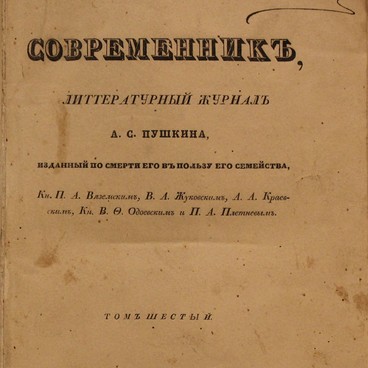
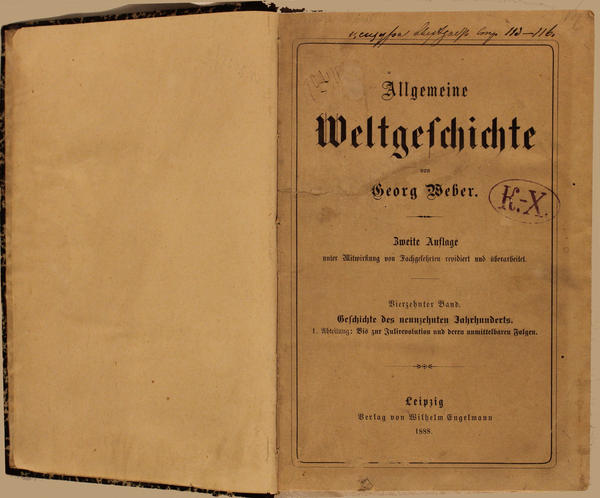
‘General History’ is a fundamental work of Georg Weber, a well-known German historian and philologer. The author covered the period of the history of the humankind from the earliest times until the 19th century (inclusive). Weber attempted to present the holistic picture of the humankind development — he believed that ‘General History’ should be ‘true, straight and unflattering review of all the human deeds and intents in their true colours’.
The volumes were created in 1857–1880 and became very popular — the 2nd edition followed immediately after the 1st one. Nikolay Gavrilovich Chernyshevsky chose this book for translating, and informed his old friend Alexander Vasilyevich Zakharyin about it in October 1884. In his letter, Chernyshevsky also wrote that in his opinion the publication of this book in Russian would be of great success.
In November 1884, Chernyshevsky finally received the long awaited permission for literature activity. He was allowed to work subject to two conditions: all the materials had to undergo preliminary censorship and should be published under a pseudonym.
Mikhail Chernyshevsky wrote to his father: ‘If you still have the same opinion about Weber… dear Dad, I will send this book to you’. Chernyshevsky received the first volume of the original on March 7, 1885, and immediately started the translation work. At the end of the same year, he stated translating the second volume. He wrote about it to Ivan Ilyich Baryshev: ‘I would like to present the continuation of this publication in the form that would catch fancy with the Russian audience and assure the success of Russian edition’.
Thanks to active promotion by Zakharyin, newspapers and journals published articles by N.G. Chernyshevsky. The poem ‘Anthem to the Sky Virgin’ was published by Russkaya Mysl under the surname Andreyev. Chernyshevsky decided he would use the same surname to sign the translation of Weber’s work.
N.G. Chernyshevsky jealously protected the text of his translation from any interference. In February of 1884, he wrote to the publishers of Russian version: “I do not allow any amendments to my manuscripts, except for pure corrections of obvious lapses”.
When the writer still saw such amendments to his translations of the second and further volumes, he claimed to Ivan Ilyich Baryshev in December of 1888: “The author like me does not need in amendments to what he writes” and requested to change the proof-reader.
#4
Author: Georg Weber
Date: 1888
Technique: printing
Dimensions: 23×15 mm
Collection: Rare Books
Copyright: Municipal institution of culture The Memorial Estate of N.G. Chernyshevsky
Goskatalog Number: 18297578
Date: 1888
Technique: printing
Dimensions: 23×15 mm
Collection: Rare Books
Copyright: Municipal institution of culture The Memorial Estate of N.G. Chernyshevsky
Goskatalog Number: 18297578
#5
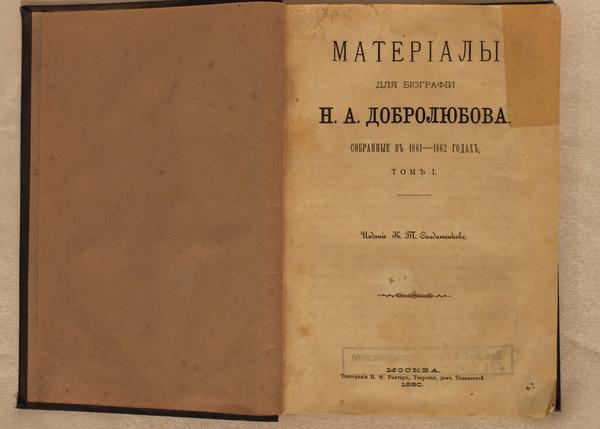
Book Materials for a Biography of N.A. Dobrolyubov Gathered in 1861–1862
#22
#6
Nikolay Chernyshevsky attached great importance to his work on Nikolay Dobrolyubov’s biography. He was the only one who could recount the life and literary work of that art critic, poet, and political writer. At Dobrolyubov’s funeral Chernyshevsky recited excerpts from Dobrolyubov’s diary and two of his poems. The obituary was published in Sovremennik magazine followed by Materials for Dobrolyubov’s Biography drafted by N.G. Chernyshevsky.
Chernyshevsky turned to the subject of Dobrolyubov’s biography in his Astrakhan period, and later while living in Saratov. Chernyshevsky’s cousin Alexander Pypin promised to arrange for its publication in Moscow and Chernyshevsky found the promise convincing. He decided to start with the publication of the Materials for Dobrolyubov’s Biography first published in Sovremennik. The Materials appeared in the January and February issues of the 1889 Russkaya Mysl publication.
In March 1889, in his letter to a book publisher Kozma Soldatyonkov, Chernyshevsky gave a tentative name to his future book: Materials for a Biography of N.A. Dobrolyubov Gathered and Systemized by the Behest of his Siblings. The plan was to publish the work in two volumes: one volume of correspondence and the other one with an overview of manuscripts and memoirs. “The cover won”t have my name on it, neither will my name appear in the book narrative”, Chernyshevsky wrote.
In April 1889, Nikolay Gavrilovich promised the publisher to have the handwritten manuscript of the first volume ready in May; the rest, by the early June. “The Russian public will highly appreciate your publication”, he wrote to Soldatyonkov in a letter. However, the stated deadline was moved to a later date and the second volume has never been sent to print. As for the first volume, it was published as late as 1890 after Chernyshevsky’s death. Alexander Pypin published the book under a changed name: the reference to Dobrolyubov’s relatives was dropped.
Working on the book Nikolay Chernyshevsky had potential censorship restrictions in mind and used the Aesopian language. Nonetheless, the Moscow Censorship Committee arrested the whole print-run. The circulation was permitted only after the name of the author was removed together with his introduction.
#7
Author: Nikolay Gavrilovich Chernyshevsky
Date: 1890
Technique: print, embossing, gilding
Dimensions: 22.5×155.х3 cm
Collection: Rare Books
Copyright: Municipal institution of culture The Memorial Estate of N.G. Chernyshevsky
Goskatalog Number: 002069425
#11
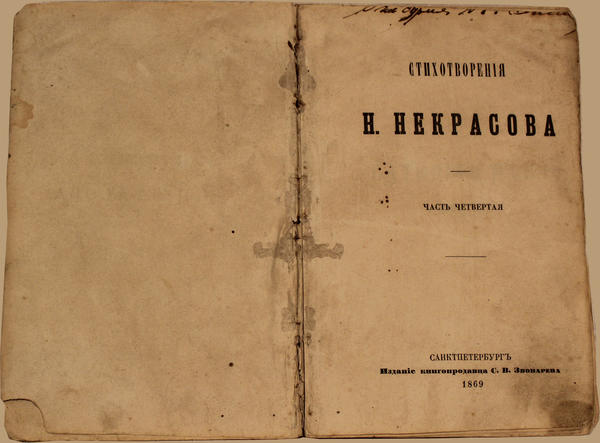
Nikolay Alekseevich Nekrasov. Poems. Part 4. Edited by bookseller S.V. Zvonaryov in St. Petersburg. Printed in Eduard Pratz’ typography.
#23
#12
Nikolay Gavrilovich Chernyshevsky and his wife Olga Sokratovna moved to St. Petersburgh right after their marriage. Chernyshevsky found a job as a teacher of Russian language in the Second Cadet Corps, but quit it in less than a year. In 1854, he started working in the Sovremennik magazine where Nikolay Alekseevich Nekrasov, whom he already knew personally, was the editor. In the summer of 1856, when Nekrasov left Russia for a treatment course, he handed over his editor’s rights and functions to Chernyshevsky.
Nekrasov’s Poems were published 12 times during his life. The first edition was published in 1856 and was of crucial importance for his creative career. In that book, Nekrasov, already a well-known author of lyrical and patriotic literary works, first presents himself to the reader as a poet with his own style. The contents of the book were thoughtfully organized and became the base of all the following books of his poems published while he was alive.
In his letter to the poet, dated November 5, 1856, Chernyshevsky asked about Nekrasov’s health: “You are responsible for your health before the Russian society. You have given us a book that had never been seen in Russian literature before, but you still have to give us much more”. He underlined that Nekrasov’s mission was to discover new ways in poetry, that the form of his works was as new as their content.
Chernyshevsky did not manage to write an article about Nekrasov’s work, but he could give him a general evaluation: “He was a man with a noble soul and a powerful mind. And as a poet, he certainly was above all Russian poets”.
Chernyshevsky recognized Nekrasov’s crucial role in his own creative career. In one of his letters to Alexander Nikolayevich Pypin, he called Nekrasov his benefactor: ‘Only thanks to his great mind, the nobility of his soul and the unwavering firmness of his character I was able to write the way I did. I have served faithfully to my motherland and I am entitled to its gratitude, but all my merits to it are his merits’.
Nikolay Gavrilovich knew about Nekrasov’s terminal disease when he was in exile in Siberia. He wrote to his friend and companion a letter in which he once again admired his work. Nekrasov read his letter lying on his deathbed, and he asked Alexander Pypin: “Please tell Nikolay Gavrilovich that I am very thankful to him, and now my mind is at rest: his words have more significance to me than the words of any other person”.
#13
Author: Nikolay Alekseevich Nekrasov
Date: 1869
Technique: print
Dimensions: 18.9×13.7 cm
Collection: Rare Books
Copyright: Municipal institution of culture The Memorial Estate of N.G. Chernyshevsky
Goskatalog Number: 18297391
Date: 1869
Technique: print
Dimensions: 18.9×13.7 cm
Collection: Rare Books
Copyright: Municipal institution of culture The Memorial Estate of N.G. Chernyshevsky
Goskatalog Number: 18297391
#14
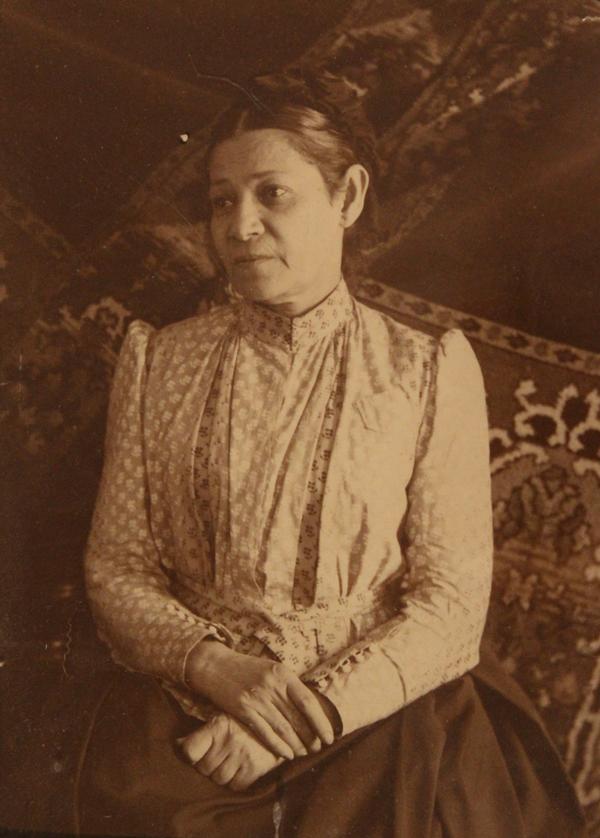
Photographic Portrait of Olga Sokratovna Chernyshevskaya
#24
#15
‘She is the first beauty in the world. Her character is just what I need for my happiness and joy’, wrote Nikolay Chernyshevsky in The Diary of My Relations with the Girl Who Is Now My Happiness. He first met Olga on January 26th 1853, and on February 19th, he proposed to her. They married in St. Sergius’ church on April 29th.
Olga Sokratovna looked like her Italian grandmother: with olive skin and the same “black sparkling eyes”. In her social circle, she was known for her spontaneity, liveliness and courage. She passionately loved nature and her native land, and those who knew her sometimes called her, in jest, “Volga Saratovna”.
After the marriage, the young couple moved to Saint Petersburg, where, in several years, Chernyshevsky became known as a talented essay writer and respected literary critic. His tough rhetoric on the government’s and the emperor’s actions made his name a symbol of imminent revolution: in 1862, Nikolay Gavrilovich was arrested and later, sentenced to penal servitude and exile.
Even before the marriage, he warned Olga: “I have views that make me think that, at any time, the police might come, take me to Saint Petersburg and lock me in a fortress for a long time. I do things that reek of penal servitude…”
In 1866, Olga Sokratovna visited her husband in Yakutia. During her visit, he told her: “Please don”t repeat such trips, my dear, don”t subject yourself to hardship. Abandon me! Marry another man! ” But she did not obey her husband”s request.
After Chernyshevsky”s death, she found his letter from the Petropavlovsk Fortress: “There”s only one thing that I”ll tell you: our life belongs to history: hundreds of years will pass, but our names will still be dear to people, and when they forget all those who lived in our times, they will still remember us with gratitude. So we should not show any weakness of spirit to the people who will study our life”.
In the last years of her life, Olga Sokratovna did not leave Saratov. In March 1890, she moved from the Pypins’ house to the Armyanskaya Street, to the apartment of her friend P. M. Osetrova. Chernyshevskaya died when she was 86. She was buried in the Voskresenskoye cemetery.
#16
Author: Mikhail Nikolayevich Chernyshevsky
Date: 1890
Technique: photographic paper
Dimensions: 12×9 cm
Collection: Photos
Copyright: Municipal institution of culture The Memorial Estate of N.G. Chernyshevsky
Goskatalog Number: 18297040
Date: 1890
Technique: photographic paper
Dimensions: 12×9 cm
Collection: Photos
Copyright: Municipal institution of culture The Memorial Estate of N.G. Chernyshevsky
Goskatalog Number: 18297040
#17
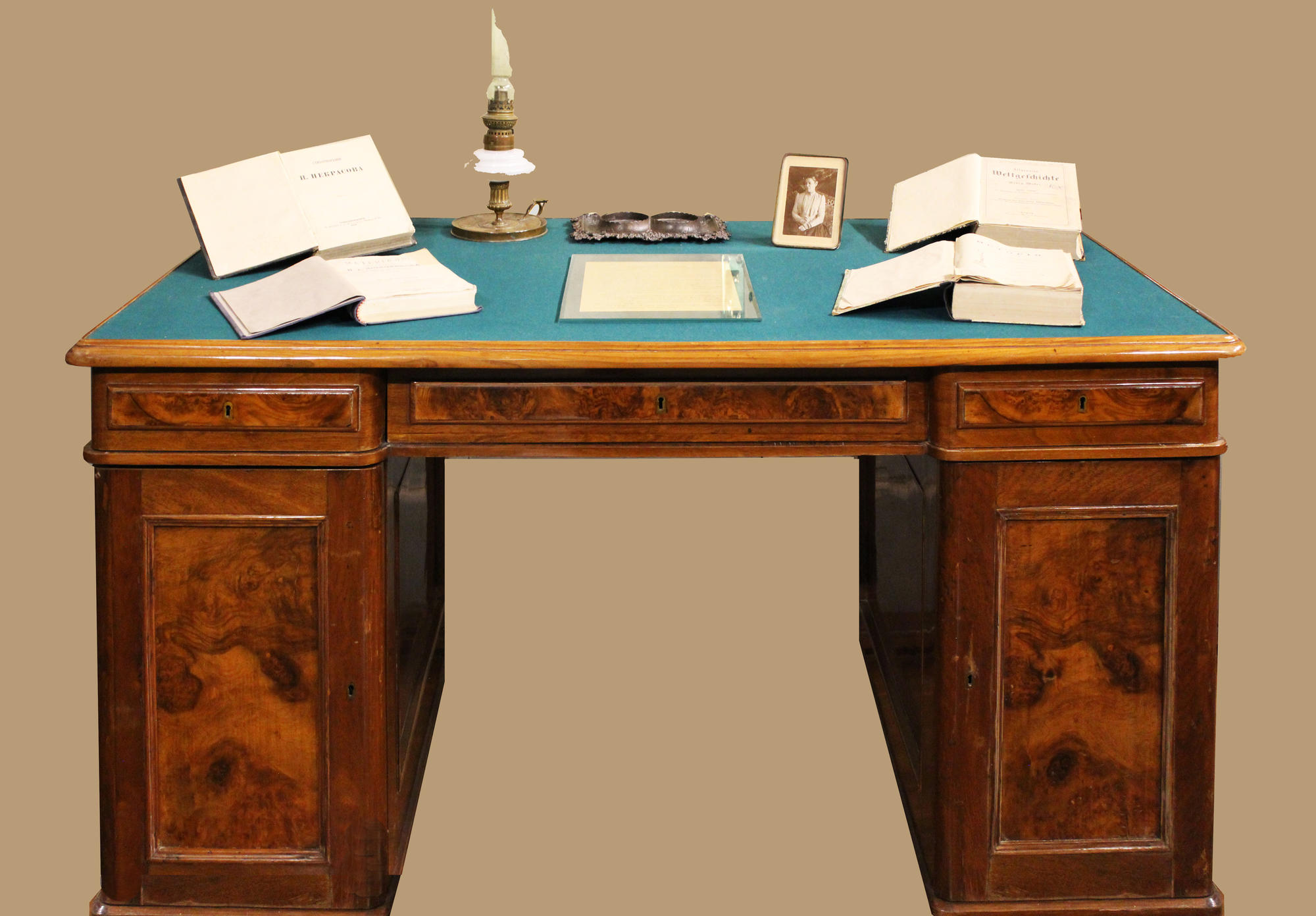
The writing desk N. G. Chernyshevsky owned in the 1880s
#25
#18
The final section of the Worthy Son of Motherland exposition includes a writing desk that Nikolai Chernyshevsky used in Astrakhan and Saratov in the last years of his life.
Like the double pedestal desk in St. Petersburg, this piece displays classic proportions although it is smaller in size. The desk is veneered with chestnut plywood; it has three top drawers and several drawers behind the doors in the pedestals. The under desk drawers are decorated with chestnut panels and an astragal separates them from the pedestals. The corners of the under desk unit and pedestals are rounded and the top has oval edges.
After the sudden death of Nikolai Chernyshevsky in 1889, his widow, Olga Sokratovna, made an inscription of the date of his death inside one of the drawers: ‘Desk of the late Nikolai Gavrilovich Chernyshevsky, from his widow Olga Chernyshevskaya. Oct. 17, 1889.’ She gave the desk to her nephew A. K. Bukovsky. In 1936, the desk was found in the accounting department of the Council of Trade Unions in the town of Engels — identified by the memorial inscription in the drawer.
As remembered by his secretary, Konstantin Fedorov, Chernyshevsky secluded himself from society in Saratov, just as he had in Astrakhan: ‘He was an indefatigable man of desk work, his life was only about his books; he would spend days and nights sitting over his translation of numerous volumes of [Georg Weber’s] Basic World History, biographical materials on the life of Dobrolyubov, and other works’.
At this very desk, Chernyshevsky began working on his last ever article, Thoughts about the Future of Saratov, which he intended to publish in a Saratov newspaper. He believed social and political writing had an important public mission — in his opinion, it was to establish a progressive belief system in the Russian society.
The article begins with Chernyshevsky’s memories of the Volga River as he saw it as a child and later, a teacher in a Saratov secondary school. Above all, the writer associated the future of his home town with saving the river from shallowing — at that time, a rare newspaper issue came out without an article on the topic. The beginning of Thoughts about the Future of Saratov was found in the archive by Chernyshevsky’s younger son Mikhail.
Like the double pedestal desk in St. Petersburg, this piece displays classic proportions although it is smaller in size. The desk is veneered with chestnut plywood; it has three top drawers and several drawers behind the doors in the pedestals. The under desk drawers are decorated with chestnut panels and an astragal separates them from the pedestals. The corners of the under desk unit and pedestals are rounded and the top has oval edges.
After the sudden death of Nikolai Chernyshevsky in 1889, his widow, Olga Sokratovna, made an inscription of the date of his death inside one of the drawers: “Desk of the late Nikolai Gavrilovich Chernyshevsky, from his widow Olga Chernyshevskaya. Oct. 17, 1889.” She gave the desk to her nephew A. K. Bukovsky. In 1936, the desk was found in the accounting department of the Council of Trade Unions in the town of Engels — identified by the memorial inscription in the drawer.
As remembered by his secretary, Konstantin Fedorov, Chernyshevsky secluded himself from society in Saratov, just as he had in Astrakhan: “He was an indefatigable man of desk work, his life was only about his books; he would spend days and nights sitting over his translation of numerous volumes of [Georg Weber”s] Basic World History, biographical materials on the life of Dobrolyubov, and other works”.
At this very desk, Chernyshevsky began working on his last ever article, Thoughts about the Future of Saratov, which he intended to publish in a Saratov newspaper. He believed social and political writing had an important public mission — in his opinion, it was to establish a progressive belief system in the Russian society.
The article begins with Chernyshevsky’s memories of the Volga River as he saw it as a child and later, a teacher in a Saratov secondary school. Above all, the writer associated the future of his home town with saving the river from shallowing — at that time, a rare newspaper issue came out without an article on the topic. The beginning of Thoughts about the Future of Saratov was found in the archive by Chernyshevsky’s younger son Mikhail.
#19
Author: unknown
Date: 1880s 1880s
Technique: carpentry carpentry
Dimensions: 93×77×0.1390 cm 93×77×0.1390 cm
Collection: Furniture Furniture
Copyright: Municipal institution of culture The Memorial Estate of N.G. Chernyshevsky
Goskatalog Number: 83109068310906
Technique: carpentry carpentry
Dimensions: 93×77×0.1390 cm 93×77×0.1390 cm
Collection: Furniture Furniture
Copyright: Municipal institution of culture The Memorial Estate of N.G. Chernyshevsky
Goskatalog Number: 83109068310906
read morehide
00:00
00:00
1x
Books, Portrait of Chernyshevska, table
Exhibition
0
 Point your smartphone camera to open in the app
Open in app
Share