Pintaderas are a form of clay relief stamps with a decorative pattern. They were used in various cultures from the Neolithic period to the Middle Ages. They were mainly popular in Mediterranean countries, but were also found in other regions, as far as Japan. On the territory of the former USSR, pintaderas were used in the Caucasus and the Black Sea region during the Paleolithic, Bronze, and Early Iron Ages. Their name originated from the Spanish word “pintadera”, which referred to clay stamps used by Indians in Mexico, Colombia, and other regions to apply natural dyes to their body as a form of decoration. However, it is unlikely that many ancient pintaderas had this function. They may have been used for other purposes, for example, to stamp patterns on ritual breadcakes.
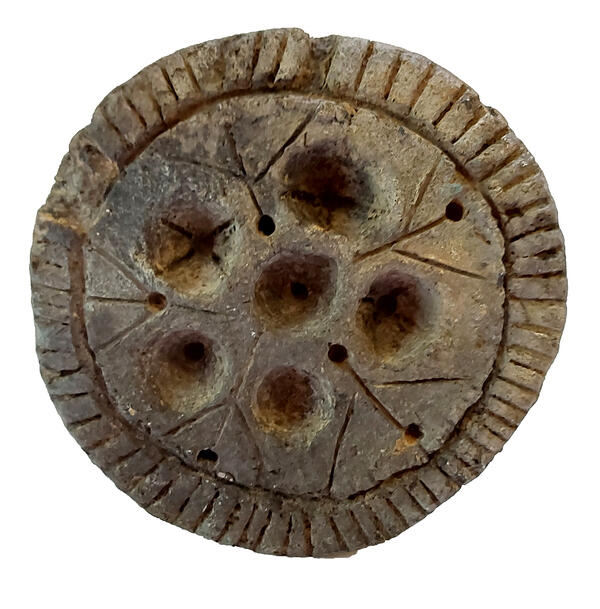
The pintadera found in Tanais is a clay stamp with a truncated conical shape and strongly concave walls. It has a narrow part that serves as a handle. There is a decorative pattern on the wide, rounded front surface. There are six rounded impressions in the center, separated by three lines drawn on the raw clay by branches with three twigs. Dense vertical notches are applied along the edge, separated from the impressions by a relief groove. The handle, which is cut flat from the bottom, also features a pattern consisting of densely applied rounded indentations. While it is unknown what these symbols represent, such stamps were used to mark breadcakes when celebrating various events in the history of Tanais.
One such event could be the Tanais Day — an annual
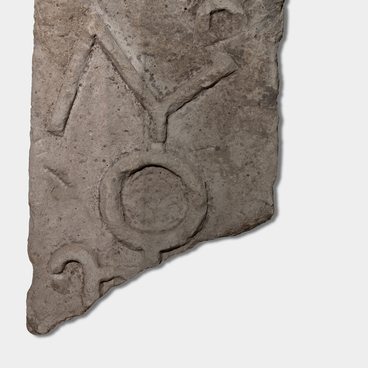
feast celebrated by the citizens. This fact was revealed based on a marble
slab, discovered by the Cossacks at the Tanais settlement in 1913 and
transferred to the Novocherkassk Museum of the History of the Don Cossacks,
where it is currently stored. The slab features an image in high relief that
depicts a horseman riding a horse near an altar, where a fire is burning. Next
to the altar stands a tree, with the head of a bull hanging from it. The Tanais
Day could be a holiday honoring the deity of the Tanais River, or it could be
associated with an event in the city’s history, such as the city’s restoration
after it was destroyed by King Polemon at the turn of the era.