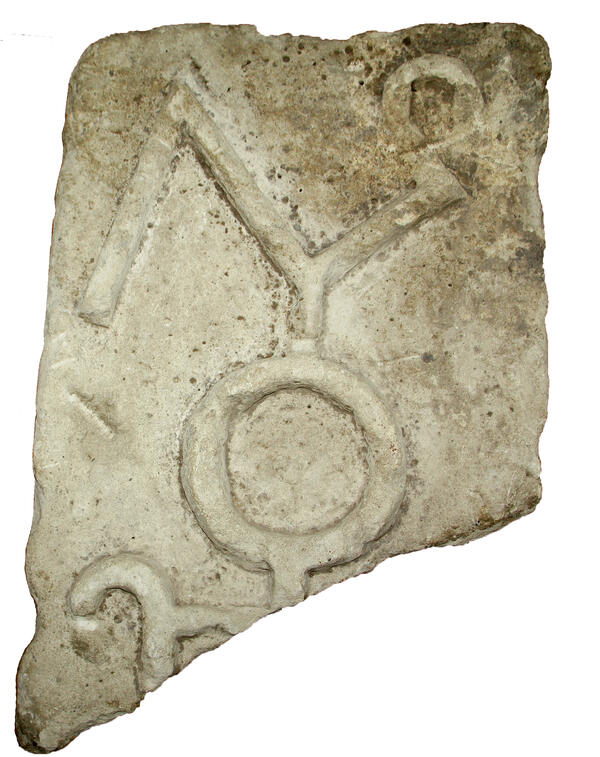
In 1972, when conducting excavations in Tanais, the Lower-Don archaeological expedition discovered a limestone slab with a Sarmatian tamga-like symbol carved on it. The slab is a large rectangular block with carefully processed sides.
On the front side of the slab, there is a relief tamga attributed to one of the Bosporan kings. The symbol consists of three vertical rods, each with a square cross-section, and an additional rod placed above them, featuring projections that form a semicircular shape at the edges. At the top of the lattice-like structure, there is a small protrusion with a large ring on it. From this ring, two branches extend: one in the shape of an L, and the other curved, ending in a semicircle. This tamga is believed to be the symbol of Bosporan king Rhescuporis III (210–226), who was the son of Sauromates II and a member of the Tiberian-Julian dynasty. Rhescuporis III succeeded his father around 210 CE and continued to uphold the pro-Roman policies that his father had established. The lower part of the slab has been lost. A similar tamga has been found on the tip of a bridle belt from “the grave with a golden mask.”
A tamga is a symbol that identified family and tribal identity, personal property, and affiliation with political and other organizations. The tamgas of the Bosporan kings featured geometric shapes, schematic images of animals and various objects, and alphabetic characters. They marked the borders of arable land and pastures, as well as valuable personal belongings, pets, coins, and official documents. In some cases, they were also put on a stone or some large object to sign a contract, serving as a kind of signature or oath. Some tamgas were believed to have protective and other sacred functions. Damaging or destroying a tamga was considered a serious crime.
Most likely, the tamgas of the Bosporan kings,
carved on limestone slabs, were mounted on the walls of ancient Tanais to
confirm the city’s affiliation with the Bosporan Kingdom. Merchants and
representatives of local tribes arriving in the city would see these symbols
and get an understanding of the laws by which the city lived at that time.