Font
Color
Graphics
Изображение точки

To see AR mode in action:

1. Install ARTEFACT app for iOS or Android;

2. Find the exhibition «In the World of Fine Arts. The 20th Century»

3. Push the «Augmented reality» button and point your phone's camera at the exhibit;

Скрыть точки интересаПоказать точки интереса
Показать в высоком качестве

Three Pines, Landscape with a Birch, Pyatnitskay

0
Open in app
#1

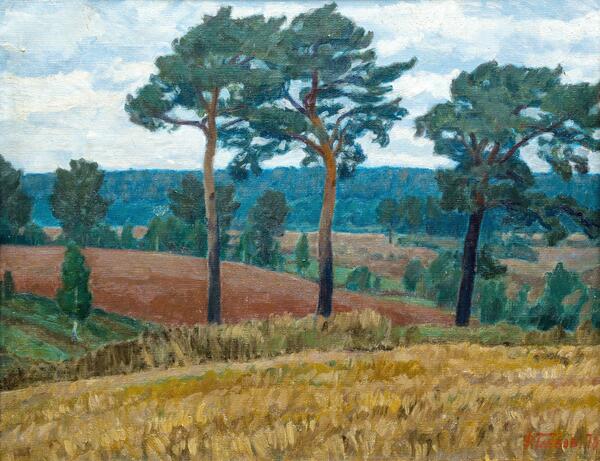
Three Pines

#8

An Honored Artist of Russia, Fyodor Petrovich Glebov is considered one of the best landscape painters of the 20thcentury. His work has become a significant phenomenon in Russian fine art.

He received his initial professional education at the Moscow Art School in Memory of 1905 from 1932 to 1936, where he studied under Nikolay Petrovich Krymov.

Immediately after, he entered the Surikov Moscow Institute of Fine Arts. Alexander Alexandrovich Osmerkin and Sergey Vasilyevich Gerasimov were his teachers there. In 1941, the artist volunteered for the front.

After the war, in 1948, his graduation work was the painting “On the Frontline Road”. At that time, Fyodor Glebov’s active artistic career began. At first, the artist worked in book design.

He created illustrations for the works of Veniamin Alexandrovich Kaverin, Alexander Aleksandrovich Fadeyev, and Sergey Vladimirovich Mikhalkov, and worked in the technique of linocut. Then, under the influence of Nikolay Petrovich Krymov, with whom he was friends, he became interested in painting. Fyodor Glebov wrote,
#9

I studied under Krymov not just for two years, but my entire life.

#10

In the 1960s, his style matured. His main genre was landscape and his favorite subject was Central Russia. The painter’s strengthened skill and understanding of his own original manner allowed him not to limit himself in choosing themes and motifs.

The artist traveled a lot around the country. A series of landscapes created in 1973 had a special significance in Fyodor Glebov’s legacy — he depicted places associated with Alexander Pushkin. The series marked a new stage in the artist’s work: the assertion of monumentality in the landscape and the perception of nature as a majestic, powerful human environment.

The art critic Ivan Borisovich Porto wrote,

#11

Glebov’s paintings are distinguished by a special dramatic element; there is always an individual perception of nature. In some cases, the artist seeks to convey the dynamics of the landscape, in others, on the contrary, peacefulness and quietude. But in each of his works, the viewer can always perceive the deeply felt attitude of the artist to the depicted motif.

#12

The work “Three Pines” embodies the power and beauty of the Russian forest.

In 1979, Fyodor Petrovich Glebov was awarded a diploma of the Soviet Academy of Arts for this landscape, as well as for the paintings “Clouds over the Lake” and “The Mezenka River”.

#4
Name: Three Pines
Author: Fyodor Glebov
Date of creation: 1970
Place of creation: the USSR
Technique: canvas, oil
Dimensions: 55×70 cm

№: 10360949

#2
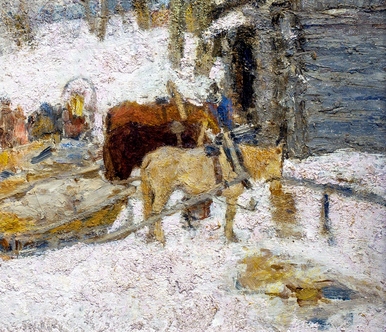
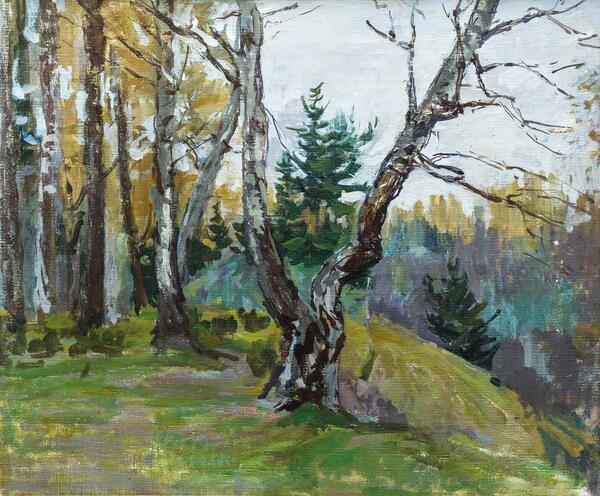
Landscape with a Twin-Trunk Birch
#13

Vasily Vasilyevich Pochitalov (1903–1973) was born in Uglich into a large family of a cabinetmaker. When his family moved to Moscow, he ended up in a summer labor colony for children and teenagers of poor workers. The institution was headed by the famous teacher Stanislav Teofilovich Shatsky.

At the colony, children had music lessons, were taught to draw, staged performances, including opera, and studied foreign languages. They were fully self-sufficient. After the Russian Revolution, the colony was called “Vigorous Life”.

Many of its graduates later became prominent cultural figures. Vasily Pochitalov faced a choice: to become an opera singer or an artist. He opted for studying at VKhUTEIN (VKhUTEMAS), where his teacher was Alexander Vasilyevich Shevchenko. After graduation, he taught and at the same time worked at the Meyerhold Theater together with the Kukryniksy (caricaturists).

Vasily Vasilyevich Pochitalov brought up several generations of Soviet artists: he taught painting for many years at the Moscow Art School, the Surikov Art Institute, and the Textile Institute. Pochitalov was one of the founders of the Moscow Secondary Art School. The artist Ivan Vasilyevich Sorokin wrote,

#14

We were boys and went to the art school on our own… There were many teachers, but only Vasily Vasilyevich Pochitalov managed to understand us, and so we trusted him our entire lives…

#15

Vasily Pochitalov worked until the very last day of his life, participated in the organization of the Society for the Protection of Historical and Architectural Monuments, and organized exhibitions. He discovered many talented craftsmen and craftswomen. With all that, however, he always found time to paint.

The museum’s collection includes Pochitalov’s work “Landscape with a Twin-Trunk Birch”. One can imagine how the movement of the brush directed the artist, merging with the forms of nature. The artist clearly felt the plasticity and color of the depicted world. From his very first independent steps, Pochitalov learned from nature. The artist himself wrote,“I don’t reflect nature, I live in it.”

Vasily Pochitalov passed away at his workshop when he was 70 years old. It happened on the eve of the opening of his first solo exhibition. That exhibition was prepared by his closest students, who were with him all their lives.

#5
Name: Landscape with a Twin-Trunk Birch
Author: Vasily Pochitalov
Date of creation: the 1950s–1960s
Place of creation: the USSR
Technique: canvas, oil
Dimensions: 50×60 cm
#3
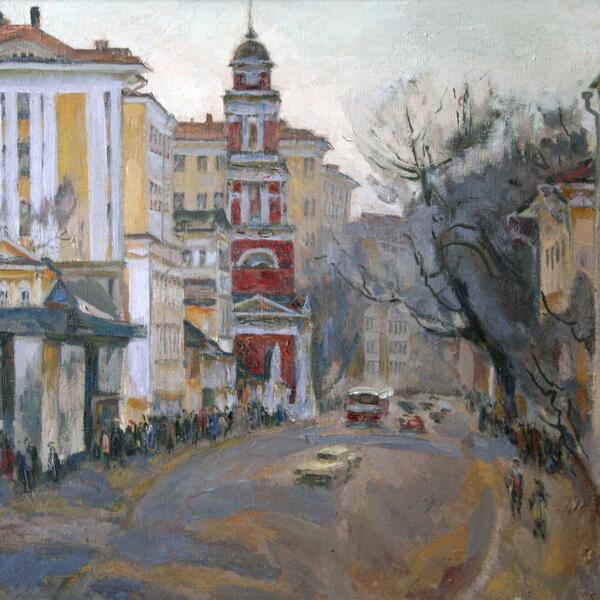
Moscow. Pyatnitskaya Street
#16

Nikolay Alekseyevich Kabanov was born in the village of Selilovo in 1928. After the Great Patriotic War, he entered the Kalinin Moscow College of Industrial and Applied Arts, and from 1965 to 1972, he studied at the Moscow Higher Art and Industrial College.

Nikolay Kabanov’s manner was characteristic of the Moscow painting school. He was one of the artists who devoted themselves to one genre and one theme. Kabanov’s genre was urban landscape, and his theme was the city of Moscow.

His paintings are distinguished by a pronounced unique vision and effect on the viewer. Therefore, in them, the familiar places of Moscow appear topographically recognizable, but transformed by the poetic interpretation of the artist. They seem to acquire a new life and sound.

Nikolay Kabanov’s daughter wrote,

#17

As far as I remember, Dad never worked on commissions, instead, he always painted from life his favorite corners of Moscow or his favorite landscapes. He went out in any weather, even in severe frost. He rarely made sketches for his works; indeed, he did not make them at all, as I can’t recall any.

#18

The central districts of Moscow and its centuries-old architectural monuments are recognizable in most of the artist’s landscapes, for instance, in the presented work “Moscow. Pyatnitskaya Street”.

Pyatnitskaya Street today is one of the busiest thoroughfares of Zamoskvorechye. It stretches from the Chugunny Bridge that spans Vodootvodny Canal to the Garden Ring. It is a slightly winding, narrow street with low rise buildings, bell towers and churches.

The names of Alexander Nikolayevich Ostrovsky and Leo Tolstoy are often associated with this street. In 1857 and 1858, after the Crimean War, a young Tolstoy rented an apartment on Pyatnitskaya Street, 12. At that time, he was already a famous writer.

Life in Zamoskvorechye brought Leo Tolstoy closer to Alexander Ostrovsky and Afanasy Fet. The latter, as a student, stayed at the writer Dmitry Vasilyevich Grigorovich’s house, who also lived in Pyatnitskaya.

Moscow in the painting by Nikolay Kabanov is a city of the 20th century. 

#6
Name: Moscow. Pyatnitskaya Street
Author: Nikolay Kabanov
Date of creation: 1982
Place of creation: Moscow, the USSR
Technique: canvas, oil
Dimensions: 60×60 cm
№: 10363794
#7
read morehide

Three Pines, Landscape with a Birch, Pyatnitskay

0
Point your smartphone camera to open in the app
Share
VkontakteOdnoklassnikiTelegram
Share on my website
Copy linkCopied
Copy
Open in app
To see AR mode in action:
  1. Install ARTEFACT app for 
  2. iOS or Android;
  3. Find and download the «Paintings in Details» exhibition
  4. Push the «Augmented reality» button and point your phone's camera at the painting;
  5. Watch what happens on your phone screen whilst you flip through the pictures.
 
We use Cookies
Cookies on the Artefact Website. We use cookies to ensure that we give you the best experience on our website. If you continue without changing your settings, we'll assume that you are happy to receive all cookies on the Artefact website. However, if you would like to, you can change your cookie settings at any time.
Learn more about useHide
Content is available only in Russian

X

Нашли опечатку?...

%title%%type%