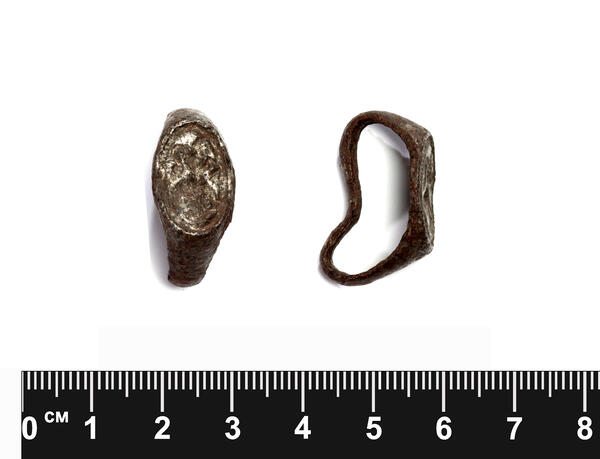
The hall “Relics from the Battle of Kulikovo” presents a piece of jewelry of the 13th–14th centuries. The item has been badly distorted. Its overall dimensions are 2.5×1.4 cm. The hoop is flat, narrow, up to 0.5 cm wide on the sides, gradually flaring to the bezel. The oval bezel measures 1.3×1.7 cm. It is engraved with a relief, poorly preserved image of a predator — a snow leopard. The image is separated from the edge by a groove. The bezel is flat, and does not protrude beyond the surface of the exhibit. The ring itself has an oval shape in cross section.
The ring was discovered in excavations conducted by the military-historical unit of the Upper-Don archaeological expedition of the State Historical Museum and the State Museum-Reserve “Kulikovo Field” in 2013 in the upper reaches of the Smolka River, to the north of the Khvorostyanka village, Tula Region. It is currently housed by the State Museum-Reserve “Kulikovo field”.
The ring belongs to the type of narrow-plate cast rings with oval bezels placed in the center, and closed ends. The bezel is in the same plane as the hoop. The ring has a low relief image. In Novgorod the Great, such items existed from the late 12th century to the middle of the 15th century. The ring with the image of a “beast” was found in Novgorod the Great in the layers of the 1310s–1340s. A similar ring comes from the layers of the 13th–14th centuries of the ancient settlement of Nastasino in the Moscow region.
In Old Rus, a ring that is put on a finger was first mentioned in written records in the 11th century. However, the history of the first finds goes back to the 7th century, and widespread finds date back to the 9th and 10th centuries. It is noteworthy that even after the adoption of Christianity, the images on jewelry remained pagan for a very long time. Mass production of rings began in the 12th–13th centuries. According to the shape and the way in which the ends are connected, the rings can be divided into cane, twisted, woven and lamellar. There are also peculiar types of rings: bezel-centered rings, signet rings and rings with inserts.
For a person who lived in the Middle Ages, the ring was both a seal and a talisman, as well as an indication of their social status, ethnic group and religion.
The ring was discovered in excavations conducted by the military-historical unit of the Upper-Don archaeological expedition of the State Historical Museum and the State Museum-Reserve “Kulikovo Field” in 2013 in the upper reaches of the Smolka River, to the north of the Khvorostyanka village, Tula Region. It is currently housed by the State Museum-Reserve “Kulikovo field”.
The ring belongs to the type of narrow-plate cast rings with oval bezels placed in the center, and closed ends. The bezel is in the same plane as the hoop. The ring has a low relief image. In Novgorod the Great, such items existed from the late 12th century to the middle of the 15th century. The ring with the image of a “beast” was found in Novgorod the Great in the layers of the 1310s–1340s. A similar ring comes from the layers of the 13th–14th centuries of the ancient settlement of Nastasino in the Moscow region.
In Old Rus, a ring that is put on a finger was first mentioned in written records in the 11th century. However, the history of the first finds goes back to the 7th century, and widespread finds date back to the 9th and 10th centuries. It is noteworthy that even after the adoption of Christianity, the images on jewelry remained pagan for a very long time. Mass production of rings began in the 12th–13th centuries. According to the shape and the way in which the ends are connected, the rings can be divided into cane, twisted, woven and lamellar. There are also peculiar types of rings: bezel-centered rings, signet rings and rings with inserts.
For a person who lived in the Middle Ages, the ring was both a seal and a talisman, as well as an indication of their social status, ethnic group and religion.