The permanent exhibition “Relics from the Battle of Kulikovo” presents a copy of a handmade reliquary of the 11th–12th centuries. The original was found on the Kulikovo field and donated to the Historical Museum at the end of the 19th century by D.I. Andreevsky. The exhibit was lost in the 1920s–1930s.
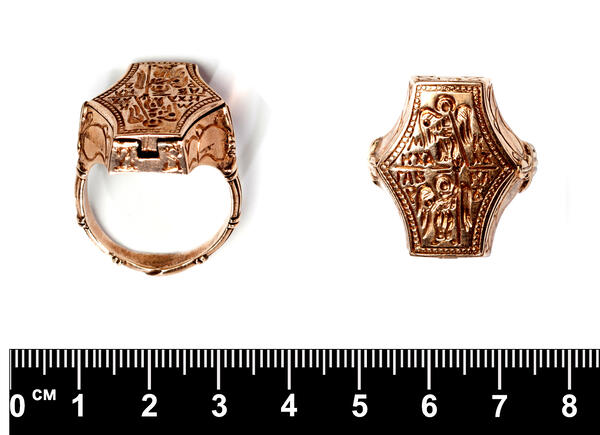
The ring was a rather thick and had a large hexagonal bezel, on which the archangels Michael and Gabriel were depicted with mirrors and scales in their hands, one above the other and with the inscriptions of their names flanking the images. The bezel was the lid of a low hexagonal box for storing relics. The bezel also locked the reliquary with a special latch.
This ring was an old tribal talisman that belonged to a noble warrior because there is an image of the archangels (who were referred to as commanders in chief in Russian). It is even older than the Battle of Kulikovo. The sacred protective images and a chamber for relics suggest that it was not intended to be worn on a daily basis, but only during important and dangerous times. In addition, the ring is not worn much.
The Slavic inscriptions accompanying the images of archangels Michael and Gabriel are cut in the usual form, and the images themselves are “inverted”. This proves that the ring, which dates back to the 12th century, served not only as a reliquary, but also as a seal. Stylistically, it differs greatly from Byzantine and Russian rings dating back to the 12th and 13th centuries. This ring does not belong to the number of rings common in Old Rus. There is only one more know copy of such a gold ring with the image of Archangel Michael, the patron saint of warriors, from a treasure buried in Kyiv in the late 12th — early 13th centuries.
Thanks to the photographs and the publication “The Golden Ring Found on the Kulikovo Field” written by the famous art critic Vyacheslav Nikolaevich Shchepkin and published in 1897 by the A.I. Mamontov printing house, O.N. Zaidov made an exact copy of the ring for the Kulikovo Field State Museum-Reserve in 2012.
The ring was a rather thick and had a large hexagonal bezel, on which the archangels Michael and Gabriel were depicted with mirrors and scales in their hands, one above the other and with the inscriptions of their names flanking the images. The bezel was the lid of a low hexagonal box for storing relics. The bezel also locked the reliquary with a special latch.
This ring was an old tribal talisman that belonged to a noble warrior because there is an image of the archangels (who were referred to as commanders in chief in Russian). It is even older than the Battle of Kulikovo. The sacred protective images and a chamber for relics suggest that it was not intended to be worn on a daily basis, but only during important and dangerous times. In addition, the ring is not worn much.
The Slavic inscriptions accompanying the images of archangels Michael and Gabriel are cut in the usual form, and the images themselves are “inverted”. This proves that the ring, which dates back to the 12th century, served not only as a reliquary, but also as a seal. Stylistically, it differs greatly from Byzantine and Russian rings dating back to the 12th and 13th centuries. This ring does not belong to the number of rings common in Old Rus. There is only one more know copy of such a gold ring with the image of Archangel Michael, the patron saint of warriors, from a treasure buried in Kyiv in the late 12th — early 13th centuries.
Thanks to the photographs and the publication “The Golden Ring Found on the Kulikovo Field” written by the famous art critic Vyacheslav Nikolaevich Shchepkin and published in 1897 by the A.I. Mamontov printing house, O.N. Zaidov made an exact copy of the ring for the Kulikovo Field State Museum-Reserve in 2012.