Lestovka is a type of prayer rope with a special design. They were popular in the Ancient Rus and were preserved in the everyday life of the Old Believers. Their appearance resembles a flexible ladder: the word “lestovka” comes from the Old Slavonic “lestvitsa”, which means a ladder. In Christianity, it symbolizes the steps of the Ladder of Divine Ascent. Believers used such prayer ropes to count prayers and bows during home and cathedral prayers.
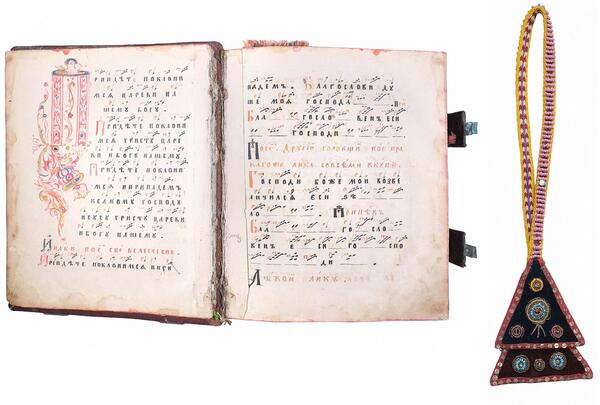
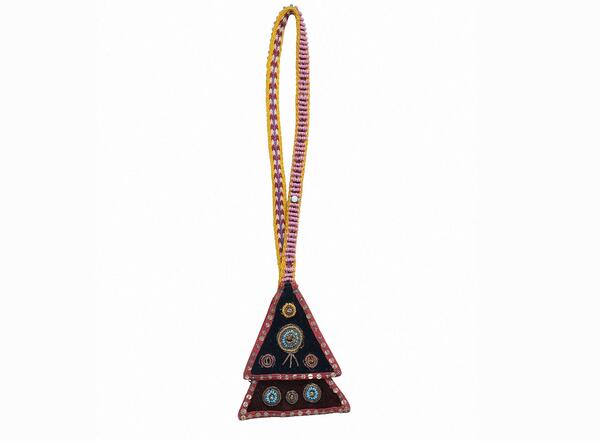
The lestovka from the museum’s collection is made of velvet. It looks like a narrow ribbon braid with rollers wound across the length. The braid closes into a ring, which ends with four triangular blades, they are also called lapostki or petals. They are sewn together in pairs in the herringbone pattern. The craftsman decorated the outer side with an embroidered ornament made of metal thread, seed beads and beads, and the edges are adorned with metal sequins.
The roller steps are called “bobochki”. There should be 109 of them: these are 100 small, 3 large roller steps and 6 additional small ones — hallelujah, meaning praise to God. The bobochki for counting these praises are located at the beginning and the end, with 3 pieces on each.
The beginning and end of the prayer rope have no steps. These gaps of smooth braid symbolize heaven and earth. Then the entire length of the rope, covered with bobochki, is divided into five parts with 3 large rollers — great steps. They divide 100 small rollers into unequal parts of 12, 38, 40, 33 and 17 steps.
Such a design helps to conveniently count 40-fold or 12-fold recitation of prayers. At the same time, each number has an important sacred meaning. The 12 simple steps are the memory of the 12 apostles. The 38 is counted by the number of weeks of the Blessed Virgin carrying the Saviour. The steps from the first great to the second great step make 40, which is the number of days the Lent of Jesus Christ lasted. Then there are 33 steps — the number of years Jesus lived on earth. After the third great step, there are 17 more small ones, according to the number of the Old Testament prophecies about Christ. The strict order of the bobochki, which has remained unchanged for centuries, symbolizes the Ladder of Divine Ascent — an endless prayer road.
Other elements also have special significance. Thus, the triangular shape means the Trinity of God — the Father, the Son and the Holy Spirit. Four petals mean four evangelists: Mark, Matthew, Luke and John the Theologian.
The lestovka from the museum’s collection is made of velvet. It looks like a narrow ribbon braid with rollers wound across the length. The braid closes into a ring, which ends with four triangular blades, they are also called lapostki or petals. They are sewn together in pairs in the herringbone pattern. The craftsman decorated the outer side with an embroidered ornament made of metal thread, seed beads and beads, and the edges are adorned with metal sequins.
The roller steps are called “bobochki”. There should be 109 of them: these are 100 small, 3 large roller steps and 6 additional small ones — hallelujah, meaning praise to God. The bobochki for counting these praises are located at the beginning and the end, with 3 pieces on each.
The beginning and end of the prayer rope have no steps. These gaps of smooth braid symbolize heaven and earth. Then the entire length of the rope, covered with bobochki, is divided into five parts with 3 large rollers — great steps. They divide 100 small rollers into unequal parts of 12, 38, 40, 33 and 17 steps.
Such a design helps to conveniently count 40-fold or 12-fold recitation of prayers. At the same time, each number has an important sacred meaning. The 12 simple steps are the memory of the 12 apostles. The 38 is counted by the number of weeks of the Blessed Virgin carrying the Saviour. The steps from the first great to the second great step make 40, which is the number of days the Lent of Jesus Christ lasted. Then there are 33 steps — the number of years Jesus lived on earth. After the third great step, there are 17 more small ones, according to the number of the Old Testament prophecies about Christ. The strict order of the bobochki, which has remained unchanged for centuries, symbolizes the Ladder of Divine Ascent — an endless prayer road.
Other elements also have special significance. Thus, the triangular shape means the Trinity of God — the Father, the Son and the Holy Spirit. Four petals mean four evangelists: Mark, Matthew, Luke and John the Theologian.