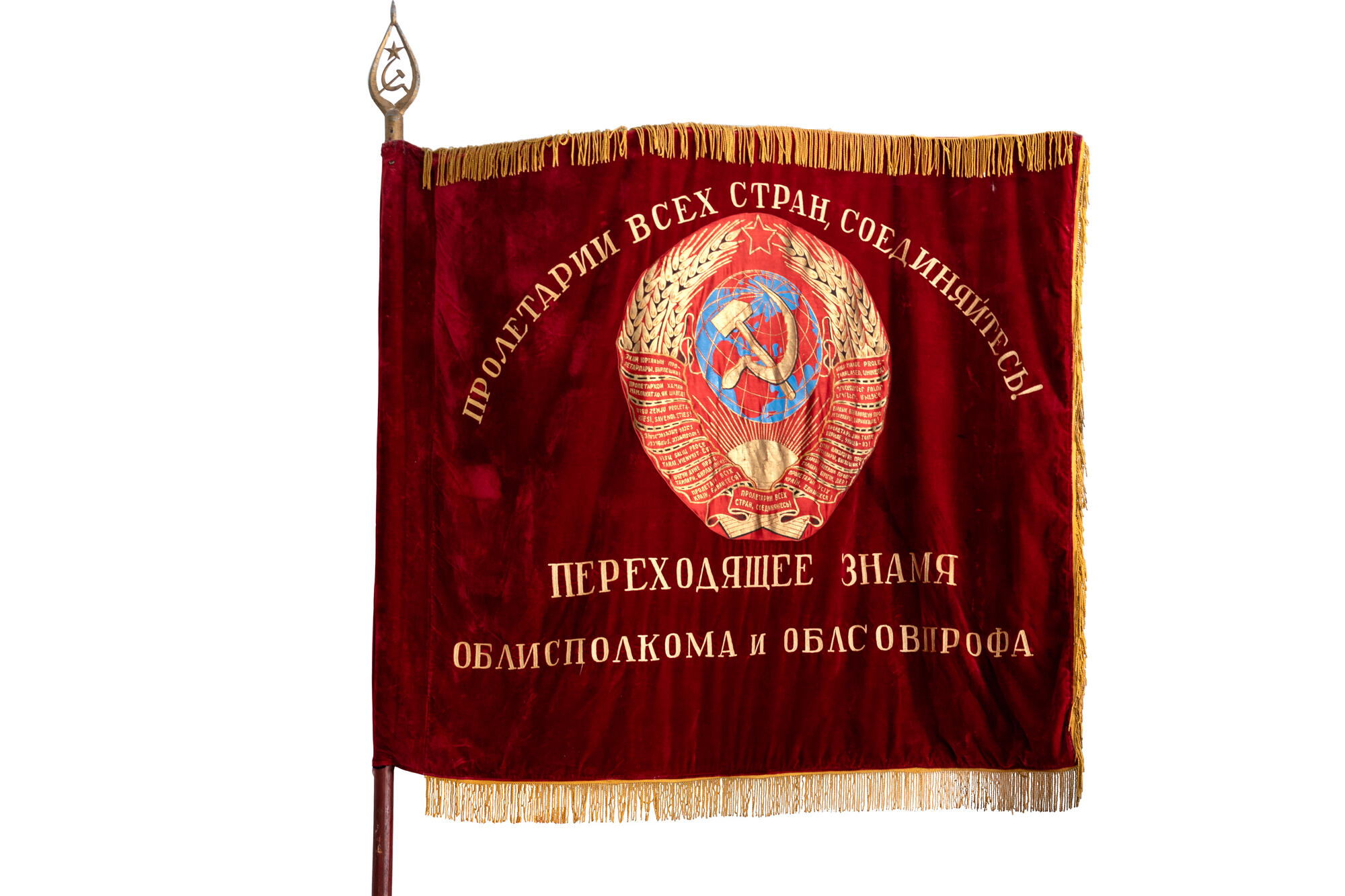


The Tambov Gunpowder Factory was awarded the Challenge Red Banner in the 1940s for winning a socialist competition among the industrial facilities of the Tambov Oblast. The factory’s employees completed their annual powder charge and ammunition production plan ahead of time.
Nowadays, this velvet banner with a wooden flagstaff and a metal tip belongs to the museum’s collection. It has the State Emblem of the Soviet Union and two inscriptions embroidered with colored threads. The inscriptions translate as ‘Challenge Red Banner of the Regional Executive Committee of Soviets of People’s Deputies and the Regional Trade Union Council’ and “Workers of the world, unite!”.
The first socialist competitions were organized during the early years of the Soviet Union. In 1919, at the height of the Russian Civil War, workers of the Moscow-Sortirovochnaya railway depot reacted to Lenin’s appeal to improve railway operations and organized the first communist subbotnik — a day of volunteer unpaid work. The idea was that the main motivation for work in the new Soviet state should be ‘the sense of duty and social responsibility’. In accordance with these ideas, Soviet authorities established a system of social competition between individuals and enterprises. In 1928, the authorities introduced five-year plans for developing the country’s social and economic indicators. Each enterprise attempted to complete the works assigned by the government within the shortest possible time.
During the Great Patriotic War, socialist competitions were conducted to help fewer workers manufacture more products that were needed both on the front line and in the rear. After the war, such competitions were implemented to repair the national economy, including the manufacturing industry, construction, agriculture, and many other economic sectors.
In 1947, during the second year of the fourth five-year plan, the employees of the Tambov Gunpowder Factory worked under the slogan “From individual records to Stakhanovite output!” Stakhanovites were workers, collective farmers, and engineers who exceeded their production targets by many times. The movement was started by Soviet coal miner Alexey Stakhanov. He and his team exceeded the target quota for their shift by 14.5 times.
The Stakhanovite movement was represented both by individuals and collectives, such as plants, factories, and workshops. The first Stakhanovites in Tambov were Vasily Koshelev and Nikolay Panin. The employees of Koshelev’s woodshop and Panin’s shop floor No. 16 were active participants in the socialist competition. The factory regularly presented performance reports. There was also a daily performance board that showed the output of workers. Nikolay Panin managed to ensure that every worker of shop floor No. 16 became a Stakhanovite. In 1947, these collectives completed their annual plan by October 1 — way ahead of schedule.
Nowadays, this velvet banner with a wooden flagstaff and a metal tip belongs to the museum’s collection. It has the State Emblem of the Soviet Union and two inscriptions embroidered with colored threads. The inscriptions translate as ‘Challenge Red Banner of the Regional Executive Committee of Soviets of People’s Deputies and the Regional Trade Union Council’ and “Workers of the world, unite!”.
The first socialist competitions were organized during the early years of the Soviet Union. In 1919, at the height of the Russian Civil War, workers of the Moscow-Sortirovochnaya railway depot reacted to Lenin’s appeal to improve railway operations and organized the first communist subbotnik — a day of volunteer unpaid work. The idea was that the main motivation for work in the new Soviet state should be ‘the sense of duty and social responsibility’. In accordance with these ideas, Soviet authorities established a system of social competition between individuals and enterprises. In 1928, the authorities introduced five-year plans for developing the country’s social and economic indicators. Each enterprise attempted to complete the works assigned by the government within the shortest possible time.
During the Great Patriotic War, socialist competitions were conducted to help fewer workers manufacture more products that were needed both on the front line and in the rear. After the war, such competitions were implemented to repair the national economy, including the manufacturing industry, construction, agriculture, and many other economic sectors.
In 1947, during the second year of the fourth five-year plan, the employees of the Tambov Gunpowder Factory worked under the slogan “From individual records to Stakhanovite output!” Stakhanovites were workers, collective farmers, and engineers who exceeded their production targets by many times. The movement was started by Soviet coal miner Alexey Stakhanov. He and his team exceeded the target quota for their shift by 14.5 times.
The Stakhanovite movement was represented both by individuals and collectives, such as plants, factories, and workshops. The first Stakhanovites in Tambov were Vasily Koshelev and Nikolay Panin. The employees of Koshelev’s woodshop and Panin’s shop floor No. 16 were active participants in the socialist competition. The factory regularly presented performance reports. There was also a daily performance board that showed the output of workers. Nikolay Panin managed to ensure that every worker of shop floor No. 16 became a Stakhanovite. In 1947, these collectives completed their annual plan by October 1 — way ahead of schedule.