Font
Color
Graphics
Изображение точки

To see AR mode in action:

1. Install ARTEFACT app for iOS or Android;

2. Find the exhibition «Tyumen — The War — The Great Victory»

3. Push the «Augmented reality» button and point your phone's camera at the exhibit;

Скрыть точки интересаПоказать точки интереса
Показать в высоком качестве

Сapsule, pistol, flashlight, SSh-36 steel helmet

0
Open in app
#1
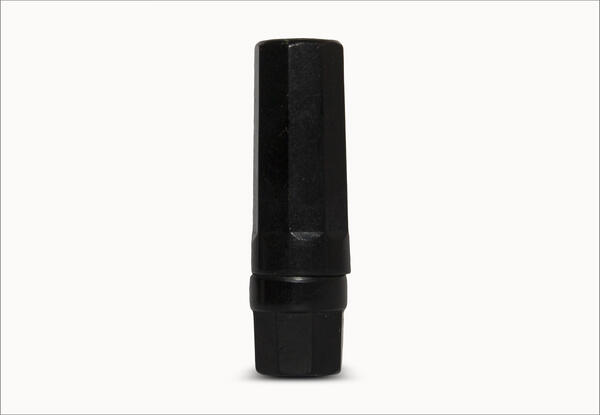
Dog tag capsule
#2
During the Great Patriotic War, the Workers’ and Peasants’ Red Army used ebonite capsules instead of metal tags. The so-called dog tag capsule contained a piece of paper with the soldier’s personal details. Either a special blank or a handwritten note was used.

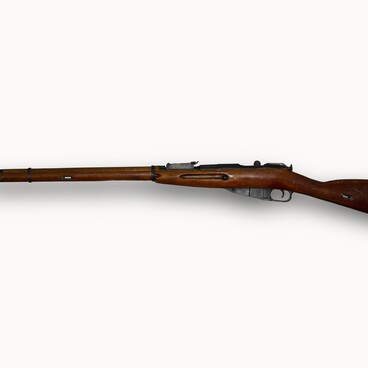
Each soldier had to fill in two copies of the blank. In the event of the soldier’s death, one copy was transferred to the unit headquarters, while the other one remained with the soldier’s body and was sent to the relatives after the burial. If for some reason a soldier did not have a specialized dog tag capsule, they could make their own capsule, using a cartridge case from a Mosin’s rifle.

In this case, a soldier would pull out the bullet, pour out the gunpowder, put a note in the cartridge case, and then plug the hole with the bullet inserted backward. As years have shown, this is not the most practical way of storing personal information. Over time, water could get inside the capsule, damage the paper, or make it completely illegible.

The integrity of information depended on the conditions in which the capsule was located, and on how well it was rolled up. Diggers have developed special methods for opening the capsule in order to minimize the risks of damaging it or losing information. First of all, it concerns the method of unfolding the roll of paper.

Dog tag capsules are not found commonly. Some soldiers even got rid of them because they were superstitious and believed that filling in the form would lead to certain death. Others chose not to keep a death note inside the capsule but to store various small items, such as needles. A capsule could also be adapted to be used as a mouthpiece.

Red Army soldiers often signed various items of ammunition and equipment, allowing diggers to identify them. For example, the names of soldiers are found on pots, mugs, belts, and most often on aluminum spoons, which were hidden behind the top of the boot or the belt.

However, many fighters signed their belongings not for the purpose of facilitating their identification in case of death. Often, they did this so that their possessions would not get lost or mixed up with those of other soldiers.
#3
Наименование: Dog tag capsule
Дата создания: 1941
Место создания: the USSR
Техника: handicraft
Размеры: 5×1,2×1,2 cm
#4
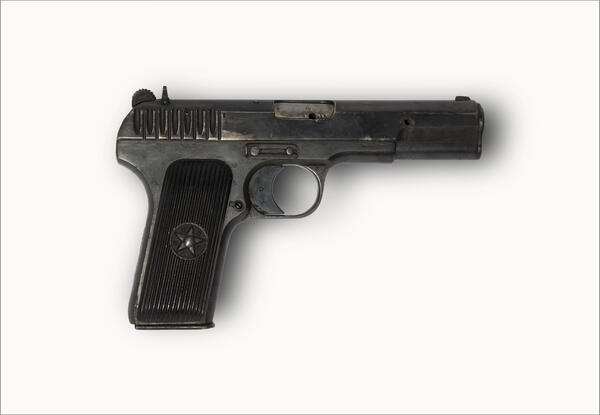
Semi-automatic pistol
#5
The TT pistol was developed by Fedor Vasilievich Tokarev in the early 1930s as a service pistol for the Soviet military to replace the Nagant revolver that had been in use since the time of the Russian Empire.

In 1930, the Revolutionary Military Council approved a resolution to test a new pistol. Even as the TT-30 was being put into production, design changes were made to simplify manufacturing. Minor changes to the barrel, disconnector, and trigger were implemented. About 93,000 TT-30 pistols were produced between 1930 and 1936.

The TT-33 automatic pistol was a popular modification of the TT-30. Soviet engineers made several alterations to simplify the manufacturing and maintenance of the pistol, most notably, they simplified the barrel’s locking lugs. Some models used a captive recoil spring that was secured to the guide rod. The TT-33 pistol had a free slide. It used a short recoil tilting-barrel system.

The TT-33 was chambered for the 7.62×25mm Tokarev cartridge, which was based on the similar 7.63×25mm Mauser C96 round. The Tokarev cartridge was sufficiently powerful, had an extremely flat trajectory, and was capable of penetrating thick clothing and soft body armor.

As the TT-33 proved reliable, a large number of such pistols were produced during World War II and well into the 1950s. They were issued to the commanders of military units, and later to police officers and the People’s Commissariat for Internal Affairs (NKVD). The TT-33 was widely used by the Soviet troops during the Great Patriotic War but did not replace the Nagant revolver completely.

In total, 1,330,000 TT pistols were manufactured in the Soviet Union between 1931 and 1945. This pistol was used until 1952 when it was replaced by the Makarov pistol. In the postwar years, the Izhevsk Mechanical Plant also produced a 5.6 mm R-3 sports pistol based on the TT-33 design. It was designed by the gunsmith Georgy Vasilyevich Sevryugin.
#6
Наименование: Semi-automatic pistol
Автор: Fedor Tokarev
Дата создания: 1933
Место создания: Tula Arms Plant, the USSR
Техника: factory production
Размеры: 19,5×12,6×3 cm; caliber — 7.62 mm
#7
Flashlight
#8
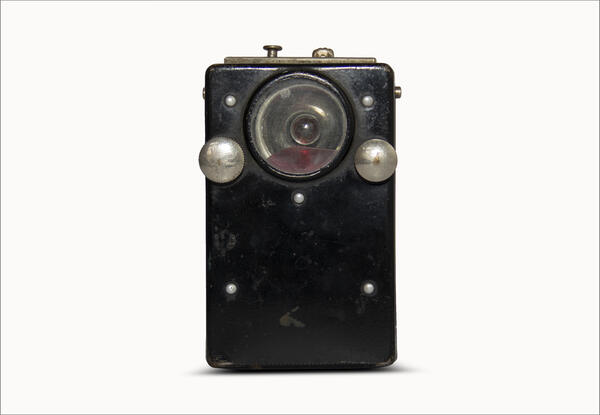
The Soviet signal flashlight was originally intended for the Red Army fighters. Such flashlights were issued to servicemen during the Great Patriotic War. Later, the flashlights began to be distributed not only among the military, but also police officers (including traffic police servicemen), and railway workers.

The signal flashlight had two light filters — red and green. Those could be switched using screws on the front wall of the case. The flashlight was powered by a 3R12 battery. The 3R12 dry galvanic battery was created by the German inventor and entrepreneur Paul Schmidt back in 1901. Early batteries were assembled in a cardboard case, which was filled with resin from the side of the contacts.

The flashlight was one of the essential items in the equipment of officers and soldiers of reconnaissance units during the Second World War. The flashlight was not only used to illuminate the road, but also to give signals. Troops began to use flashlights for service purposes as early as the First World War.

Soldiers used them mostly at night as means of communication between units in conditions of poor visibility. To differentiate between short and long light signals, two locks were provided on the end part of the flashlight.

Before the Second World War, almost every Soviet soldier was issued such a device. However, with the outbreak of hostilities, the procurement of troops with flashlights became selective. They were now issued only to the military personnel, detachments, and units who actually needed them for official duties.

The standard flashlight had a rectangular flat case with a round lens at the top. Below there were sliders for switching between filters of three colors: blue, red, and green. The power button was located on the top or bottom of the case, depending on the specific model.

Leather loops were attached to the back wall in the upper and lower parts for fastening the flashlight to the buttons of the uniform. Quite often, the flashlight was worn with its upper loop fastened to the button of the left shoulder mark, and with its lower loop fastened to the button of the corresponding breast pocket. In addition to standard army devices, general-purpose civilian flashlights and captured trophy flashlights were in use in the army.
#9
Наименование: Flashlight
Дата создания: the 1940s
Место создания: the USSR
Техника: factory production, metal
Размеры: 10,5×6,5×2,9 cm
#10
SSh-36 steel helmet
#11
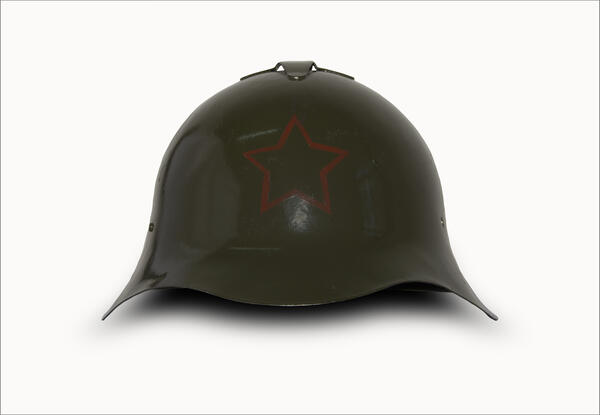
The SSh-36 steel helmet was adopted into service by the Workers’ and Peasants’ Red Army and the Workers’ and Peasants’ Red Fleet in 1936. Before that, the army had used the Adrian helmet, or “adrianka”, designed by the French General Louis Auguste Adrian in 1915. The Adrian helmet had been used since World War I and by the 1930s it no longer satisfied the requirements of the new combat conditions.

The new helmet had a dome shape, a prominent rim, and flares on the sides. The shape of the SSh-36 resembled that of the German “Stahlhelm”. The innovations served to protect the soldier’s head from a slashing blow.

The helmet was impenetrable for a sword or a saber, and its dome shape made the blade slip off the surface. The flares and rim deflected the blow. These characteristics were tested personally by the hero of the Russian Civil War and Marshal of the Soviet Union Semyon Budyonny. The small comb on top covered the air inlet. The helmet had a wall thickness of 1.1 mm and a weight of 1.2–1.3 kg.

The helmet was produced in three sizes. The SSh-36 was used by the Red Army during the battle at Lake Khasan (1938), the First Soviet-Finnish War (1939–1940), the Polish Campaign of the Red Army (1939), and the Khalkin-Gol battles (1939) where it received its nickname the “Khalkhingolka”. It was also called the “Khasanka” after the battle at Lake Khasan.

During the Khalkin Gol campaign of 1939, certain disadvantages of the SSh-36 were revealed. The flares created the effect of a sail, hindering the ground forces. The front rim was too large and limited the field of vision. The helmet’s steel was not strong enough for combat conditions, and its protection was inferior compared to similar helmets produced in other countries.

The SSh-36 was the main helmet of the Red Army until 1940 when it was replaced by the SSh-40 which was subsequently used throughout the Great Patriotic War. The SSh-36 from the museum’s collection is painted green and features the silhouette of a red star in front which was typical of such helmets. The helmet has been well-preserved, with slight scuff marks on the surface. The liner is missing.
#12
Наименование: SSh-36 steel helmet
Дата создания: 1936
Место создания: the USSR
Техника: factory production, metal, leather
Размеры: 27,5×25,3×15,5 cm
#13
read morehide
00:00
00:00
1x

Сapsule, pistol, flashlight, SSh-36 steel helmet

0
Point your smartphone camera to open in the app
Share
VkontakteOdnoklassnikiTelegram
Share on my website
Copy linkCopied
Copy
Open in app
To see AR mode in action:
  1. Install ARTEFACT app for 
  2. iOS or Android;
  3. Find and download the «Paintings in Details» exhibition
  4. Push the «Augmented reality» button and point your phone's camera at the painting;
  5. Watch what happens on your phone screen whilst you flip through the pictures.
 
We use Cookies
Cookies on the Artefact Website. We use cookies to ensure that we give you the best experience on our website. If you continue without changing your settings, we'll assume that you are happy to receive all cookies on the Artefact website. However, if you would like to, you can change your cookie settings at any time.
Learn more about useHide
Content is available only in Russian

X

Нашли опечатку?...

%title%%type%