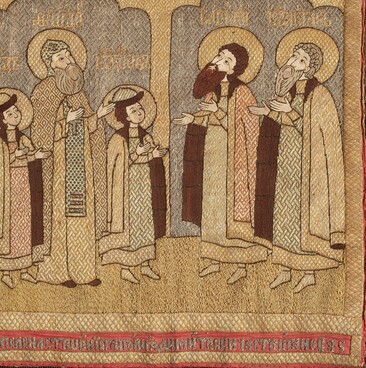
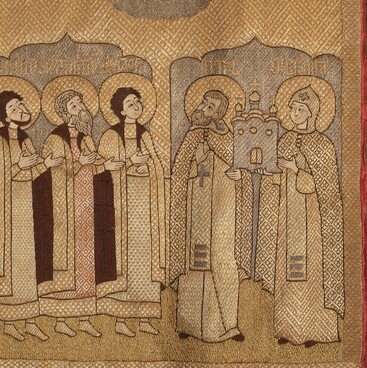
The podea “Holy Fools” was made by the Solvychegodsk gold embroidery workshop of Anna Ivanovna Stroganova. In the cloudy segment at the top of the podea, there is an embroidered image of Our Lady of the Sign. Below Her, stand five “fools for Christ” of equal height. From left to right, these are the Holy Fools Isidore, Procopius, John, Basil, and Maxim (the last two are depicted naked).
Saint Isidore of Rostov became an Orthodox Christian and took on the unique role of being a fool for Christ’s sake. Pretending to be a madman, he denounced human sins and vices, especially those of the rich and powerful. He humbly endured the beatings and ridicule of mean people and suffered from hunger and cold. The saint lived in extreme poverty until the end of his life.
Procopius of Ustyug became the first saint venerated as a holy fool. He was born into a noble family of German merchants. Once, he arrived in Veliky Novgorod on trade business and was amazed by the multitude and beauty of local churches and monasteries. Procopius decided to convert to Orthodoxy and stay in Russia. He gave away all his possessions to the poor. Later, Procopius left Veliky Novgorod and settled in Veliky Ustyug where he started living on the porch of the Church of the Dormition of the Virgin Mary. He possessed the gifts of foresight and prophecy. The most important of his many predictions was the deliverance of Ustyug from being destroyed by a cloud of stones and fire in 1290.
The Holy Fool John of Ustyug was born in the village of Pukhovo, near Old Ustyug. From a young age, he distinguished himself by a strict life of fasting. He moved to Ustyug where he lived in a hut and spent his nights praying. The holy ascetic became famous as an intercessor during the invasions of enemies and as a healer for those afflicted with various ailments.
Basil the Blessed, the Wonderworker of Moscow, walked naked and barefoot throughout the streets of Moscow, preaching mercy, both in the scorching summer heat and piercing frost. Having saved his soul by great feats and prayer, Basil the Blessed received the gift of foresight: in 1547, he predicted the great fire in Moscow, and he later helped extinguish the fire in Veliky Novgorod by praying. He was canonized after his death.
Maxim of Moscow also wandered around the city almost naked throughout the year. He had no shelter, mostly lived outside regardless of the weather, ate only the meager food that people gave him, had no family, and was a lonely person.
The podea is made in the technique of gold embroidery. The faces, hands, feet, and bodies of the holy fools, the Virgin Mary, and Christ Child are embroidered with pearl-gray twisted silk threads. The facial features and bodies are sketched using silk threads of a grayish-brown tone.
The clothes and background are embroidered with spun gold and silver threads using the couching technique. Colorful silk couching threads form a beautiful geometric pattern. The clouds and earth are made using the filigree technique.
The background, made of
the red obyar silk fabric, is left uncovered only at the bottom where there is
an embroidered inscription,