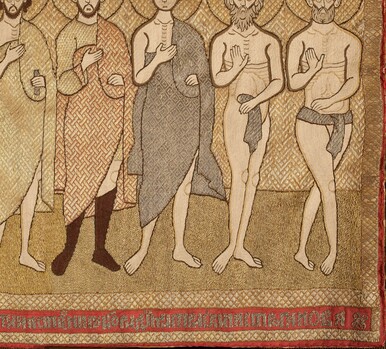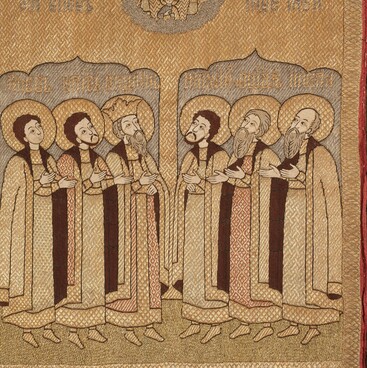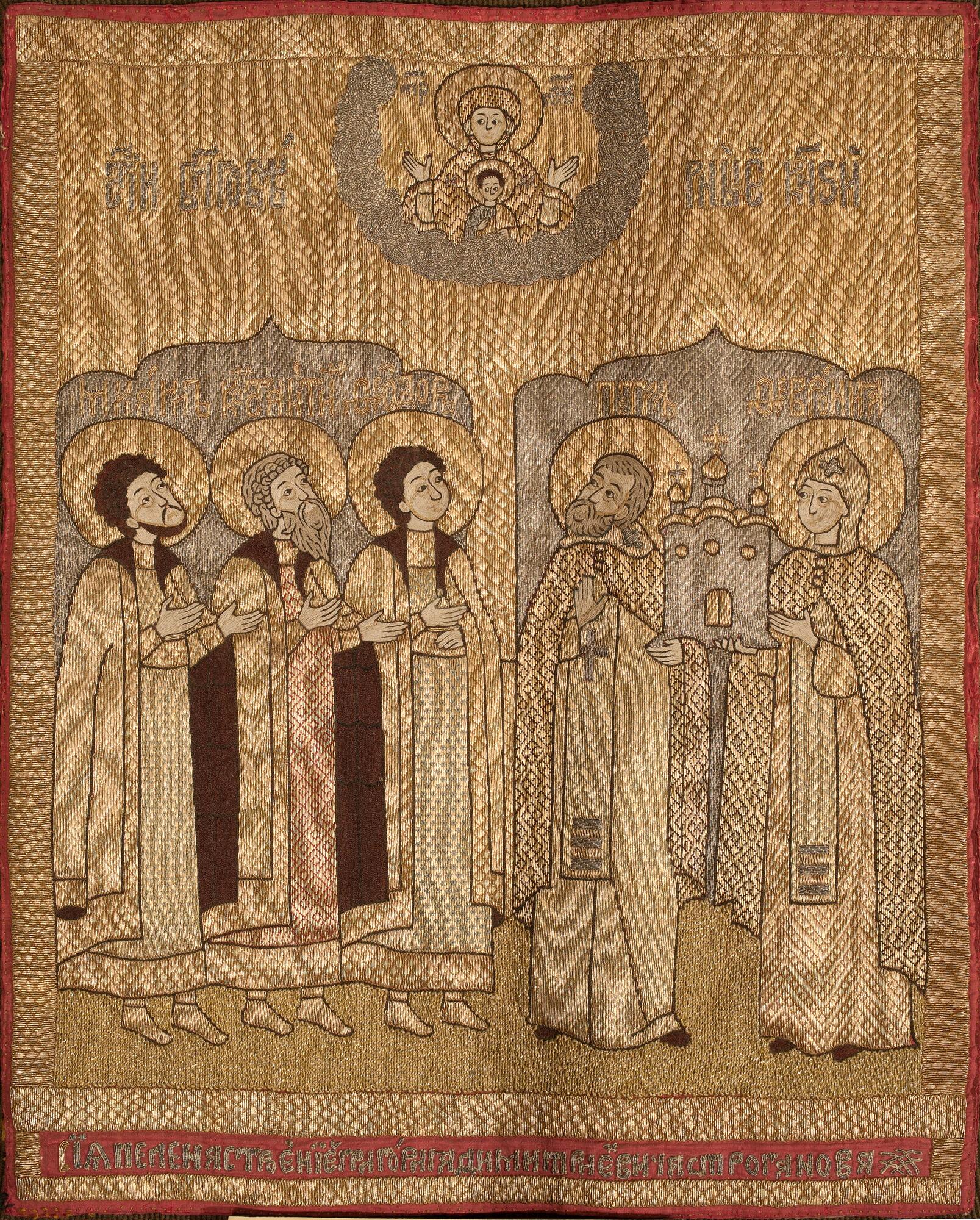


The podea “Saint Princes of Murom” was made by the workshop of Anna Ivanovna Stroganova. In the cloudy hemisphere at the top of the podea, there are traditional images of Our Lady of the Sign and Jesus Christ. In the center, there are two arches with praying Murom saints. On the left, there are the Saint Princes Konstantin, Mikhail, and Fyodor, and on the right — Peter and Fevronia, who hold a three-domed church.
The Saint Prince Konstantin of Murom and his sons Mikhail and Fyodor lived in the 11th — 12th centuries. They are commemorated in the Orthodox Church on June 3 (May 21, Old Style). In 1860, a church was built in their name at the All-Hallows Cemetery in Murom.
During their lifetime, Peter and Fevronia set an example of a perfect family. They lived in perfect harmony and died on the same day — July 8, 1228 (June 25, Old Style). Legend has it that they were buried separately but eventually ended up together in the same coffin, which was considered a true miracle.
Based on oral legends, their hagiography was compiled by Yermolay-Yerazm, a 16th-century Russian monk and writer. He was a scribe from the entourage of Macarius, Metropolitan of Moscow. It was the latter who convened the Local Council in 1547 to canonize Russian saints, including Peter and Fevronia.
Orthodox Christians pray to these saints for family happiness and love. The Moscow Patriarchate has around 90 churches and chapels consecrated in honor of Peter and Fevronia. They are located in Russia, Belarus, and Kazakhstan.
The exposed parts of the body of the Virgin Mary, Christ Child, and the saints are embroidered with pearl-gray twisted silk threads, using the “satin” stitch “according to the form”. The facial features are sketched using threads of a grayish-brown tone. The clothes, background, and other details of the composition are embroidered with spun gold and silver threads, which are attached with thin colorful silk threads, forming small geometric patterns.
The clouds and earth were made using the filigree technique. The background is made of red obyar, a silk fabric with a wavy appearance that was popular from the 15th to the 17th century. The background is uncovered only at the bottom where there is an embroidered inscription, “This podea was donated by Grigory Dmitriyevich Stroganov.” He presented it to the Solvychegodsk Annunciation Cathedral.