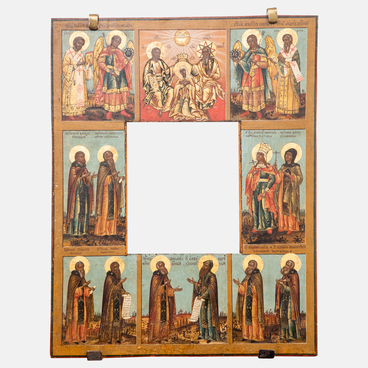
In church terminology, a podea is a kind of apron, hung under the most revered icons of the lower row of the iconostasis, placed in a separate icon case or standing on a pedestal. Pious customers and artists, creating a podea for an image, expressed special reverence for it. To decorate the presented podea, several different techniques were used, of which gold embroidery is the most interesting.
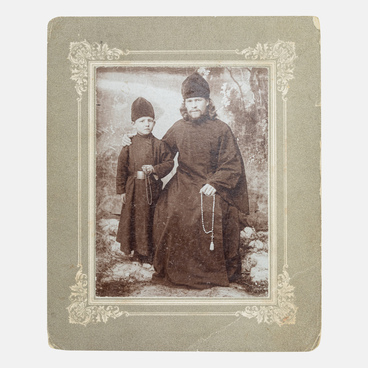
This craft originated in monasteries. Back in 1886, a member of the Kargopol law enforcement, Pavel Vasilyevich Kachalov wrote that most of the craftswomen were nuns, but there were also goldwork embroiderers among peasants who learned the needlework skills.
The description of the Olonets podea, exhibited in 1906 at the Scientific and Art Exhibition in Petrozavodsk, mentions that “the wives of village priests are considered to be the propagators of this skill of <goldwork embroidery>.” They, in turn, learned sewing from the nuns of the Dormition Convent of Kargopol. The researcher of the Russian North Gennady Petrovich Durasov also noted this fact, referring to the memories of a resident of the Arkhangelsk region about her mother, a former student of the Dormition nuns.
According to the craftswomen, they began working by transferring the drawing from an old podea to yellow paper. Next, the figured elements were cut out, attached to a piece of fabric inserted into square embroidery hoops. Then, to embroider the item, the couching technique was used: the gold threads were held onto the surface of the fabric by a second thread, attached from the wrong side. It was typically a yellow silk thread and was called the couching thread. Stems and separate details of the pattern were made using chain-stitch. In addition to the gold thread, they also used beaten metal threads, attaching them over the pattern: thanks to them, the pattern acquired a special shine.
Most gold embroidery items were produced in the spring and summer: they were made both to order and for fairs in several volosts of Kargopolsky and Vytegorsky counties of the Olonets Governorate.
Sometimes the date of creation was embroidered on
the products. This “documentary evidence”, as well as the memoirs of
contemporaries, allowed researchers to establish that the heyday of goldwork
occurred in the 1860s and 1870s. By the late 19th century, expensive
hand-made podeai were gradually replaced by the more affordable silk
factory-made products.