

Stamp — one of the simplest tools for verifying the authenticity of documents. The imprint obtained with its help also bears the same name. Stamp on a ring is called a signet ring. For legal purposes, the definition of seal can be expanded to include stamps and even the spelling of special words.
If the impression is made as a relief, with the help pressure on the paper, and has seals at the places where the stamp touches — this is a dry print. In other cases, a liquid or plastic substance such as ink, wax, or sealing wax is used — it usually differs in color from the paper.
Not so long ago, ink or sealing wax seals were applied to letters and parcels to check whether the item was opened after applying the seal. This sealed the item from hacking, and proved that the parcel is not fake and really came from the declared sender. Despite the fact that many documents still require seals to confirm their authenticity, individuals are using this tool less often.
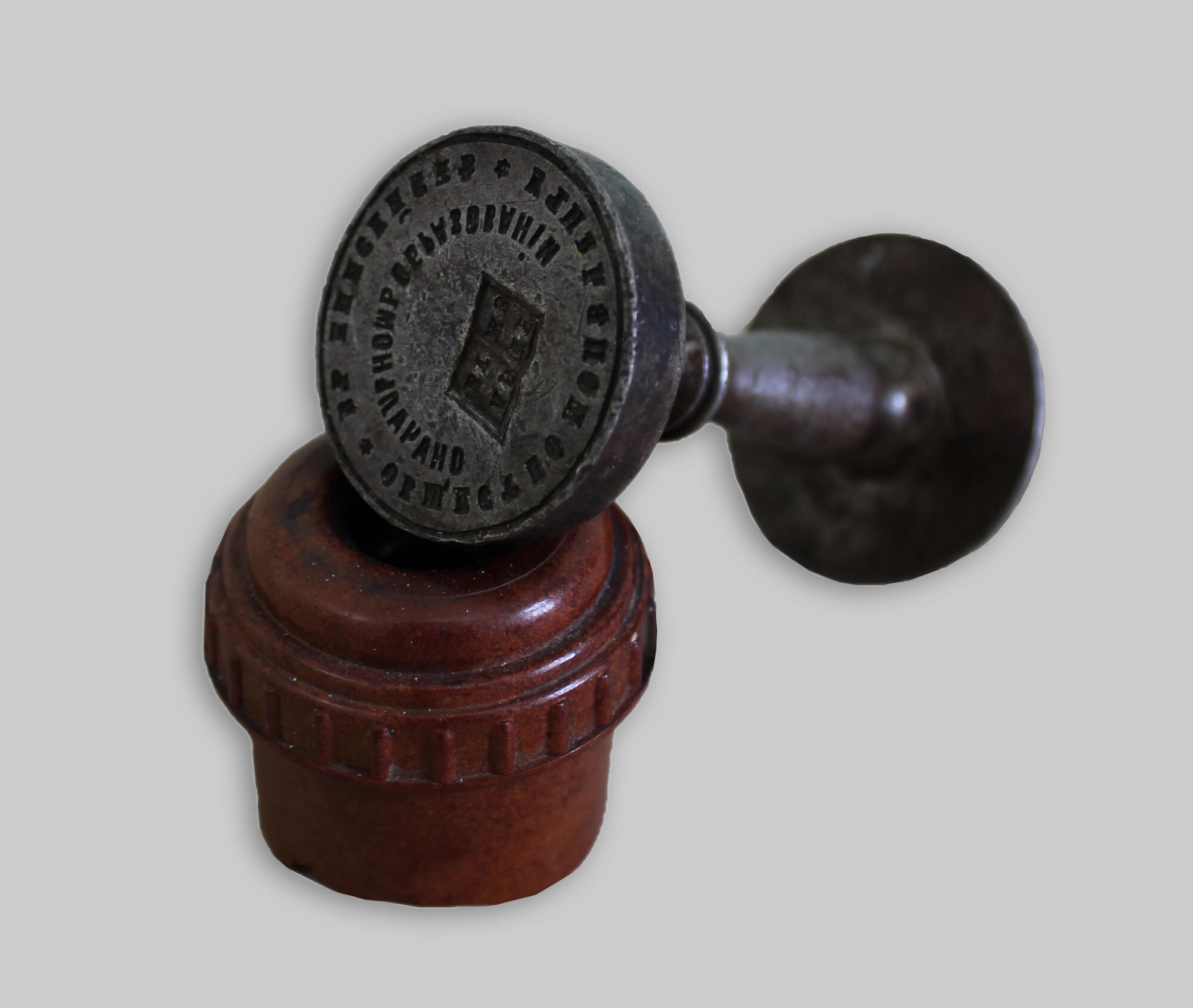
The seal presented in the exhibition was used for approving reports of the Board of the Society for the Care of Primary Education in Yeniseysk, receipts and expenditures in city parochial schools and a women’s Sunday school.
Usually, seals are placed directly on the front side of the document or attached to the document with a cord, tape, or a narrow strip that is not separated from the document. This allows you to ensure authenticity without allowing the seal to be reused. If an attacker tries to open the document, he will under no circumstances be able to preserve the integrity of the imprint.
The auxiliary historical discipline sigillography deals with the study of seals. At first, it was developed as part of diplomacy, and its task was to determine the authenticity of documents. However, archaeologists found more and more seals themselves, as well as imprint on ceramics, so sigillography developed into a whole science that focuses on the classification, chronology, and typification of seals of an archaeological culture, state, or civilization. Among the famous representatives of this field is Nikolai Likhachyov, Russian and Soviet historian, academician of the USSR Academy of Sciences.
If the impression is made as a relief, with the help pressure on the paper, and has seals at the places where the stamp touches — this is a dry print. In other cases, a liquid or plastic substance such as ink, wax, or sealing wax is used — it usually differs in color from the paper.
Not so long ago, ink or sealing wax seals were applied to letters and parcels to check whether the item was opened after applying the seal. This sealed the item from hacking, and proved that the parcel is not fake and really came from the declared sender. Despite the fact that many documents still require seals to confirm their authenticity, individuals are using this tool less often.
The seal presented in the exhibition was used for approving reports of the Board of the Society for the Care of Primary Education in Yeniseysk, receipts and expenditures in city parochial schools and a women’s Sunday school.
Usually, seals are placed directly on the front side of the document or attached to the document with a cord, tape, or a narrow strip that is not separated from the document. This allows you to ensure authenticity without allowing the seal to be reused. If an attacker tries to open the document, he will under no circumstances be able to preserve the integrity of the imprint.
The auxiliary historical discipline sigillography deals with the study of seals. At first, it was developed as part of diplomacy, and its task was to determine the authenticity of documents. However, archaeologists found more and more seals themselves, as well as imprint on ceramics, so sigillography developed into a whole science that focuses on the classification, chronology, and typification of seals of an archaeological culture, state, or civilization. Among the famous representatives of this field is Nikolai Likhachyov, Russian and Soviet historian, academician of the USSR Academy of Sciences.