

Today, we use boxes and containers made of plastic, metal or paper to store or transport various household items. And our ancestors wove vessels and baskets from roots, willow twigs, grass, reeds. Moreover, they did this long before they started making ceramic and fabrics.
For the first time wicker baskets appeared about 8,5 thousand years ago in Africa and the Middle East. This is evidenced by the excavations carried out by archaeologists at the sites of old civilizations. In Europe, similar products appeared much later. An interesting fact is that for so long the method of weaving has not undergone fundamental changes.
In ancient times, human life was almost unthinkable without wicker things. Cradles for babies were made of grass, and the bed was a mat of willow twigs. The roof and walls of the dwellings were built from reeds — to increase their strength and stability, hardened clay in the sun was used. People kept a variety of things in vine baskets: the harvested crop and seeds, caught fish and game, clothing and provisions.
Wicker baskets were placed in tombs to store things that belonged to the deceased and could be ‘useful’ in the afterlife. Each tribe decorated their products in their own way — according to the method of weaving and individual characteristic design elements, it was possible to determine whether a particular item belonged to a particular family clan.
Aeronautics pioneers attached wicker baskets to balloons. This tradition has survived to this day — aeronauts continue to use such structures in lifting balloons to the sky.
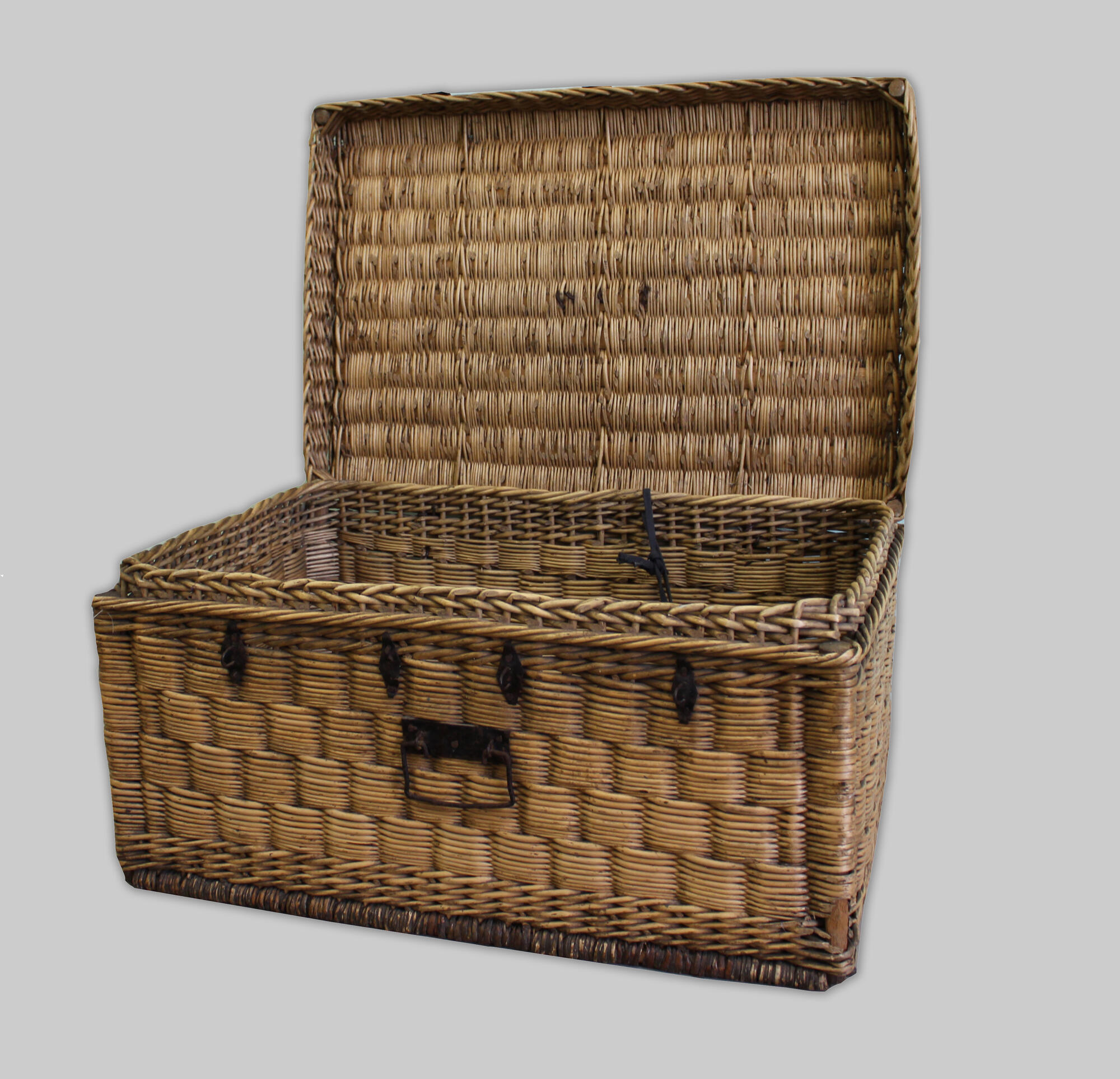
People have been cultivating sorghum for about 5 thousand years, and now all its variety of species can be divided into 4 types according to the principle of use: grain, sugar, broom and herbaceous. Flour, cereals, starch and alcohol are obtained from the grain. Straw is used for making paper, cardboard, wicker products, brooms, and also covers the roofs of houses. Some species are used to make red leather dyes. Wicker basket made of sorghum presented at the exhibition is suitable for travelling, Luggage transportation, and storage of various things.
For the first time wicker baskets appeared about 8,5 thousand years ago in Africa and the Middle East. This is evidenced by the excavations carried out by archaeologists at the sites of old civilizations. In Europe, similar products appeared much later. An interesting fact is that for so long the method of weaving has not undergone fundamental changes.
In ancient times, human life was almost unthinkable without wicker things. Cradles for babies were made of grass, and the bed was a mat of willow twigs. The roof and walls of the dwellings were built from reeds — to increase their strength and stability, hardened clay in the sun was used. People kept a variety of things in vine baskets: the harvested crop and seeds, caught fish and game, clothing and provisions.
Wicker baskets were placed in tombs to store things that belonged to the deceased and could be ‘useful’ in the afterlife. Each tribe decorated their products in their own way — according to the method of weaving and individual characteristic design elements, it was possible to determine whether a particular item belonged to a particular family clan.
Aeronautics pioneers attached wicker baskets to balloons. This tradition has survived to this day — aeronauts continue to use such structures in lifting balloons to the sky.
People have been cultivating sorghum for about 5 thousand years, and now all its variety of species can be divided into 4 types according to the principle of use: grain, sugar, broom and herbaceous. Flour, cereals, starch and alcohol are obtained from the grain. Straw is used for making paper, cardboard, wicker products, brooms, and also covers the roofs of houses. Some species are used to make red leather dyes. Wicker basket made of sorghum presented at the exhibition is suitable for travelling, Luggage transportation, and storage of various things.