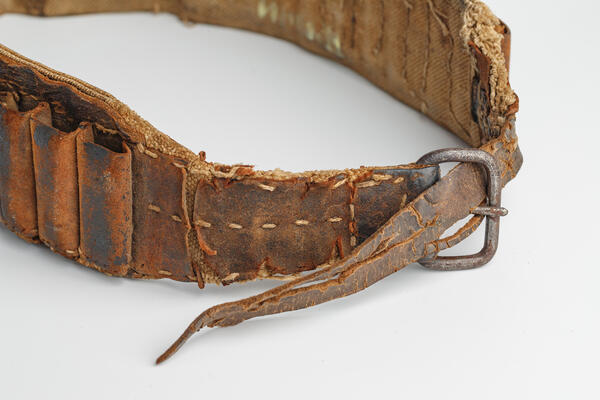
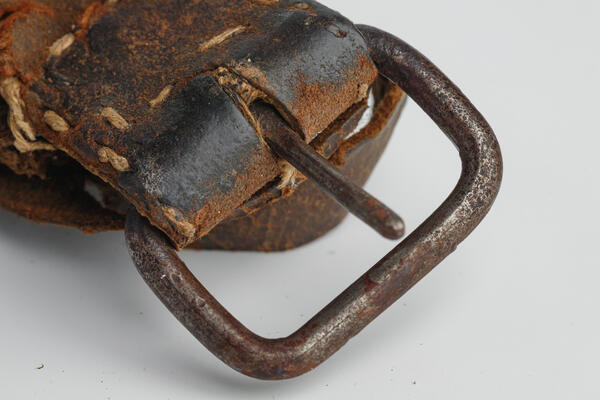
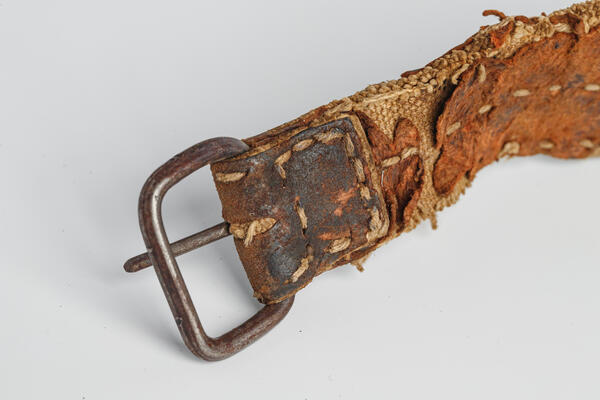
The Museum of Intelligence Officer Nikolai Ivanovich Kuznetsov displays a bandolier — a specialized piece of equipment designed to carry cartridges, with individual compartments for each round. Nikolai Kuznetsov used a similar bandolier during his time as a forest inventory specialist.
The origins of the bandolier are rooted in the hunting traditions of the peoples of the Caucasus. Highlanders were among the first to use dedicated cartridge holders attached to the chest, a practical solution for quick access during hunts or combat. This early version was known locally as a gazyr bag.
The Russian term for a bandolier is “patrontash”: it derived from German Patrone (“cartridge”) and Tasche (“pouch” or “bag”). It entered the Russian language in the 17th century with the arrival of foreign mercenaries in the troops of some elected regiments.
Originally, the bandolier was a standard element of military gear for riflemen in the era of single-shot firearms — first used with paper cartridges, later with metallic ones. By the early 20th century, European armies largely replaced bandoliers with dedicated cartridge pouches designed for magazine-fed rifles, which required faster reloading and more secure storage.
In April 1930, after being expelled from the Talitsa Forestry College, Nikolai Kuznetsov moved to the town of Kudymkar in the Komi-Permyak Okrug. There, he took a position as a forest inventory specialist with the district land administration. His role involved surveying and assessing forest resources: an inventory specialist was responsible for evaluating timber volume, compiling inventories, and producing cartographic materials.
Kuznetsov’s work was demanding, especially in the remote taiga. Constant vigilance was essential, and his rifle and bandolier became trusted companions on extended expeditions that often lasted weeks or even months. With food supplies limited, the team supplemented their rations by hunting and foraging in the wilderness.
During his time in Kudymkar, Kuznetsov developed a keen interest in hunting and marksmanship. He was a regular at the local shooting range, where he honed his precision and earned a reputation as an excellent shot. These skills — combined with his deep familiarity with navigating isolated terrain — later proved invaluable during his undercover missions in German-occupied Ukraine, where he operated under the alias Oberleutnant Paul Siebert.