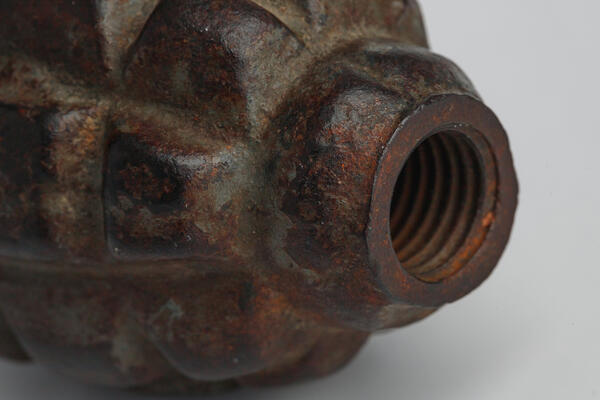
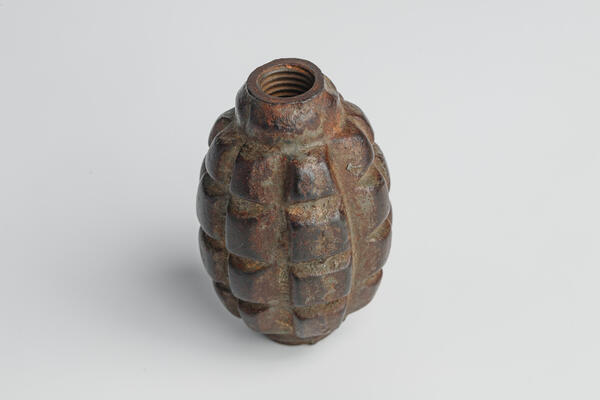
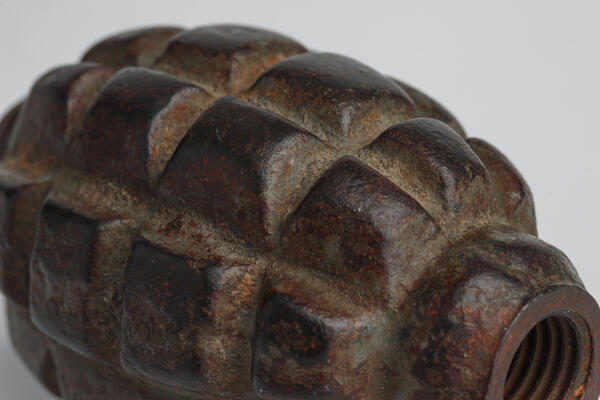
French F1 hand grenades of the 1915 model were supplied to the Russian Imperial Army during the First World War (1914–1918). These grenades were later used extensively during the Russian Civil War (1917–1922). By 1925, the Workers’ and Peasants’ Red Army (commonly known as the Red Army) held approximately one million such grenades in its warehouses.
The original French-made fuses supplied with these grenades were quite unreliable. Their main flaw lay in the use of cardboard fuse housings, which failed to provide adequate moisture resistance. Exposure to damp conditions frequently caused fuse malfunctions, including a dangerous phenomenon (pyrotechnic delay shortening) that significantly increased the risk of premature detonation in the thrower’s hand.
In 1920, the Soviet engineer Fyodor Vasilyevich Koveshnikov proposed a new fuse specifically designed for the F1 grenade. Following extensive testing and several design refinements, the F-1 hand grenade fitted with the Koveshnikov fuse was officially adopted by the Red Army in 1928. By the early 1930s, all existing F1 grenades in storage had been retrofitted with this more reliable fuse.
In 1939, the military engineer Fyodor Iosifovich Khrameev developed a fully domestic version of the defensive hand grenade, using the French F1 fragmentation grenade as a reference. His version was simpler: notably, he eliminated the hole in the base of the grenade body and switched to cast iron for the casing, which improved both manufacturability and reliability. Subsequent mass production of the F-1 grenade was based on Khrameev’s design documentation.
To enhance reliability and standardization across the Soviet arsenal, a universal fuse — the UZRG (Unified Ignition Fuse for Hand Grenades) — was later developed. Compatible with multiple grenade types, including the RG-42, F-1, and RGD-5, this fuse greatly simplified logistics, maintenance, and ammunition handling during large-scale production and wartime operations.
During the Great Patriotic War (1941–1945), the Soviet Union continued manufacturing the F-1 grenade despite severe wartime constraints. Shortages of raw materials and explosives led to the use of substitute compounds.