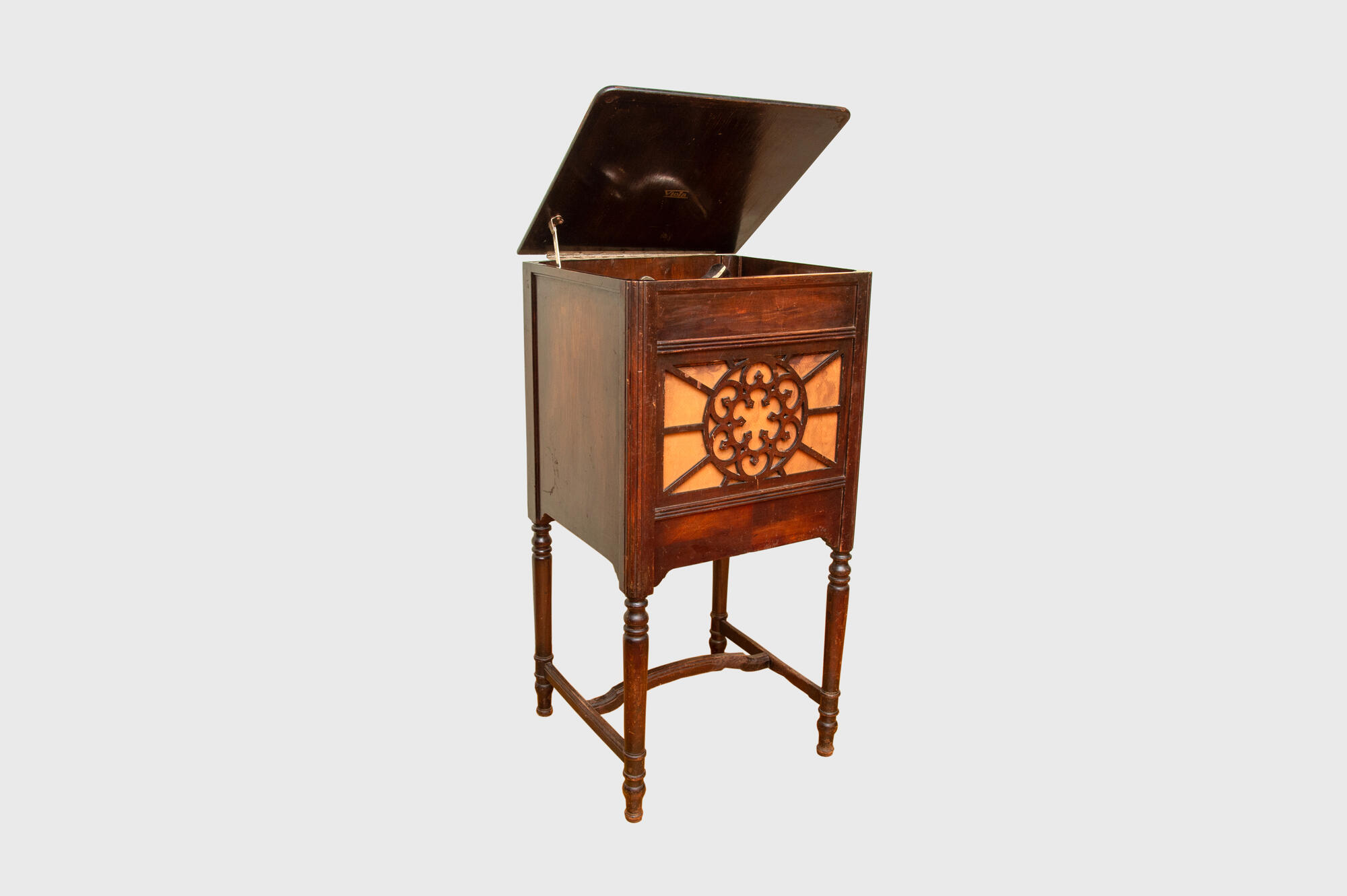


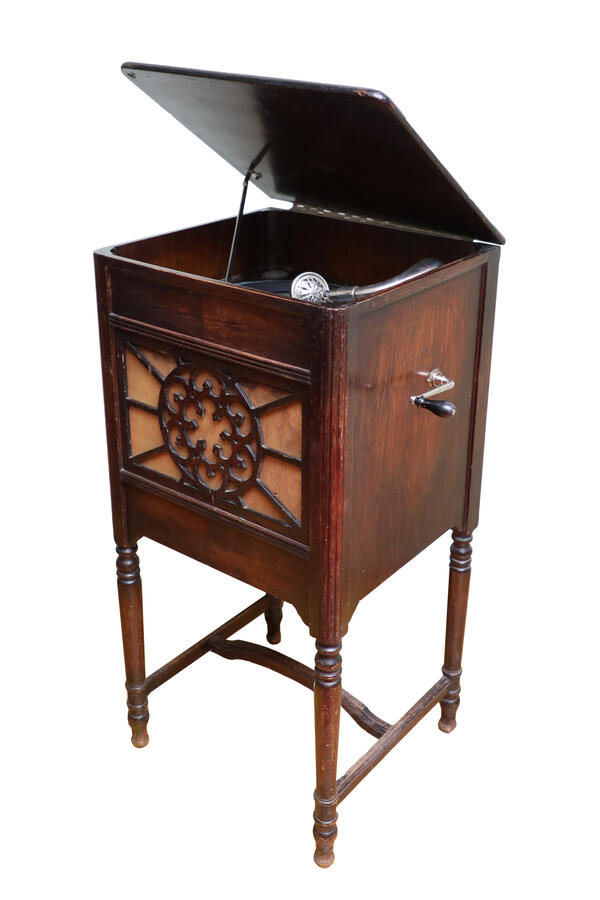
The Verkhnyaya Pyshma Historical Museum contains a collection of 22 musical instruments and devices donated by the residents of the city. The museum houses a gramophone built into a wooden cabinet. It was made in the post-war years in China.
The predecessor of the gramophone was the phonograph — a device for the mechanical recording and reproduction of sound. The device was designed in the 1870s and 1880s simultaneously by several inventors. The gramophone consisted of a gramophone needle, which transferred recordings onto a membrane, and a speaker, which amplified the sound.
The first music record was made from zinc, and later ebonite (a durable rubber) and natural resins, including shellac began to be used.
In 1901, Guillon Kemmler, an employee of the French company ‘Pate’, decided that the horn of the gramophone was too large. He designed the device with a small built-in horn that would still retain the sound quality. This is how a more compact gramophone appeared.
The new device was intended for the British army to listen to music in the field. After the end of World War I, the gramophone began to be advertised as a record player that could be used outside, for example, at picnics. The device was designed as a suitcase with a handle, so it was easy to carry it around.
The earlier gramophone records were not suitable for the device of the ‘Pate’ company: the sound was recorded on them in a different way. In the new gramophone model, a special sapphire needle was used, which moved from the center to the edge.
At the beginning of the 20th century, gramophones appeared in Russia and quickly became popular. At first, they were supplied from abroad, and then they began to be produced by local factories. Some models made in the USSR technically were compact gramophone types, so they reproduced sound from all kinds of records.
In the 1930–1950s, young people often gathered to dance in parks or courtyards. The gramophones were usually put on window sills or taken outside. Since they were quite loud and small, the devices remained popular until the middle of the 20th century, even when cable radios became ubiquitous.
The predecessor of the gramophone was the phonograph — a device for the mechanical recording and reproduction of sound. The device was designed in the 1870s and 1880s simultaneously by several inventors. The gramophone consisted of a gramophone needle, which transferred recordings onto a membrane, and a speaker, which amplified the sound.
The first music record was made from zinc, and later ebonite (a durable rubber) and natural resins, including shellac began to be used.
In 1901, Guillon Kemmler, an employee of the French company ‘Pate’, decided that the horn of the gramophone was too large. He designed the device with a small built-in horn that would still retain the sound quality. This is how a more compact gramophone appeared.
The new device was intended for the British army to listen to music in the field. After the end of World War I, the gramophone began to be advertised as a record player that could be used outside, for example, at picnics. The device was designed as a suitcase with a handle, so it was easy to carry it around.
The earlier gramophone records were not suitable for the device of the ‘Pate’ company: the sound was recorded on them in a different way. In the new gramophone model, a special sapphire needle was used, which moved from the center to the edge.
At the beginning of the 20th century, gramophones appeared in Russia and quickly became popular. At first, they were supplied from abroad, and then they began to be produced by local factories. Some models made in the USSR technically were compact gramophone types, so they reproduced sound from all kinds of records.
In the 1930–1950s, young people often gathered to dance in parks or courtyards. The gramophones were usually put on window sills or taken outside. Since they were quite loud and small, the devices remained popular until the middle of the 20th century, even when cable radios became ubiquitous.