Alexey Petrovich Bogolyubov (1824-1896) was Russian marine painter, master of the marine battle genre. The painter’s father, Pyotr Gavrilovich Bogolyubov, was a landowner and a retired colonel. Alexey lost his father early and was transferred to the Aleksandrovsky juvenile cadet corps, from, where he was transferred to the Naval Cadet Corps. He graduated in 1841 with the rank of midshipman. Alexey Bogolyubov began to show interest in the visual arts while still studying. After long trips abroad, this interest intensified and was reinforced by acquaintance with the masterpieces of world painting. The works of Ivan Konstantinovich Aivazovsky, who was at that moment at his sharpest, also had a significant influence on the young painter.
Since 1850, with the permission of the Emperor Nicholas I, Bogolyubov began to study in the Academy of Arts. In 1853 he already graduated from the Academy with a large gold medal. The Crimean War, which began in the same year, brought the artist an imperial order: Nicholas I ordered to create seven large paintings from the history of the Crimean War. Despite the hostilities, Bogolyubov, then already a naval officer, was dismissed and appointed as an artist of the Main Naval Staff. Subsequently, the painter more than once carried out similar orders. During the reign of Alexander II, Bogolyubov created many works from the history of the Russian fleet during the time of Peter the Great. And in the reign of Alexander III, the artist worked on stories about the history of the Russian-Turkish war.
During his overseas pension’s studies, Alexey Bogolyubov managed to work with the famous marine painter Eugène Isabey and get close to other iconic French painters of that time: Horace Verno, Jean-Auguste-Dominique Ingres, Paul Delaroche, and later with Camille Corot, Charles-François Daubigny, Henri Rousseau and Constant Troyon. In 1859 Bogolyubov moved to Dusseldorf and worked there under the supervision of Andreas Achenbach. It is not surprising that the exhibition, which took place in 1861 after the artist’s return to his homeland, caused a sensation and lend Bogolyubov eclat in Russia. The painter said, ““My exhibition was visited lively and it took placefor a whole month… I made a name for myself, which I honestly live by now.”
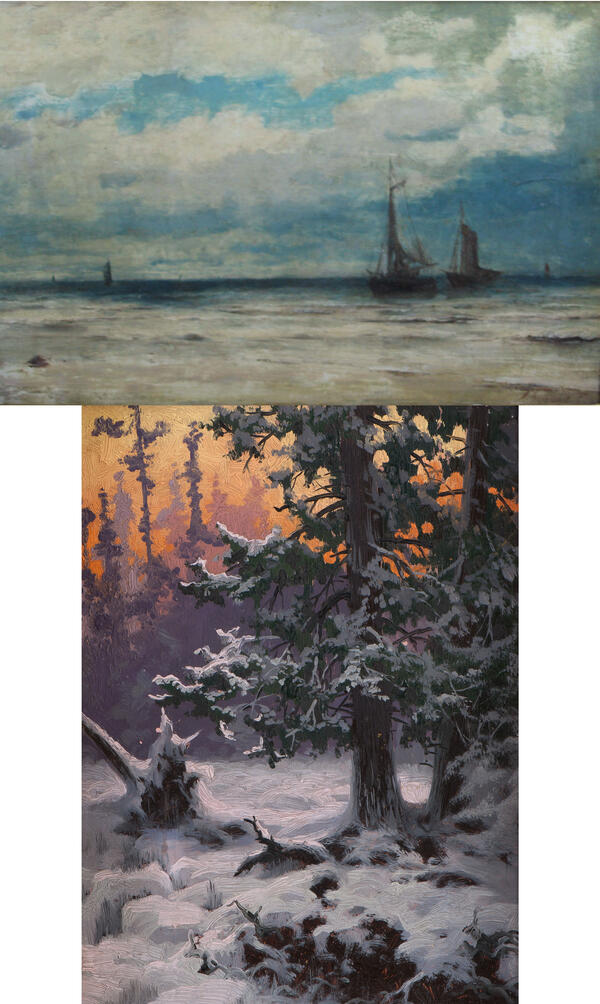
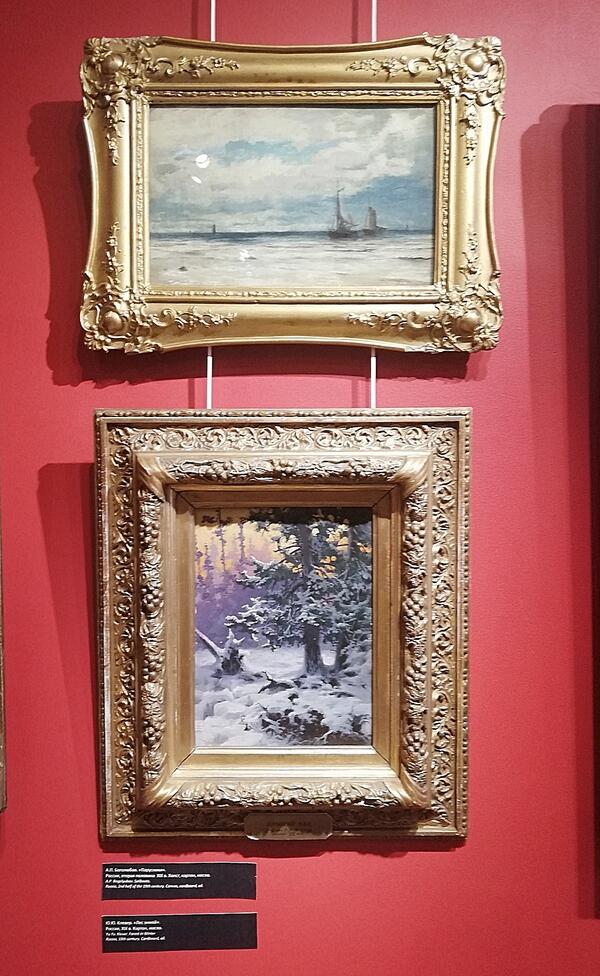
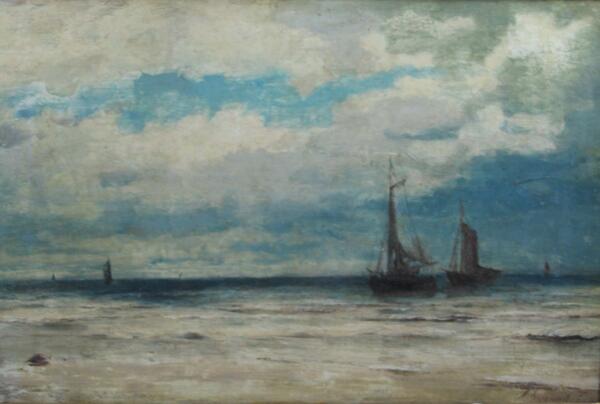
In the Zaraysk Kremlin exposition, Bogolyubov’s work is presented by the painting ‘Sailboats’. Though small, it has great artistic expression and demonstrates the skill of a painter. He depicted sky and water in an almost impressionistic manner. The work is rather sketchy, but due to this a special feeling of liveliness of everything depicted in the picture is created. It seems that a small breeze rocks the fishing schooners in shallow water and drives clouds into the distance. Pure white, blue and azure colors portray the freshness of the sea air and the expanse of water.
Since 1850, with the permission of the Emperor Nicholas I, Bogolyubov began to study in the Academy of Arts. In 1853 he already graduated from the Academy with a large gold medal. The Crimean War, which began in the same year, brought the artist an imperial order: Nicholas I ordered to create seven large paintings from the history of the Crimean War. Despite the hostilities, Bogolyubov, then already a naval officer, was dismissed and appointed as an artist of the Main Naval Staff. Subsequently, the painter more than once carried out similar orders. During the reign of Alexander II, Bogolyubov created many works from the history of the Russian fleet during the time of Peter the Great. And in the reign of Alexander III, the artist worked on stories about the history of the Russian-Turkish war.
During his overseas pension’s studies, Alexey Bogolyubov managed to work with the famous marine painter Eugène Isabey and get close to other iconic French painters of that time: Horace Verno, Jean-Auguste-Dominique Ingres, Paul Delaroche, and later with Camille Corot, Charles-François Daubigny, Henri Rousseau and Constant Troyon. In 1859 Bogolyubov moved to Dusseldorf and worked there under the supervision of Andreas Achenbach. It is not surprising that the exhibition, which took place in 1861 after the artist’s return to his homeland, caused a sensation and lend Bogolyubov eclat in Russia. The painter said, ““My exhibition was visited lively and it took placefor a whole month… I made a name for myself, which I honestly live by now.”
In the Zaraysk Kremlin exposition, Bogolyubov’s work is presented by the painting ‘Sailboats’. Though small, it has great artistic expression and demonstrates the skill of a painter. He depicted sky and water in an almost impressionistic manner. The work is rather sketchy, but due to this a special feeling of liveliness of everything depicted in the picture is created. It seems that a small breeze rocks the fishing schooners in shallow water and drives clouds into the distance. Pure white, blue and azure colors portray the freshness of the sea air and the expanse of water.