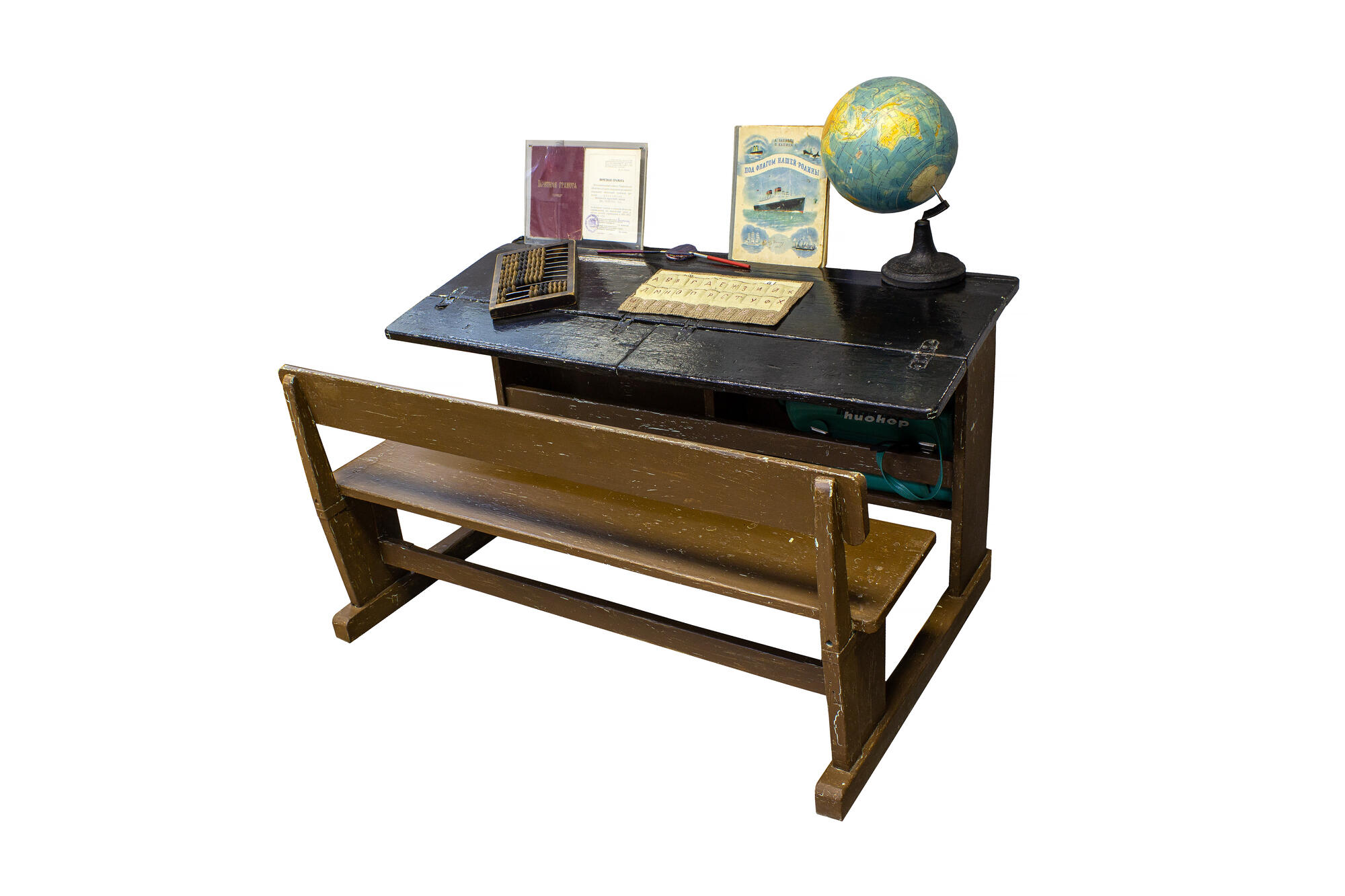


Erismann school desks were used for over 50 years until they were replaced by other writing desks. Kotovsk schools had such desks as well — one of them is currently housed by the Museum Center.
The school desk was invented in 1870 by a famous Russian and Swiss hygienist Fyodor Erismann. His invention was soon adopted by all educational institutions of pre-revolutionary Russia.
The design of this desk provided perfect conditions for writing, reading and drawing. The tabletop was placed at an angle so that students read texts in books or workbooks at a 90-degree angle. Moreover, it allowed for the ideal reading distance of 30–40 centimeters between the eyes and the book, which prevented eyesight from deteriorating.
The desk surface had enough space for students to comfortably place their elbows. There were no sharp corners and protruding parts of the fasteners, which significantly reduced the risk of accidental injury. Erismann desks were designed to accommodate only one person, eliminating the possibility of students distracting each other. The angle of the tabletop enabled students to get up and participate in a lesson without actually leaving their seats.
The design of the Erismann school desk helped to form the correct posture, making students sit with a straight back so that they felt less tired throughout a lesson. However, since the production of such desks was quite time-consuming and expensive, only elite schools and gymnasiums could afford them.
The desks and benches designed by Erismann were made of oak. They were massive and heavy, which made it rather difficult to transport or even move them.
In the late 19th century, Pyotr Korotkov, a student from St. Petersburg, improved the Erismann desk. He would later receive a silver medal at an industrial exhibition for his improvements, as well as an inventor’s certificate. The desk was transformed into a double one and equipped with a flip-over extension and a special shelf to put textbooks on. Since children in village schools did not have separate lockers to store their belongings, Korotkov suggested that hooks for briefcases be attached to the desks. He also came up with the idea of making grooves on the tabletop for holding writing materials and inkwells so that they would not fall off the table.
The school desk was invented in 1870 by a famous Russian and Swiss hygienist Fyodor Erismann. His invention was soon adopted by all educational institutions of pre-revolutionary Russia.
The design of this desk provided perfect conditions for writing, reading and drawing. The tabletop was placed at an angle so that students read texts in books or workbooks at a 90-degree angle. Moreover, it allowed for the ideal reading distance of 30–40 centimeters between the eyes and the book, which prevented eyesight from deteriorating.
The desk surface had enough space for students to comfortably place their elbows. There were no sharp corners and protruding parts of the fasteners, which significantly reduced the risk of accidental injury. Erismann desks were designed to accommodate only one person, eliminating the possibility of students distracting each other. The angle of the tabletop enabled students to get up and participate in a lesson without actually leaving their seats.
The design of the Erismann school desk helped to form the correct posture, making students sit with a straight back so that they felt less tired throughout a lesson. However, since the production of such desks was quite time-consuming and expensive, only elite schools and gymnasiums could afford them.
The desks and benches designed by Erismann were made of oak. They were massive and heavy, which made it rather difficult to transport or even move them.
In the late 19th century, Pyotr Korotkov, a student from St. Petersburg, improved the Erismann desk. He would later receive a silver medal at an industrial exhibition for his improvements, as well as an inventor’s certificate. The desk was transformed into a double one and equipped with a flip-over extension and a special shelf to put textbooks on. Since children in village schools did not have separate lockers to store their belongings, Korotkov suggested that hooks for briefcases be attached to the desks. He also came up with the idea of making grooves on the tabletop for holding writing materials and inkwells so that they would not fall off the table.