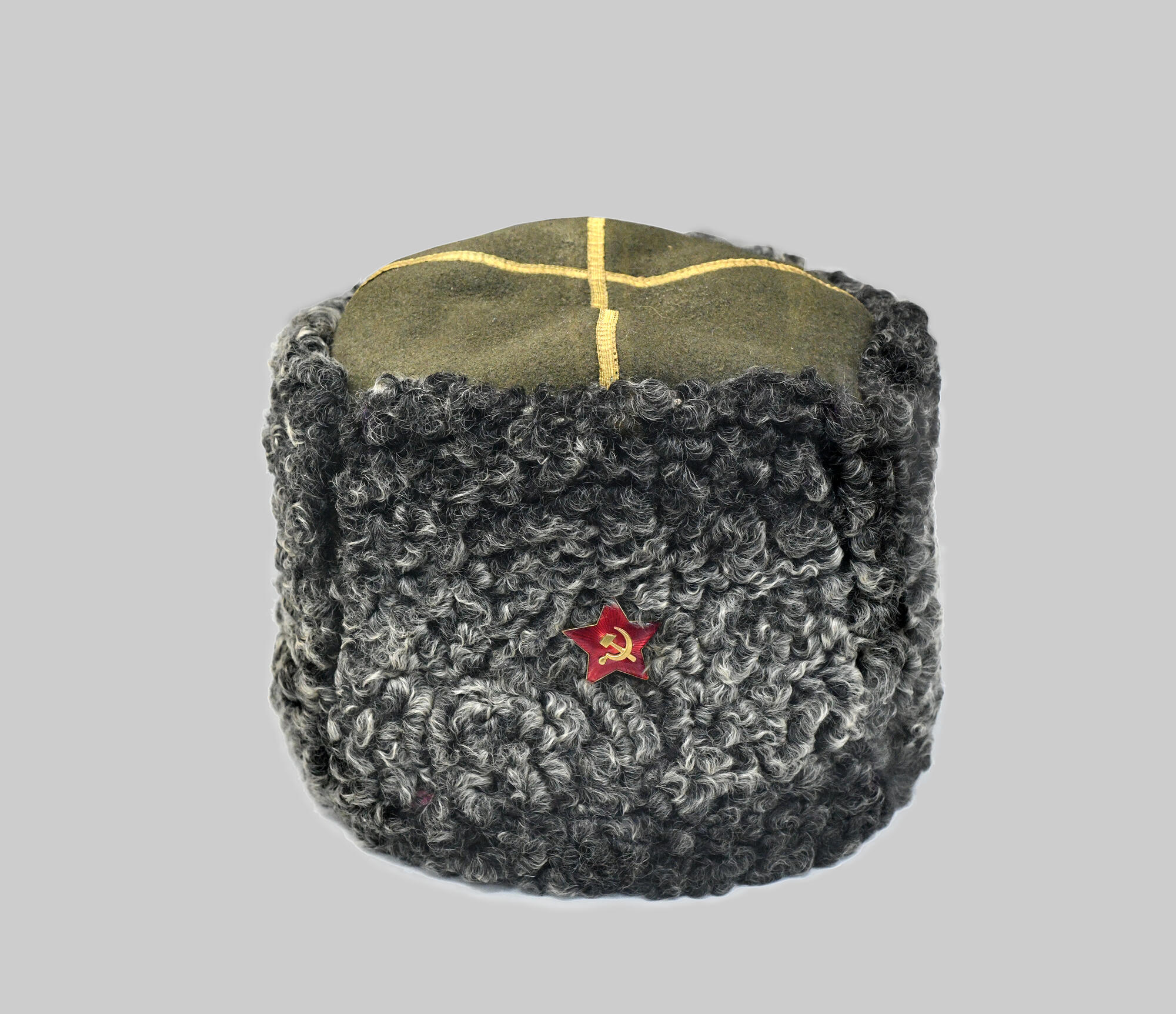


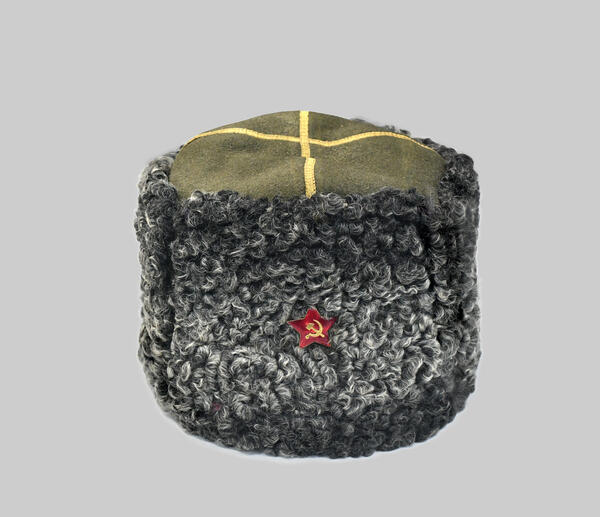
A papakha is a man’s fur headdress made of sheepskin or karakul used as an element of a military uniform.
On January 26, 1943, by order of the People’s Commissariat of Defense of the USSR No. 40, the papakha was introduced to colonels of all military branches as a winter headdress, replacing the ushanka (a hat with earflaps).
Similar to the general’s papakha, the colonel’s papakha had the shape of a truncated cone and was sewn from karakul. The top of a khaki-colored papakha was sewn from four pieces and decorated with gold galloon crosswise. There was a silk quilted lining inside the hat. The band of a headdress was 17 cm high and consisted of two parts: front (forehead) part and back (neck) part. For protection from the cold, there was a woolen cloth flap in the back. The front part was fastened to the back with hooks. In the front, a five-pointed star was placed in the center of the fur band.
During the Great Patriotic War, the equipment of a soldier-cavalryman of private and sergeant corps of the 112th Bashkir (16th Guards) Cavalry Division consisted of a woolen overcoat, a quilted jacket, a pea coat and a rain cape. In the summer, they wore a garrison cap, in the winter — a hat with earflaps. The daily general uniform included boots, a military tunic, peg trousers, underwear, footwraps, two towels, handkerchiefs and woolen gloves or mittens. The cloth for the cavalry units of Red Army was blue. Therefore, peg trousers for officers were blue with red narrow stripes. For the winter time, the cavalry officers received papakhas made from karakul.
On January 26, 1943, by order of the People’s Commissariat of Defense of the USSR No. 40, the papakha was introduced to colonels of all military branches as a winter headdress, replacing the ushanka (a hat with earflaps).
Similar to the general’s papakha, the colonel’s papakha had the shape of a truncated cone and was sewn from karakul. The top of a khaki-colored papakha was sewn from four pieces and decorated with gold galloon crosswise. There was a silk quilted lining inside the hat. The band of a headdress was 17 cm high and consisted of two parts: front (forehead) part and back (neck) part. For protection from the cold, there was a woolen cloth flap in the back. The front part was fastened to the back with hooks. In the front, a five-pointed star was placed in the center of the fur band.
During the Great Patriotic War, the equipment of a soldier-cavalryman of private and sergeant corps of the 112th Bashkir (16th Guards) Cavalry Division consisted of a woolen overcoat, a quilted jacket, a pea coat and a rain cape. In the summer, they wore a garrison cap, in the winter — a hat with earflaps. The daily general uniform included boots, a military tunic, peg trousers, underwear, footwraps, two towels, handkerchiefs and woolen gloves or mittens. The cloth for the cavalry units of Red Army was blue. Therefore, peg trousers for officers were blue with red narrow stripes. For the winter time, the cavalry officers received papakhas made from karakul.