Font
Color
Graphics
Изображение точки

To see AR mode in action:

1. Install ARTEFACT app for iOS or Android;

2. Find the exhibition «The Mari Region. Historical milestones»

3. Push the «Augmented reality» button and point your phone's camera at the exhibit;

Скрыть точки интересаПоказать точки интереса
Показать в высоком качестве

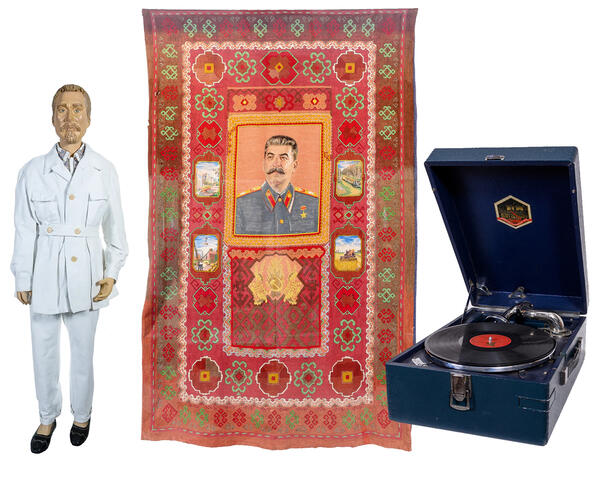
Panel with Stalin, Pathephon, Costume of Shorsky

1
Open in app
#1
Panel with Stalin, Pathephon, Costume of Shorsky
#2
Artel “Truzhenitsa”
Textile panel depicting Joseph Stalin
#3
The exposition of the National Museum of the Republic of Mari El displays a 1.5×2.5-meter textile panel with a portrait of Joseph Stalin. It was manually woven and embroidered by the workers of the women’s artel “Truzhenitsa” in the early 1950s. The panel was going to be presented to the leader of the party and the country on his birthday, December 21, 1953. But on March 5, 1953, Stalin passed away, and the gift remained in Yoshkar-Ola.

This exhibit combines both traditional Mari motifs and some new images and techniques. For example, satin stitches were uncharacteristic of the Mari embroidery, including the diagonal satin stitch used for this panel. The Mari women called this technique “rushla tur”, which meant “Russian-like”. The traditional embroidery techniques included double linear stitches for creating a contour, diagonal stitches for ornaments, and a pattern that resembled a woven design. The main motifs of national embroidery were simplified images of people, animals and birds, floral and geometric patterns.

Up to the mid-20th century, the Mari women used hand-made wool and silk threads. However, this panel was created with the use of factory-made mouline threads of red, brown, yellow, green, and white colors — the hues that are most often found in traditional Mari handicrafts. In the older works, the color scheme was wider and included black and blue colors.

The panel presents a combination of folk geometric patterns and realistic images: the portrait of Joseph Stalin, miniature cityscapes, and scenes from the lives of Mari workers and peasants, as well as the Soviet state emblem below the portrait.

The artel “Truzhenitsa”, where the panel was produced, was opened in Mari El in 1928. In 1960, it was transformed into a same-name factory. Apart from decorative panels, it also produced other items featuring national embroidery — napkins, rugs, curtains. Women usually used linen or woolen cloth of light colors, less often red or yellow, and mostly embroidered with mouline thread.
#4
Полное наименование: Textile panel depicting Joseph Vissarionovich Stalin
Автор: Artel “Truzhenitsa”
Дата создания: the early 1950s
Техника: Blue lining canvas, diagonal satin stitch, mouline thread
Коллекция: Timofey Yevseev National Museum of the Republic of Mari El
Место создания: Artel “Truzhenitsa”
Правообладатель изображений: Timofey Yevseev National Museum of the Republic of Mari El
Размеры: 250×150 cm
#5
Moscow Pathephone Factory
Pathephone (phonograph)
#6
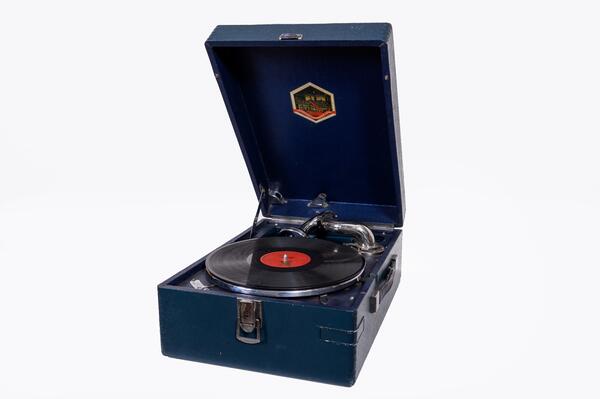
A pathephone is a mechanical device for playing gramophone records. It was different from the gramophone because there was no large horn on the outside: a similar device of much smaller size was built right within the pathephone. The pathephone often looked like a briefcase with a handle which made it easy to carry.

The word “pathephone” is based on the name of the French company Pathe, which was the first to supply portable gramophones to the Russian Empire. Then private entrepreneurs began to produce them, but after the revolution, most of the enterprises became the state property. In Soviet times, such devices were produced at several factories in Moscow, Leningrad, Vladimir, Kolomna, and Dnepropetrovsk. The unit from the collection of the National Museum of the Republic of Mari El was manufactured at the Moscow Pathephone Factory of the Moskvoretsky District Industrial Trust.

The pathephone case is closed with a latch. It has a carrying handle on the left side. When the lid was open, it was secured with a support bar, which was located on the right side.

The device is spring-actuated, with one wind-up usually enough to play one side of the record, but less often both. The sound came from the socket, which was placed inside the case. The needle took the recording from the magnetic track, and the diaphragm transmitted the acoustic vibrations to the horn. The needle was set to start recording after the record had spun up to its normal speed of 78 revolutions per minute.

A special stabilizer regulated the speed of the record revolution. It was not recommended to spin the disc by hand, as it would spoil the tracks. It was possible to stop the record with a manual or an automatic brake — this model is equipped with both. The pathephone from the museum’s collection could play gramophone records no more than 300 millimeters in diameter.

The first pathephone models were equipped with disposable steel needles. They lasted for three or four minutes of recording, and then the needle had to be changed. Later they were replaced by the stronger and more durable sapphire ones.
#7
Полное наименование: Pathephone (phonograph)
Дата создания: the second half of the 1930s — 1950s
Правообладатель изображений: Timofey Yevseev National Museum of the Republic of Mari El
Автор: Moscow Pathephone Factory
Место создания: Moscow
Коллекция: Timofey Yevseev National Museum of the Republic of Mari El
Техника: Manufacture
Размеры: 14×28×35 cm
#8
Costume of Pyotr Ivanov (Shorsky)
#9
The Timofey Yevseev National Museum of the Republic of Mari El houses a men’s suit made of white cotton fabric. It consists of trousers, a jacket with a belt and an embroidered shirt. This suit belonged to the famous Mari journalist Pyotr Ivanov, known under the pseudonym Shorsky.

Pyotr Ivanov was born on December 5, 1913, in the village of Shorsola, Irmuchashskaya volost, Urzhumsky county, Vyatka province, which is Kuzhenersky district of Mari El nowadays. His parents were unwealthy peasants. In 1931, the 18-year-old Komsomol member Ivanov, who had just graduated from school, founded a collective farm in his native village. Ever since he was young, he wrote articles for local newspapers, and in the 1930s, he got a job at the editorial office of the regional publishing house “The Young Communist” (“Rveze kommunar”). The journalist took the pseudonym Shorsky after the name of his village.

On October 21, 1937, Pyotr Shorsky was arrested on a false denunciation as an “enemy of Soviet power” and a “bourgeois nationalist”. On November 10, that same year, he was sentenced to 10 years of hard labor and sent to the Tayshet camp in the Irkutsk region.

Two years later, in 1939, Lavrentiy Beria became head of the People’s Commissariat of Internal Affairs. He initiated the movement to “restore socialist legality” — Pyotr Shorsky was found innocent, released, and allowed to return to his native Mari Autonomous Soviet Socialist Republic.

In 1943, Shorsky was accepted into the All-Union Communist Party of Bolsheviks, as the CPSU was called at the time. From that time to the end of his life, the journalist was engaged in public and party activities. In the 1940s –1950s, Shorsky worked for the big Mari El republic newspapers “Mari Kommuna”, “Mariyskaya Pravda”, as well as for the local newspapers “Kolkhoznaya Pravda”, “Kommunar”, “Socialism verch” (“For Socialism”). In 1957, he was promoted to the director of the Ronginsky stone quarry, where he later worked as a labor and wage engineer.

Pyotr Shorsky was known not only as a journalist but also as a writer. His novel “Unforgettable Friend” was published in 1962. In 2013, his daughter Zinaida Ivanova published the book “The Story of One Life” in 2013, which, in addition to biographical articles, memoirs, and photos, included an unpublished manuscript by Shorsky — “History of the Ronga Village”.
#10
Полное наименование: Costume of Mari journalist Pyotr Ivanov (Shorsky)
Правообладатель изображений: Timofey Yevseev National Museum of the Republic of Mari El
Дата создания: The mid-20th century
Техника: Cotton fabric, sewing
Коллекция: Timofey Yevseev National Museum of the Republic of Mari El
Размеры: 134×42×35 cm
#11
read morehide
00:00
00:00
1x

Panel with Stalin, Pathephon, Costume of Shorsky

1
Point your smartphone camera to open in the app
Share
VkontakteOdnoklassnikiTelegram
Share on my website
Copy linkCopied
Copy
Open in app
To see AR mode in action:
  1. Install ARTEFACT app for 
  2. iOS or Android;
  3. Find and download the «Paintings in Details» exhibition
  4. Push the «Augmented reality» button and point your phone's camera at the painting;
  5. Watch what happens on your phone screen whilst you flip through the pictures.
 
We use Cookies
Cookies on the Artefact Website. We use cookies to ensure that we give you the best experience on our website. If you continue without changing your settings, we'll assume that you are happy to receive all cookies on the Artefact website. However, if you would like to, you can change your cookie settings at any time.
Learn more about useHide
Content is available only in Russian

X

Нашли опечатку?...

%title%%type%