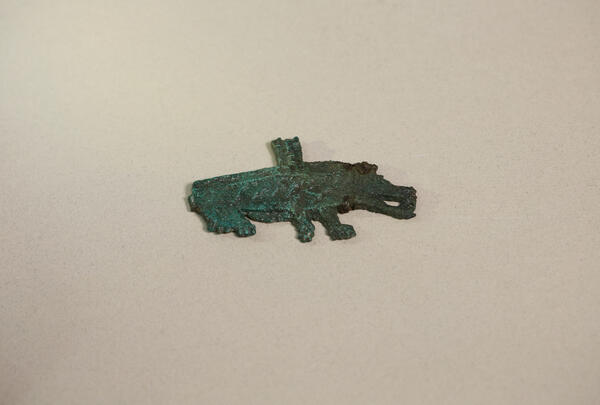
There is a special type of an image — “animal rider” in the Urals and Western Siberia people art. The exhibition “Ugra Heritage” houses a bronze casting on a similar theme — the “bear rider”. In the Siberian culture, the image of the bear has been widespread from the Neolithic era. This animal is regarded as one of the main characters in the Western Siberia Kulay plastic arts of the Early Iron Age.
The Kulay culture is a layer of archaeological finds dating back to the first millennium BC. This culture is connected by the researchers to the present Finno-Ugric peoples’ ancestors including those of the Ob-Ugrians.
The Kulay people lived in half-dugouts. They used to hunt, fish and, breed horses. Initially, only small groups of people gathered on one territory, two or three dwellings per group, and then, the number of houses increased to ten. The settlements were secured by a moat.
This culture became famous for bronze casting. Ancient people could make both hunting gears and uncustomary artifacts: figurines of people, animals, birds, and mythical beings.
The bronze figurine “Bear rider” was received by the Nefteyugansk Museum of Local History in 2001 from the Syroy Agan 6 — an ancient settlement dig site. Determination of the exact date of this figurine is problematic, supposedly it could be a time frame from the 3rd century BC to the 3rd century AD.
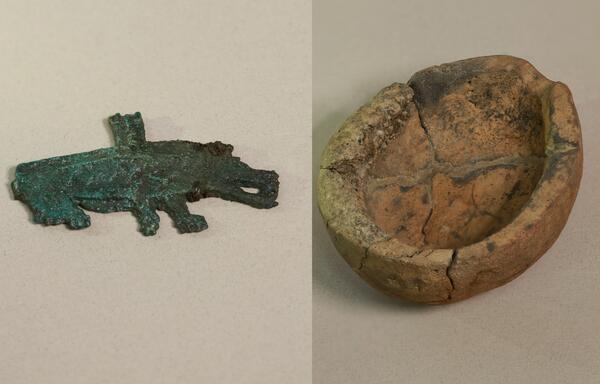
This image was found next to the horse’s lower jaw fragment, making the researchers suggest that this is one of the cult places. This is a flat casting featuring an animal with a creature on its back resembling a human. The front has been worked out in detail, but the reverse is flat. The animal is side-drawn with a head turned to the right. The researchers agreed that the animal represents a bear. The bear is tailless with a large body, short ears on his head, and paws with five claws. Teeth or probably a clamped object are shown in the open mouth (the casting quality does not allow to specify this accurately).
The anthropomorphic figure on the bear’s back is less detailed. The eyes, nose, mouth are specified on the face. There are four segments seen underneath the head. The researchers suggest that in such a way the craftsman schematically indicated the rider’s legs and arms. The Kulay people often depicted people with large heads and stylized, small limbs.
The Kulay culture is a layer of archaeological finds dating back to the first millennium BC. This culture is connected by the researchers to the present Finno-Ugric peoples’ ancestors including those of the Ob-Ugrians.
The Kulay people lived in half-dugouts. They used to hunt, fish and, breed horses. Initially, only small groups of people gathered on one territory, two or three dwellings per group, and then, the number of houses increased to ten. The settlements were secured by a moat.
This culture became famous for bronze casting. Ancient people could make both hunting gears and uncustomary artifacts: figurines of people, animals, birds, and mythical beings.
The bronze figurine “Bear rider” was received by the Nefteyugansk Museum of Local History in 2001 from the Syroy Agan 6 — an ancient settlement dig site. Determination of the exact date of this figurine is problematic, supposedly it could be a time frame from the 3rd century BC to the 3rd century AD.
This image was found next to the horse’s lower jaw fragment, making the researchers suggest that this is one of the cult places. This is a flat casting featuring an animal with a creature on its back resembling a human. The front has been worked out in detail, but the reverse is flat. The animal is side-drawn with a head turned to the right. The researchers agreed that the animal represents a bear. The bear is tailless with a large body, short ears on his head, and paws with five claws. Teeth or probably a clamped object are shown in the open mouth (the casting quality does not allow to specify this accurately).
The anthropomorphic figure on the bear’s back is less detailed. The eyes, nose, mouth are specified on the face. There are four segments seen underneath the head. The researchers suggest that in such a way the craftsman schematically indicated the rider’s legs and arms. The Kulay people often depicted people with large heads and stylized, small limbs.