#1
Зонт, Веер, Открытые письма
#3
#4
#2
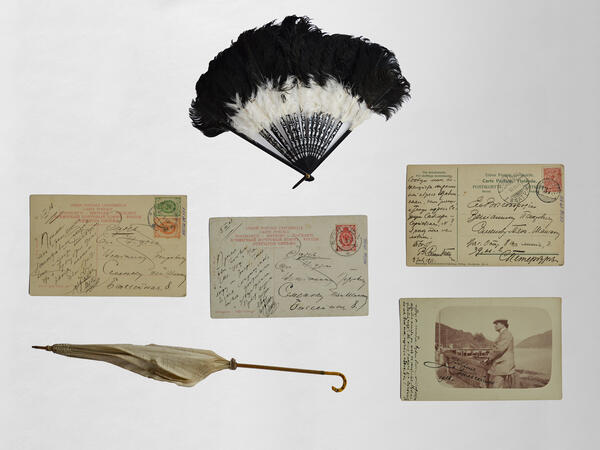
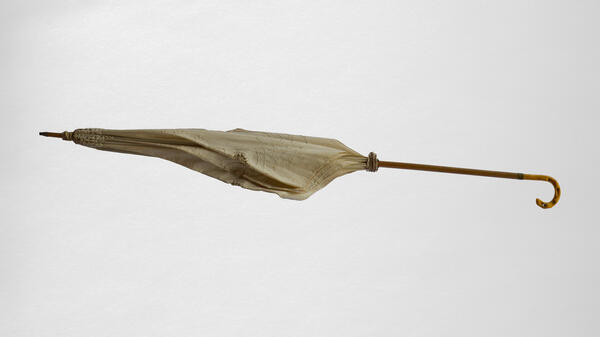
The sunshade umbrella from the collection of the museum estate was presumably made in the late 19th or early 20th century. It belonged to the granddaughter of Pyotr Semyonov-Tyan-Shansky, Vera Semyonova-Tyan-Shanskaya (Boldyreva). The umbrella tube is made of bamboo, the handle is made of bone, and the fabric is made of thick cotton with lace.
The first umbrellas in history were made of bamboo, palm leaves, and bird feathers. Such accessory weighed about 3 kg and had a handle of one and a half meters long. It symbolized power and strength and had to look presentable.
In Europe, the umbrella began to be actively used in the 17th century. The first copies appeared in France under the name “parasol”, which literally meant “sunproof”. The top of the French sunshade umbrella was made of waxed linen, and the handle was made of bone. May 4, 1715 can be considered the birthday of the folding umbrella. On that day it was first demonstrated to the public in Paris.
During the entire 17th century, the sunshade umbrella served exclusively as protection from the sun. It was first used as a means of protection from the rain by the English in the middle of the 18th century. It was there that an umbrella made of a fabric similar to a tarpaulin appeared. It weighed almost 4 kilograms and at first was not popular.
In the middle of the 18th century, Peter I first brought to Russia a Dutch umbrella. However, even in our country, lace umbrellas that protected from the sun, which were intended for noble ladies, were loved best of all. The umbrellas came in a variety of shapes: oval, round and square.
At the same time, the word “zontik” (umbrella in Russian) came to the Russian language from the marine lexicon, it came from the term zonnedek in Dutch, which meant “sunshade”, “canopy from the sun”. Initially, this was the name of the fabric, which was stretched over the deck of the ship to protect the crew from the sun and rain. For the first time, this word is found in Russian in the Peter the Great’s Marine Charter of 1720. It is written as ‘zondek’ there.
By the end of the 18th century, the form of the word was changed to " zontik ‘. And in the 19th century, it acquired the meaning of a “hand umbrella from the sun”. Over time, the name began to be perceived as a diminutive because of the suffix “ik”, which was already common in the Russian language. So, since the 1830s, the word “zont” has come into use.
The first umbrellas in history were made of bamboo, palm leaves, and bird feathers. Such accessory weighed about 3 kg and had a handle of one and a half meters long. It symbolized power and strength and had to look presentable.
In Europe, the umbrella began to be actively used in the 17th century. The first copies appeared in France under the name “parasol”, which literally meant “sunproof”. The top of the French sunshade umbrella was made of waxed linen, and the handle was made of bone. May 4, 1715 can be considered the birthday of the folding umbrella. On that day it was first demonstrated to the public in Paris.
During the entire 17th century, the sunshade umbrella served exclusively as protection from the sun. It was first used as a means of protection from the rain by the English in the middle of the 18th century. It was there that an umbrella made of a fabric similar to a tarpaulin appeared. It weighed almost 4 kilograms and at first was not popular.
In the middle of the 18th century, Peter I first brought to Russia a Dutch umbrella. However, even in our country, lace umbrellas that protected from the sun, which were intended for noble ladies, were loved best of all. The umbrellas came in a variety of shapes: oval, round and square.
At the same time, the word “zontik” (umbrella in Russian) came to the Russian language from the marine lexicon, it came from the term zonnedek in Dutch, which meant “sunshade”, “canopy from the sun”. Initially, this was the name of the fabric, which was stretched over the deck of the ship to protect the crew from the sun and rain. For the first time, this word is found in Russian in the Peter the Great’s Marine Charter of 1720. It is written as ‘zondek’ there.
By the end of the 18th century, the form of the word was changed to " zontik ‘. And in the 19th century, it acquired the meaning of a “hand umbrella from the sun”. Over time, the name began to be perceived as a diminutive because of the suffix “ik”, which was already common in the Russian language. So, since the 1830s, the word “zont” has come into use.
#26
Full name: Women’s sunshade umbrella
Date: the early 20th century
Technique: handmade
Place: Russia
Copyright: The Museum-Estate of P. P. Semyonov-Tyan-Shansky
Dimensions: 60×16 cm
Date: the early 20th century
Technique: handmade
Place: Russia
Copyright: The Museum-Estate of P. P. Semyonov-Tyan-Shansky
Dimensions: 60×16 cm
#5
Ladies Fan
#6
#7
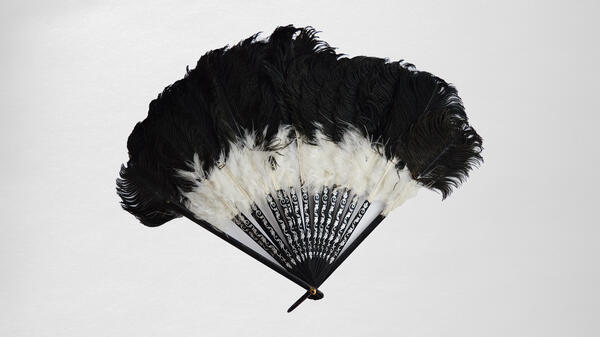
The fan with ostrich feathers belonged to Pyotr Semyonov-Tyan-Shansky’s wife, Elizaveta Andreevna. Starting from the 1870s the scientist held high posts in the state hierarchy (he was head of the population census in Russia, chairman of the Statistical Council, a senator and a member of the Academy of Sciences) and often received invitations to appear at court with his wife. Nadezhda Korolkova, granddaughter of Semyonov-Tyan-Shansky, who donated the fan to the museum’s collection, noted, ‘This fan has seen three Russian emperors — Alexander II, Alexander III and Nicholas II.’ Now it is in the permanent exhibition and serves as a vivid illustration of the Semyonov-Tyan-Shansky’s family history.
This type of fans has been known in the East since ancient times — the first information about such products in China dates back to the VIII century B.C. At that time, they were made of palm and lotus leaves. Soon Japanese craftsmen invented fans from wooden planed boards, which could be folded. Such fans were first mentioned in 988.
In Europe, fans appeared in the middle of the XVI century, when the first East India companies — colonial-era trading companies — were founded. Ships brought products from distant countries, which seemed very exotic to Europeans. In the Baroque period fans became a luxury item. The materials used for their manufacture were not available to everyone. Mostly it was silk, leather, parchment or thick paper.
Over the years, the fan transformed from a tool to provide a flow of air into a real flirtation tool. There was even a special language that allowed a woman to have a conversation with her lover without resorting to words. It had many variations, varying from city to city and social circle. Usually, the simplest gesture could decide a lover’s fate — for example, a fan was moved from one hand to the other, opened (in case of a positive answer) or closed (rejection). But in the 19th century the fan lost its meaning and became a common ladies' accessory.
During this period a new trend in product design emerged — fans were ordered to match certain outfits. There were also program fans (fans given to ladies when they entered the theater), fan-menus and fans-invitation tickets. It was in the 19 century that products began to be made not only from traditional materials, but also, for example, from ostrich feathers.
It is this kind of fan that is in the collection of the manor museum. It is made of bone plates and feathers. The product is designed in strict colors — black and white. Such a fan matched the black velvet dress that the ladies of high society wore at formal events — balls, royal receptions and parties.
This type of fans has been known in the East since ancient times — the first information about such products in China dates back to the VIII century B.C. At that time, they were made of palm and lotus leaves. Soon Japanese craftsmen invented fans from wooden planed boards, which could be folded. Such fans were first mentioned in 988.
In Europe, fans appeared in the middle of the XVI century, when the first East India companies — colonial-era trading companies — were founded. Ships brought products from distant countries, which seemed very exotic to Europeans. In the Baroque period fans became a luxury item. The materials used for their manufacture were not available to everyone. Mostly it was silk, leather, parchment or thick paper.
Over the years, the fan transformed from a tool to provide a flow of air into a real flirtation tool. There was even a special language that allowed a woman to have a conversation with her lover without resorting to words. It had many variations, varying from city to city and social circle. Usually, the simplest gesture could decide a lover’s fate — for example, a fan was moved from one hand to the other, opened (in case of a positive answer) or closed (rejection). But in the 19th century the fan lost its meaning and became a common ladies' accessory.
During this period a new trend in product design emerged — fans were ordered to match certain outfits. There were also program fans (fans given to ladies when they entered the theater), fan-menus and fans-invitation tickets. It was in the 19 century that products began to be made not only from traditional materials, but also, for example, from ostrich feathers.
It is this kind of fan that is in the collection of the manor museum. It is made of bone plates and feathers. The product is designed in strict colors — black and white. Such a fan matched the black velvet dress that the ladies of high society wore at formal events — balls, royal receptions and parties.
#8
Full name: Ladies Fan
Date: the second half of the XIX century
Technique: handmade
Place: Russia
Copyright: The Museum-Estate of P. P. Semyonov-Tyan-Shansky
Dimensions: 20×26 cm
Date: the second half of the XIX century
Technique: handmade
Place: Russia
Copyright: The Museum-Estate of P. P. Semyonov-Tyan-Shansky
Dimensions: 20×26 cm
#9
An open letter to V. P. Semyonov-Tyan-Shansky
#10
#11
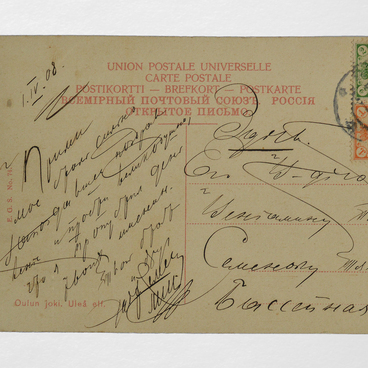
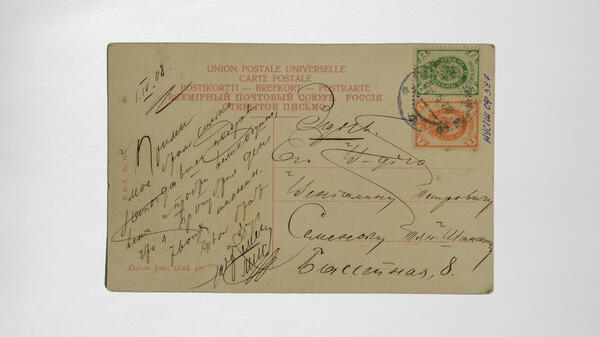
A postcard from the museum collection depicts a view of the Oulujoki River in Finland. On the back there is the text: “Accept my congratulations, which are so late, and accept my sincerest apologies that I missed your birthday celebration. Your brother and friend Andrey STSh. Veniamin Petrovich Semyonov-Tyan-Shansky, 8, Basseinaya Street “.
Andrey Semyonov-Tyan-Shansky (1866-1942) was a geographer, entomologist and translator. While growing up he was greatly influenced by his father, geographer and traveler Pyotr Semyonov-Tyan-Shansky, and surrounded by his diverse scientific interests. In his youth, he became interested in entomology, the science of insects, and devoted his whole life to it.
In 1888, Andrey Semyonov-Tyan-Shansky accompanied his father on a long journey across Central Asia. The result of the trip was the publication of the scientist”s first entomological research. From 1890 until his death, he worked at the Zoological Museum of the St. Petersburg Academy of Sciences (later called the Zoological Institute).
Overall, the scientist described 900 different species and genera of beetles and published more than a thousand scientific papers. Besides, his work as Vice President of the Russian Entomological Society (as President from 1914) was extremely fruitful. Like his father, he was an outstanding person: he knew world literature well; in particular, he was a brilliant connoisseur of Latin poetry, especially Horace. Experts consider his translations to be exemplary in beauty and accuracy.
Another of his interests was the history of the navy and maritime operations. He was the chairman of the Russian Maritime Union and, after the Russo-Japanese War, published articles defending the vital need to recreate the Russian Navy in the Far East.
He contributed much to the Russian Geographical Society where in 1910 he organized a biogeographic commission. Moreover, together with his brother Veniamin he was at the origins of nature conservation in Russia and was the initiator of the creation of the Permanent Environmental Commission under the Geographical Society. Andrey Semyonov-Tyan-Shansky died in besieged Leningrad on March 7, 1942 and was buried next to his parents and sister Olga at the Smolensk Cemetery of Vasilievsky Island.
Andrey Semyonov-Tyan-Shansky (1866-1942) was a geographer, entomologist and translator. While growing up he was greatly influenced by his father, geographer and traveler Pyotr Semyonov-Tyan-Shansky, and surrounded by his diverse scientific interests. In his youth, he became interested in entomology, the science of insects, and devoted his whole life to it.
In 1888, Andrey Semyonov-Tyan-Shansky accompanied his father on a long journey across Central Asia. The result of the trip was the publication of the scientist”s first entomological research. From 1890 until his death, he worked at the Zoological Museum of the St. Petersburg Academy of Sciences (later called the Zoological Institute).
Overall, the scientist described 900 different species and genera of beetles and published more than a thousand scientific papers. Besides, his work as Vice President of the Russian Entomological Society (as President from 1914) was extremely fruitful. Like his father, he was an outstanding person: he knew world literature well; in particular, he was a brilliant connoisseur of Latin poetry, especially Horace. Experts consider his translations to be exemplary in beauty and accuracy.
Another of his interests was the history of the navy and maritime operations. He was the chairman of the Russian Maritime Union and, after the Russo-Japanese War, published articles defending the vital need to recreate the Russian Navy in the Far East.
He contributed much to the Russian Geographical Society where in 1910 he organized a biogeographic commission. Moreover, together with his brother Veniamin he was at the origins of nature conservation in Russia and was the initiator of the creation of the Permanent Environmental Commission under the Geographical Society. Andrey Semyonov-Tyan-Shansky died in besieged Leningrad on March 7, 1942 and was buried next to his parents and sister Olga at the Smolensk Cemetery of Vasilievsky Island.
#12
Full name: Andrey Petrovich Semyonov-Tyan-Shansky’s open letter to Veniamin Petrovich Semyonov-Tyan-Shansky, 1908
Author: Andrey Petrovich Semyonov-Tyan-Shansky
Date: April 1, 1908
Technique: printed, handwritten text
Place: Russia
Copyright: The Museum-Estate of P. P. Semyonov-Tyan-Shansky
Dimensions: 8,8×13,8 cm
Date: April 1, 1908
Technique: printed, handwritten text
Place: Russia
Copyright: The Museum-Estate of P. P. Semyonov-Tyan-Shansky
Dimensions: 8,8×13,8 cm
#13
An open letter to V. P. Semyonov-Tyan-Shansky
#14
#15
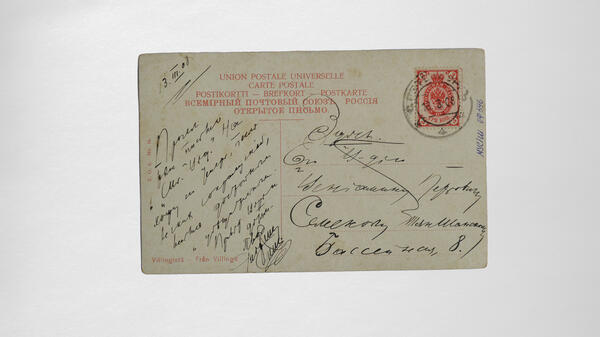
The brothers Andrey and Veniamin Semyonov-Tyan-Shansky were in constant correspondence throughout their lives. A significant part of it has been preserved in the family archive of the descendants of Veniamin Petrovich in St. Petersburg. The museum collection contains a postcard depicting a view of northern nature with a short text on the back: ‘I have read your letter in “St. Petersburg Vedomosti”, now I find this paper, after some slight abridgements, very dignified and convincing. Give my love to Vera and children. Your Andrey STSh. To His Highness Veniamin Petrovich Semyonov-Tyan-Shansky. Basseinaya Street, 8’.
Veniamin Semyonov-Tyan-Shansky (1870-1942) was a statistician and geographer. He was the author of fundamental works on urban and rural settlements. From when he was a child, his father inspired in him an interest in geography, the study of nature and society. In 1895-1897, Veniamin Petrovich took part in the first all-Russian population census as s secretary of the Main Census Commission. Afterwards he worked in the Central Statistical Committee and in the statistics department of the Ministry of Finance, and from 1905 up to 1917, he was the head of the statistics department in the Ministry of Trade and Industry.
It was he who created and edited the multivolume work ‘Russia. Complete Geographical Description of Our Fatherland’. Moreover, Veniamin Semyonov-Tyan-Shansky published the series ‘Trade and Industry of European Russia’, which was awarded the Grand Prix at the international exhibition in Turin; and he received the Academy of Sciences prize for the work ‘City and Village in European Russia’.
From 1918 he was engaged in teaching: he was a professor at the Pedagogical Institute, and then at the Leningrad University. He also was the initiator and director of the Central Geographical Museum, which became the third largest in Leningrad, after the Hermitage and the Russian Museum. An important part of his life was dedicated to the local history movement in the 1920s. He was a member of the Presidium of the Central Bureau of Local History and played an active role in the Russian Geographical Society. Veniamin Semyonov-Tyan-Shansky died in besieged Leningrad on February 8, 1942, having refused to be evacuated.
Veniamin Semyonov-Tyan-Shansky (1870-1942) was a statistician and geographer. He was the author of fundamental works on urban and rural settlements. From when he was a child, his father inspired in him an interest in geography, the study of nature and society. In 1895-1897, Veniamin Petrovich took part in the first all-Russian population census as s secretary of the Main Census Commission. Afterwards he worked in the Central Statistical Committee and in the statistics department of the Ministry of Finance, and from 1905 up to 1917, he was the head of the statistics department in the Ministry of Trade and Industry.
It was he who created and edited the multivolume work ‘Russia. Complete Geographical Description of Our Fatherland’. Moreover, Veniamin Semyonov-Tyan-Shansky published the series ‘Trade and Industry of European Russia’, which was awarded the Grand Prix at the international exhibition in Turin; and he received the Academy of Sciences prize for the work ‘City and Village in European Russia’.
From 1918 he was engaged in teaching: he was a professor at the Pedagogical Institute, and then at the Leningrad University. He also was the initiator and director of the Central Geographical Museum, which became the third largest in Leningrad, after the Hermitage and the Russian Museum. An important part of his life was dedicated to the local history movement in the 1920s. He was a member of the Presidium of the Central Bureau of Local History and played an active role in the Russian Geographical Society. Veniamin Semyonov-Tyan-Shansky died in besieged Leningrad on February 8, 1942, having refused to be evacuated.
#16
Full name: Andrey Petrovich Semyonov-Tyan-Shansky’s open letter to Veniamin Petrovich Semyonov-Tyan-Shansky written on March 3, 1908
Author: Andrey Petrovich Semyonov-Tyan-Shansky
Date: March 3, 1908
Technique: printed, handwritten text
Place: Russia
Copyright: The Museum-Estate of P. P. Semyonov-Tyan-Shansky
Dimensions: 8,8×13,8 cm
Author: Andrey Petrovich Semyonov-Tyan-Shansky
Date: March 3, 1908
Technique: printed, handwritten text
Place: Russia
Copyright: The Museum-Estate of P. P. Semyonov-Tyan-Shansky
Dimensions: 8,8×13,8 cm
#17
An open letter to V. P. Semyonov-Tyan-Shansky
#18
#19
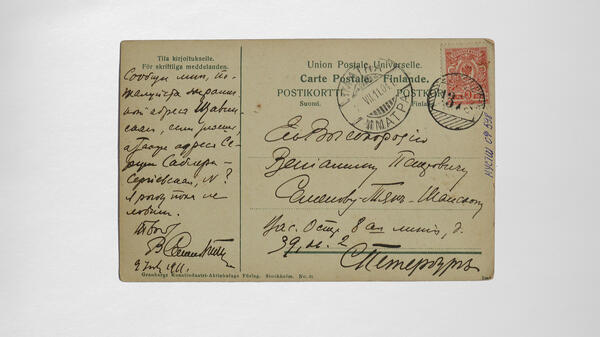
The letter was written by Valery Semyonov-Tyan-Shansky to his brother Veniamin from the Finnish town of Imatra to St. Petersburg. The text on the back of the postcard mentioned a close acquaintance of their father, Pyotr Semyonov-Tyan-Shansky, Vasily Shavinsky by saying “Please let me know Shavinsky’s overseas address, if you know, as well as the address of Seryozha Sabler, Sergievskaya Street, no.? I have not been fishing yet. July 2, 1911. Yours V. Semyonov-Tyan-Shansky”.
Vasily Shavinsky (1868-1924) was a chemical technologist, art critic and collector. A common interest in the works of Dutch and Flemish artists brought together him and Pyotr Semyonov-Tyan-Shansky. In this area of collecting, the geographer was considered an expert of the European level, and so was his acquaintance.
Shavinsky began collecting the works of Dutch artists in 1896. He was interested in techniques and ways of creating paintings as well as in the Western European art history. In 1908-1916 he wrote several articles about the art in the Netherlands and techniques of the ancient Russian art and published them in the journal called “The Old Years”
His best known articles were “On the materials of an ancient painting” (1908) and “On the restoration of Hermitage paintings” (1915). The work “Essays on painting technique history and paint technology in Ancient Russia” were published posthumously.
By 1917 Shavinsky’s collection, according to a catalogue issued in Petrograd, contained 150 paintings. In 1914 he was one of the organizers of the exhibition ‘The art of the allied peoples’ where some of the paintings from his collection were exhibited. Shavinsky bequeathed his collection of paintings to Kiev art patron Bogdan Khanenko.
The collector was killed by street hooligans on December 27, 1924 and buried at the Volkovskoye cemetery in St. Petersburg. After his tragic death, the widow, as indicated in the will, transferred the collection to the Kiev Museum of Art. The collection of Shavinsky mainly contained works of Dutch and Flemish artists.
Vasily Shavinsky (1868-1924) was a chemical technologist, art critic and collector. A common interest in the works of Dutch and Flemish artists brought together him and Pyotr Semyonov-Tyan-Shansky. In this area of collecting, the geographer was considered an expert of the European level, and so was his acquaintance.
Shavinsky began collecting the works of Dutch artists in 1896. He was interested in techniques and ways of creating paintings as well as in the Western European art history. In 1908-1916 he wrote several articles about the art in the Netherlands and techniques of the ancient Russian art and published them in the journal called “The Old Years”
His best known articles were “On the materials of an ancient painting” (1908) and “On the restoration of Hermitage paintings” (1915). The work “Essays on painting technique history and paint technology in Ancient Russia” were published posthumously.
By 1917 Shavinsky’s collection, according to a catalogue issued in Petrograd, contained 150 paintings. In 1914 he was one of the organizers of the exhibition ‘The art of the allied peoples’ where some of the paintings from his collection were exhibited. Shavinsky bequeathed his collection of paintings to Kiev art patron Bogdan Khanenko.
The collector was killed by street hooligans on December 27, 1924 and buried at the Volkovskoye cemetery in St. Petersburg. After his tragic death, the widow, as indicated in the will, transferred the collection to the Kiev Museum of Art. The collection of Shavinsky mainly contained works of Dutch and Flemish artists.
#20
Full name: Valery Petrovich Semyonov-Tyan-Shansky’s open letter to Veniamin Petrovich Semyonov-Tyan-Shansky, written on July 9, 1911
Author: Valery Semyonov-Tyan-Shansky
Date: July 9, 1911
Technique: printed, handwritten text
Place: Russia
Copyright: The Museum-Estate of P. P. Semyonov-Tyan-Shansky
Dimensions: 11,5×16 cm
Author: Valery Semyonov-Tyan-Shansky
Date: July 9, 1911
Technique: printed, handwritten text
Place: Russia
Copyright: The Museum-Estate of P. P. Semyonov-Tyan-Shansky
Dimensions: 11,5×16 cm
#21
Photo Postcard of Robert Adelheim
#22
#23
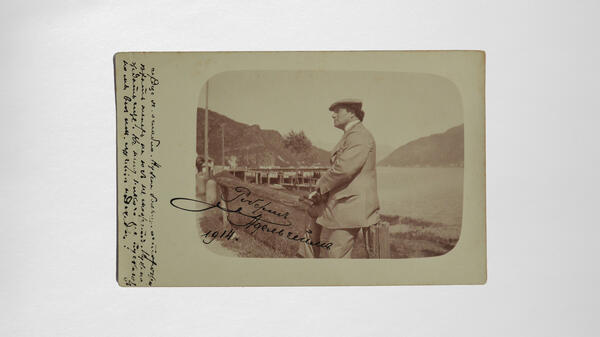
The wife of Pyotr Semenov-Tyan-Shansky, Elizaveta Zablotskaya-Desyatovskaya was an inveterate music lover and theater-goer. Among her closest acquaintances were composers and actors of the leading Russian theaters. Including the actor Robert Adelheim, featured on the postcard from the museum’s collection. More than two dozen postcards have been preserved in the Semenov-Tyan-Shansky family archive.
The brothers Robert and Raphael Adelheim were known throughout Russia. They performed in various parts of the country and were invariably successful. The theater critic Alexander Kugel explained this phenomenon in the following way: “And the secret was quite simple. While our actors still relied on ‘the off chance’ and on the coming of a certain ‘spirit’, who would bless at the right time — and ‘the spirit’ did not appear more often due to different reasons and there was an actor, poorly knowing his role, at that time, I say, the Adelheim brothers worked like real Germans. This German school — Salieri’s school — puts craft at the foot of art and craft emerges as skill… The gesture was studied in front of a mirror — daily and continuously. The role was examined entirely and in every detail. The style was learned like a lesson. All this was bearing fruit.”
The Adelheim brothers were born in the family of a Moscow doctor and graduated simultaneously from the Vienna Conservatory in drama. Furthermore, in the competitive final exam, Robert got the first prize and Raphael — the second one. After that they worked separately in various Europe theaters, but then came back to Russia and started to perform together. To mark the 10th anniversary of the brothers' joint work, an album of their photographs in various roles was published in St Petersburg in 1905.
In total, they worked on stage more than 40 years. Their repertoire included classic tragedies: “Oedipus the King”, “Othello”, “King Lear”, “The Merchant of Venice” and others. The brothers performed both on the capital’s stages and on the provincial ones. Actor Alexander Sumarokov wrote: “The brothers Adelheim were an example of how to behave an actor on stage and in life.”
They developed a special method of teaching acting skills based on breathing exercises. Over time, however, their developments were completely lost. In Soviet times, the Stanislavsky school was recognized as the underlying methodology.
After the revolution, the Adelheim brothers continued performing in clubs and cultural centers at Soviet enterprises. They were not invited to Moscow’s official theaters. Nonetheless, in 1927, the 70th anniversary of both brothers was celebrated in Moscow and they were awarded the titles of People’s Artists of the RSFSR.
The brothers Robert and Raphael Adelheim were known throughout Russia. They performed in various parts of the country and were invariably successful. The theater critic Alexander Kugel explained this phenomenon in the following way: “And the secret was quite simple. While our actors still relied on ‘the off chance’ and on the coming of a certain ‘spirit’, who would bless at the right time — and ‘the spirit’ did not appear more often due to different reasons and there was an actor, poorly knowing his role, at that time, I say, the Adelheim brothers worked like real Germans. This German school — Salieri’s school — puts craft at the foot of art and craft emerges as skill… The gesture was studied in front of a mirror — daily and continuously. The role was examined entirely and in every detail. The style was learned like a lesson. All this was bearing fruit.”
The Adelheim brothers were born in the family of a Moscow doctor and graduated simultaneously from the Vienna Conservatory in drama. Furthermore, in the competitive final exam, Robert got the first prize and Raphael — the second one. After that they worked separately in various Europe theaters, but then came back to Russia and started to perform together. To mark the 10th anniversary of the brothers' joint work, an album of their photographs in various roles was published in St Petersburg in 1905.
In total, they worked on stage more than 40 years. Their repertoire included classic tragedies: “Oedipus the King”, “Othello”, “King Lear”, “The Merchant of Venice” and others. The brothers performed both on the capital’s stages and on the provincial ones. Actor Alexander Sumarokov wrote: “The brothers Adelheim were an example of how to behave an actor on stage and in life.”
They developed a special method of teaching acting skills based on breathing exercises. Over time, however, their developments were completely lost. In Soviet times, the Stanislavsky school was recognized as the underlying methodology.
After the revolution, the Adelheim brothers continued performing in clubs and cultural centers at Soviet enterprises. They were not invited to Moscow’s official theaters. Nonetheless, in 1927, the 70th anniversary of both brothers was celebrated in Moscow and they were awarded the titles of People’s Artists of the RSFSR.
#24
Full name: Photo Postcard of Robert Adelheim and the actor’s autograph
Date: 1914
Technique: photography, handwritten text
Place: Russia
Copyright: The Museum-Estate of P. P. Semyonov-Tyan-Shansky
Dimensions: 9×14 cm
Date: 1914
Technique: photography, handwritten text
Place: Russia
Copyright: The Museum-Estate of P. P. Semyonov-Tyan-Shansky
Dimensions: 9×14 cm
#25
Ministry of Culture of the Russian Federation
read morehide
00:00
00:00
1x
Umbrella, Ladies Fan, Open letters
Exhibition
0
 Point your smartphone camera to open in the app
Open in app
Share