#1
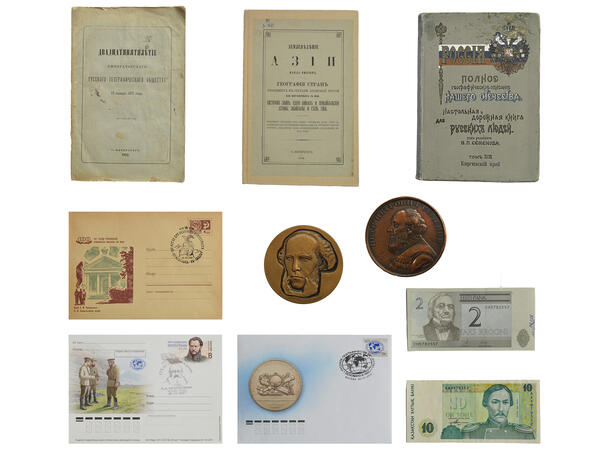
Postcards, postal envelopes, medals, banknotes
#3
#4
#2
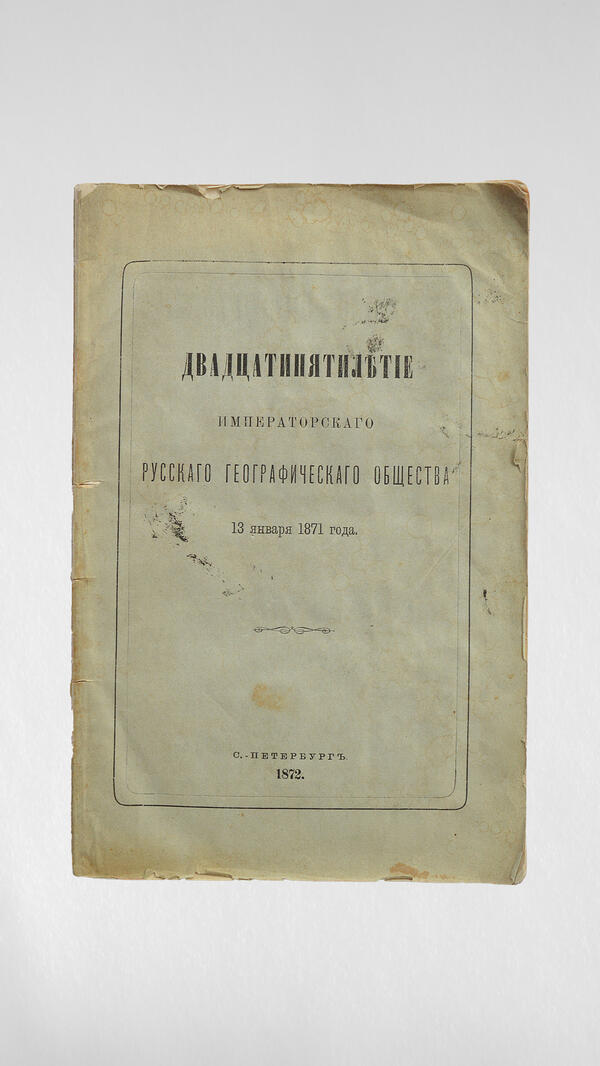
The book was published in 1871 exclusively for the anniversary of the Imperial Russian Geographical Society. This was the first work to give a detailed history of the organization, publishing an account of its activities, congratulatory letters and telegrams. Including an official greeting from Emperor Alexander II.
The publication tells the story of the creation of the Society, its founding fathers, and the departments exist within the organization. The history of the Department of General Geography is most well covered — the author of this material was Pyotr Semyonov. The text on ethnography was prepared by the literary historian and scholar of ethnography Leonid Maikov. He was admitted to the Russian Geographic Society in 1867, and four years later became the head of the ethnographic department.
Maikov played a major role in the history of the organization and contributed to the works of Semyonov-Tyan-Shansky. He was the author of several scholarly works, the best known of which were the ‘Great Russian Spells’, one of the first and still most complete collections of Russian incantations, prayers, and spells. The book was published in 1869 in the ‘Notes’ of the Russian Geographical Society. The scientist was also deeply involved in the organization’s publishing activities as an editor. Thanks to him, ethnographic maps of the European part of Russia were published, as well as the " Geographical and Statistical Dictionary’ compiled by Pyotr Semyonov-Tyan-Shansky. His role was also important in the creation of the “Living antiquity, ” a magazine that brought together experts in the field of ethnography and folklore.
Another chapter — a review of the activities of the Department of Statistics was written by Arthur von Buschen, a Russian statistician, Actual State Councilor, master and writer. He went to great lengths to ensure that up-to-date information about life in Russia was available abroad. In particular, Buschen published the book “The Population of the Russian Empire” in German in 1862, and at the time of the peasant reform he wrote a brochure on the situation of the serfs.
The history of the Society concludes with a list of full members as of 1871. The book is now considered a rare historical document, which contains interesting facts about the activities of the organization since its early days.
#5
Full name: Twenty-fifth Anniversary of the Imperial Russian Geographical Society
Author: Pyotr Semyonov
Date: 1871
Technique: typographic printing
Place: Russia
Copyright: The Museum-Estate of P. P. Semyonov-Tyan-Shansky
Dimensions: 23×15×1,1 cm
Date: 1871
Technique: typographic printing
Place: Russia
Copyright: The Museum-Estate of P. P. Semyonov-Tyan-Shansky
Dimensions: 23×15×1,1 cm
#6
Asian Earth Sciences
#7
#8
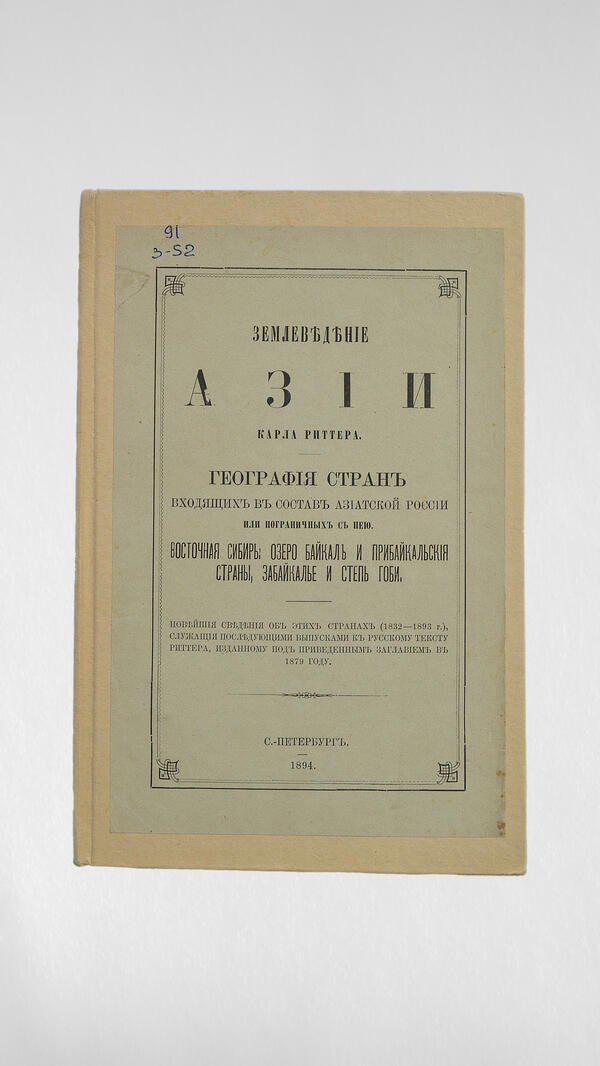
Russian Geographical Society Council decided in 1850 to prepare a translation into Russian of the fundamental work of the European geographical scientist Carl Ritter ‘Asian Earth Sciences’.
The work on the translation was given to a young scientist Peter Semyonov, who joined the Geographical Society in 1849. But he decided not to limit himself to just a formal translation. Since the first publication of this work in 1832, geographical science had gained quite a lot of knowledge that Ritter was ignorant about. It was necessary to make many additions and to process the expedition materials of Russian scientists and the European travelers’ publications. Thus, “Asian Earth Sciences” was published together with additional editions in the form of full volumes, on which Pyotr Semyonov worked.
This work continued for many decades. The scientist started the translation in 1851, and the first volume was published in 1856. The last, the sixth book, appeared in 1895. At the same time, the second and third volumes, published in 1859 and 1860, did not have extensive additions like the first edition.
Subsequently, Semyonov involved many scientists in compiling the supplements. For example, in the fourth volume, published in 1877, he wrote a large new section together with the geographer Grigory Potanin. The fifth volume dedicated to Eastern Siberia was published In 1879. New materials for it were created by the researcher Ivan Chersky and the geologist Herman Petz.
Pyotr Semyonov believed that it was very important to express scientific ideas in a language accessible to every reader. He writes about this in the introduction to the first volume of the translation of “Asian Earth Sciences”. In the translation he also had to give Russian names to many phenomena and objects that previously had no designations in the Russian language. To make the content of this work understandable to a wide range of readers, Semyonov introduced into the Russian literary language the terms “plateau”, “highland”, “mountain or alpine country”, “foothills”, “basin”, “river area”, “reservoir” and a number of other words that we use to this day.
#9
Full name: Asian Earth Sciences. Eastern Siberia: Lake Baikal and the Baikal countries, Transbaikal and the Gobi Desert
Author: Carl Ritter
Date: 1894
Technique: typographic printing
Place: Russia
Copyright: The Museum-Estate of P. P. Semyonov-Tyan-Shansky
Dimensions: 25×16×1,5 cm
Author: Carl Ritter
Date: 1894
Technique: typographic printing
Place: Russia
Copyright: The Museum-Estate of P. P. Semyonov-Tyan-Shansky
Dimensions: 25×16×1,5 cm
#10
Russia. Complete Geographical Description
#11
#12
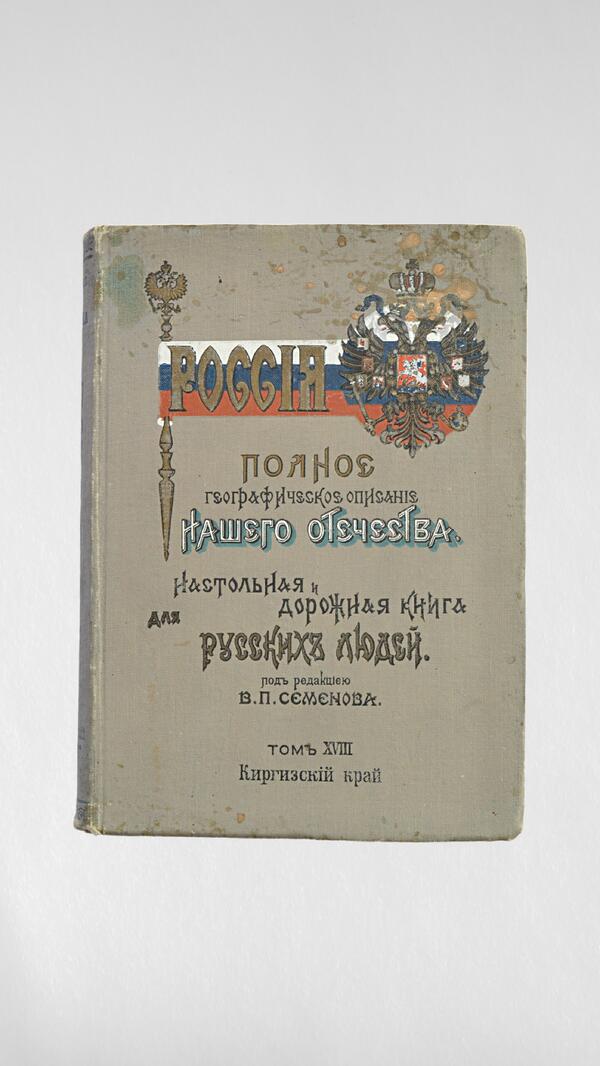
The book ‘Complete Geographical Description of Our Homeland.’ was published under the editorship of Veniamin Semyonov-Tyan-Shansky, the son of Pyotr Semyonov-Tyan-Shansky, the geographer and scientist. Pyotr Semyonov-Tyan-Shansky, as vice-chairman of the Imperial Russian Geographical Society managed this editorial project jointly with academician Vladimir Lamansky.
In his preface to the edition, Veniamin Semyonov emphasized the importance of this comprehensive work for understanding the country’s geographical layout and promoting the study of geography. His father also put a lot of effort into ensuring that the publication was of a high scientific standard and at the same time was written in interesting and lively style.
Each volume had three large sections on nature, population and “remarkable populated areas and locations”. The last section was given the most space. For this purpose, the description of individual settlements was made as a guidebook, describing locations along railways, navigable rivers and other transport locations.
In the first volume, Pyotr Semyonov-Tyan-Shansky’s writings include the section ‘Remarkable Populated Areas’, which set the pattern for similar sections in the next volumes.
It should be noted as well, that the second volume ‘The Central Black Earth Region (Chernozem)"was entirely created by the Semyonovs: Peter Petrovich himself, his sons Dmitry, Andrey, Veniamin, Valery, Izmail and his daughter Olga. The other specialists worked on the rest of the book volumes.
This country study publication enjoyed wide popularity in the Pre-Revolutionary Russia. It played a significant role in the promotion of geographical knowledge in our country. However, unfortunately the publication was not finished because the First World War started. Primarily, it was supposed to publish 20 volumes, but only 10 books were published: the first volume was published in 1899, and the last one in 1914. The volumes 4, 8, 10, 11, 12 and 13 never appeared, as the books were not published in numerical order.
Also, some books were reprinted in several editions over the subsequent years. Of particular value are the first volumes of Alfred Devrien’s original edition.
#13
Full name: Russia. Complete Geographical Description of Our Homeland. Desktop and travel book. Volume 18
Author: Veniamin Semyonov-Tyan-Shansky
Date: 1903
Technique: typographic printing
Place: Russia
Copyright: The Museum-Estate of P. P. Semyonov-Tyan-Shansky
Dimensions: 22×15×2 cm
Author: Veniamin Semyonov-Tyan-Shansky
Date: 1903
Technique: typographic printing
Place: Russia
Copyright: The Museum-Estate of P. P. Semyonov-Tyan-Shansky
Dimensions: 22×15×2 cm
#14
Postal Envelope 100 Years of Przhevalsk
#15
#16
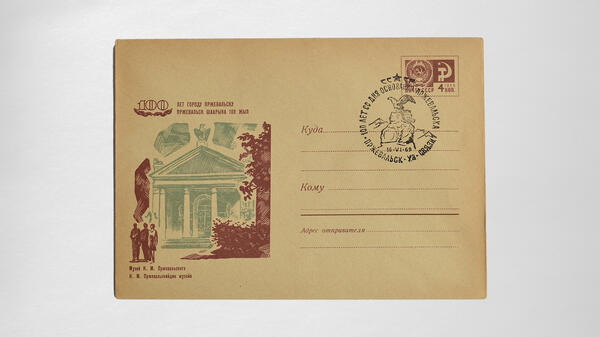
The postal envelope was issued in honor of the centennial of the town of Przhevalsk in 1969. The picture shows the museum of Nikolai Przhevalsky, and a special postmark shows the grave of the scientist. Nikolai Przhevalsky was a traveler, a geographer and a naturalist, and one of Pyotr Semenov-Tyan-Shansky’s associates in the Russian Geographical Society.
The scientist is considered to be the first researcher of the nature of Central Asia. During his lifetime he undertook several expeditions to this region. On his travels, Przhevalsky explored the territories of Mongolia, China, and Tibet. In total, he mapped 20 thousand square kilometers of new territories.
In 1867, on the initiative of Semenov-Tyan-Shansky, Przhevalsky went to the Ussuriysk region. The Siberian branch of the Russian Geographical Society entrusts him with the study of the flora and fauna of these places. He conducted his research for three months, having walked about 1,100 kilometers over that time. The result of expeditions were the books ‘On the Foreign Population in the Southern Part of the Amur Region’ and ‘Journey to the Ussuriysk territory’.
In 1870 Przhevalsky undertook his first trip to Central Asia. He was the first European to visit the interior of northern Tibet and explore new territories. The two-volume work ‘Mongolia and the Country of the Tanguts, ’ based on the expedition, made the scientist famous. The Russian Geographical Society awarded him the Grand Gold Medal and a lifetime prize of 600 rubles annually.
Przhevalsky’s second trip to Central Asia was in 1876. It is described in the book ‘From Kuldja to Tyan-Shan and to Lob-Nor’. And three years later he went on his third expedition. After his return to Russia, Przhevalsky published the first information about a new species of horse, previously unknown to science and named after him. The scientist also assembled vast zoological and botanical collections, which included previously undescribed specimens.
The Nikolai Przhevalsky Memorial Museum, which is pictured on the envelope, was opened on April 29, 1957. A special place in the exhibition is occupied by the scientist’s belongings, including the gun, which was made, among other weapons, by the famous gunsmith Vasily Lezhin at the request of Przhevalsky in preparation for his fourth journey to Tibet. Now the gun serves as the item of greatest interest to visitors to the museum.
#17
Full name: Postal Envelope 100 Years since founding of Przhevalsk City
Author: Roman Komsa
Date: 1969
Technique: typographic printing
Place: USSR
Copyright: The Museum-Estate of P. P. Semyonov-Tyan-Shansky
Dimensions: 11,5×16 cm
Author: Roman Komsa
Date: 1969
Technique: typographic printing
Place: USSR
Copyright: The Museum-Estate of P. P. Semyonov-Tyan-Shansky
Dimensions: 11,5×16 cm
#18
Postcard P.A. Kropotkin
#19
#20
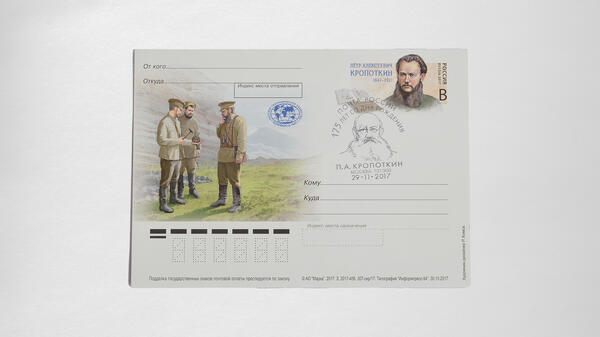
The postcard depicts three travelers in field clothes — Pyotr Kropotkin and his associates on an expedition to explore rocks. Kropotkin was a revolutionary, geographer, publicist, and one of the most influential theorists of anarchism. His portrait can also be seen on the stamp and postmark. Such envelopes were printed in 2017 to commemorate the 175th anniversary of Kropotkin’s birth.
Pyotr Kropotkin was born in Moscow in 1842. He was a representative of the ancient aristocratic family, which traced its history back to the Rurikids, the first princes in Russia. In 1862 Kropotkin graduated from the Corps of Pages in St. Petersburg and was made an officer, but gave up a brilliant court career. Instead, he went to Siberia of his own free will and joined the Amur Cossack Army.
‘The Amur region had just been annexed to Russia at that time. I read about this Mississippi of the Far East, about the mountains punctuated by the river, about the subtropical vegetation along the Ussuri; I admired the drawings attached to Maak’s Ussuri voyage, and was mentally carried further, to the tropical belt so wonderfully described by Humboldt. Besides, I thought that Siberia was an endless field for applying those reforms that were worked out or conceived, ’ Kropotkin wrote in ‘Notes of a Revolutionary’.
During this period, he undertook a number of expeditions to unexplored areas of Eastern Siberia and the Far East. This made it possible to prepare scientific works that later made him famous worldwide.
In 1867 Kropotkin retired and entered the physics and mathematics department of St. Petersburg University, and a year later he was elected a member of the Russian Geographical Society. Among the geographical works he presented to the organization there was a report on the existence of the Ice Age, which became a sensation in the scientific community.
However, Kropotkin was soon arrested on charges of participation in the revolutionary movement and imprisoned in the Peter and Paul Fortress. On the personal directive of Alexander II, he was able to continue his scientific work in prison. The result was the book ‘Studies on the Ice Age’. Where the scientist substantiated his theory.
Soon, for health reasons, Kropotkin was moved to a hospital, from which he escaped in the summer of 1876. He managed to leave Russia and lived in emigration for more than 40 years. He did not return until June, 1917, but turned down an offer from the new government to become a minister. Kropotkin died in Dmitrov in 1921.
#21
Full name: Postcard Dedicated to the 175th Anniversary of the Birth of P. A. Kropotkin
Date: 29.11.2017
Technique: typographic printing
Place: Russia
Copyright: The Museum-Estate of P. P. Semyonov-Tyan-Shansky
Dimensions: 11,5×16 cm
Date: 29.11.2017
Technique: typographic printing
Place: Russia
Copyright: The Museum-Estate of P. P. Semyonov-Tyan-Shansky
Dimensions: 11,5×16 cm
#22
Postal envelope to the RGS
#23
#24
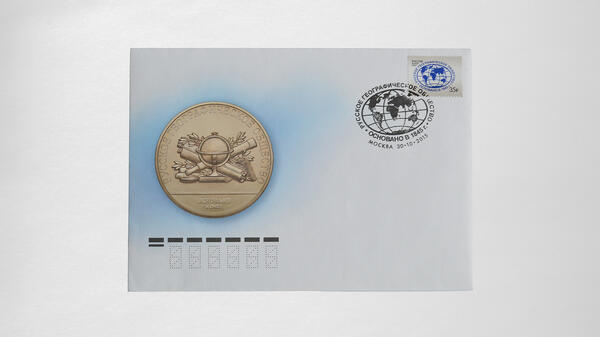
A postal envelope depicting the Great Gold Medal of the Russian Geographical Society was issued on a memorable date — the 170th anniversary of the founding of the organization. It has a postage stamp with the official emblem of society, which is the globe, and the inscription ‘Russian Geographical Society. It was founded in 1845 “.
The Russian Geographical Society was founded by order of Nicholas I in 1845. The emperor approved the temporary charter of the Russian Geographical Society. The idea of creating the organization belonged to Admiral Fedor Litke, the educator of the future first chairman of the Russian Geographical Society of Grand Duke Konstantin Nikolaevich. The main task of the new organization was to gather and guide the best minds towards a comprehensive study of their native country.
Among the founders of the Russian Geographical Society are famous seafarers: admirals Fedor Litke, Ivan Kruzenshtern, Ferdinand Wrangel and Peter Ricord, as well as scientists — natural scientist Karl Baer, astronomer Vasily Struve, geologist Grigory Gelmersen, statistician Peter Keppen. Among them were prominent military figures — quartermaster general Fedor Berg, surveyor Mikhail Vronchenko, statesman Mikhail Muravyov, and representatives of the Russian intelligentsia — linguist Vladimir Dahl and Prince Vladimir Odoevsky.
This is how Peter Semenov-Tyan-Shansky described the essence of the Russian Geographical Society: “Free and open to all who are imbued with love for their native land and a deep, indestructible faith in the future of the Russian state and Russian people, corporation”.
The Russian Geographical Society contributed to the study of the Urals, Siberia, the Far East, Central and Inner Asia, the Caucasus, Iran, India, New Guinea and many other territories. These explorations are associated with the names of famous travelers — such as Nikolai Severtsov, Ivan Mushketov, Nikolai Przhevalsky.
In Soviet times, the work of society changed. The Russian Geographical Society focused on relatively small but deep regional studies, as well as large theoretical generalizations. Today, the organization has more than 25,000 members in Russia and abroad. Regional offices are open in all 85 entities of the country.
#25
Full name: Postal envelope 170 years to the Russian Geographical Society
Date: 2015
Technique: typographic printing
Place: Russia
Copyright: The Museum-Estate of P. P. Semyonov-Tyan-Shansky
Dimensions: 11,5×16 cm
Date: 2015
Technique: typographic printing
Place: Russia
Copyright: The Museum-Estate of P. P. Semyonov-Tyan-Shansky
Dimensions: 11,5×16 cm
#26
Memorial Medal
#27
#28
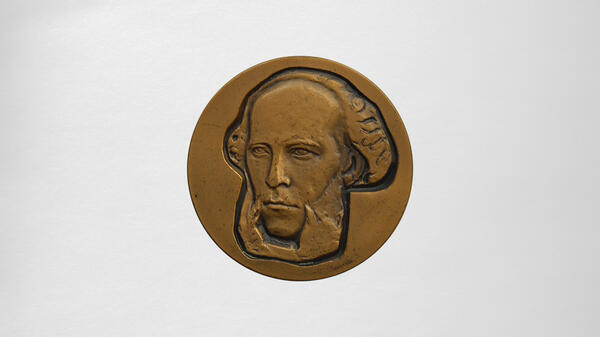
The medal was made in 1964 to commemorate the 50th anniversary of the death of Pyotr Semyonov-Tian-Shansky. On the front side, there is a portrait of the scientist from the time of his work in the Commission for the preparation of the Peasant Reform of the 1860s. On the reverse side in the center, there is a ‘Wind Rose’ — a symbol of travel. Around the edge of the medal is an inscription: ‘Semyonov-Tyan-Shansky. 1827-1914.’
The reverse side of the medal is in the shape of irregular relief, reminiscent of the mountain landscape — one of the main interests in the life of the scientist. Semyonov-Tyan-Shansky was one of the first to study the geography of the mountains of Central Asia. In 1856, and in 1857 during the expeditions, he explored more than twenty passes and collected hundreds of samples of rocks, insects, shellfish, and plants. Many of them were unknown to science.
It was produced in 300 copies and was made of metal. The author of the medal was Yurii Neroda, a sculptor from a famous artistic family. His father, Georgy Neroda, was also a sculptor and a member of the Association of Artists of Revolutionary Russia; his mother was an artist, a graduate of the Stroganoff School of Arts and Crafts.
Yurii Neroda was born in 1920 in Chernigov. He graduated from the Art School in Memory of 1905. He created the medal from the museum’s collection after he was seriously concussed in the war in 1941. The war theme was very important for Neroda, he worked scrupulously on portraits of soldiers who fought at the battlefront.
In the 1960s, Yurii Neroda played one of the leading roles in the revival of medallic sculpture in the country. It was at this time that he created the memorial medal depicting Pyotr Semyonov-Tyan-Shansky. There are medals for the 150th anniversary of the composer Franz Liszt, works with portraits of Ivan Krylov and Fyodor Dostoevsky among other items of his medal art.
His best sculptural works also include a monument dedicated to space exploration in Geneva. Neroda was a participant in most of the All-Soviet Union and foreign art exhibitions. His works were honored with prizes and diplomas.
#29
Full name: “50 years since the death of P.P. Semyonov-Tyan-Shansky” memorial medal
Author: Yurii Neroda
Date: 1965
Technique: сasting
Place: USSR
Copyright: The Museum-Estate of P. P. Semyonov-Tyan-Shansky
Dimensions: 6×6 cm
Date: 1965
Technique: сasting
Place: USSR
Copyright: The Museum-Estate of P. P. Semyonov-Tyan-Shansky
Dimensions: 6×6 cm
#30
Pyotr Petrovich Semyonov Memorial Medal
#31
#32
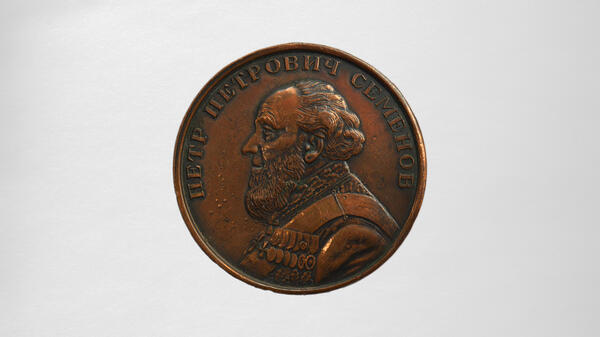
A memorial medal from the collection of the museum was cast by the Geographic Society of the USSR for 150th anniversary of the birth of Pyotr Semyonov-Tyan-Shansky. It was handed out to the participants of the celebration dedicated to the scientist’s anniversary.
The obverse of the medal fully repeats the insignia, which the Geographic Society used in the 19th century. The silver and gold medals of Pyotr Semyonov, used as a model, were established in 1898 on the occasion of the twenty-fifth anniversary of his tenure as vice-chairman of the society. They served as a symbol of “promotion of the works of primarily Russian travelers and scientists on the geographical, in the broad sense of the word, study of Russia, neighboring countries, as well as those from more distant countries related to Russia.”
In Soviet times the work of the Russian Geographic Society changed. The organization focused on relatively small regional researches and theoretical generalizations. At this time the geography of its branches has increased substantially. By 1980, there were 18 subsidiaries apart from the central branch in Leningrad.
In 1930, all awards discontinued. Only 16 years later, on the centennial anniversary of Geographic Society, they restored the awarding and presenting medals named after Pyotr Semyonov-Tyan-Shansky.
The medal has since been awarded for geographical descriptions of large parts of Russia and other countries, based on their own observations and containing independent views and conclusions, and essays on topical issues and the history of geographical studies and discoveries.
The medal has a regular circle shape with a convex rim on both sides. The obverse of the medal centers a relief portrait of Pyotr Semyonov -Tyan-Shansky, and on the circumference from left to right there is the relief inscription “Pyotr Petrovich Semyonov “. On the reverse of the medal there is the relief inscription “from the Russian Geographic Society”. The inscription is framed with a relief laurel wreath on the inner side. In the lower part are the words in two lines “Founded in 1845”.
#33
Full name: Pyotr Petrovich Semyonov Memorial Medal
Date: 1977
Technique: casting
Place: Russia
Copyright: The Museum-Estate of P. P. Semyonov-Tyan-Shansky
Dimensions: 5×5 cm
Date: 1977
Technique: casting
Place: Russia
Copyright: The Museum-Estate of P. P. Semyonov-Tyan-Shansky
Dimensions: 5×5 cm
#34
2 Krooni Banknote, Karl Baer
#35
#36
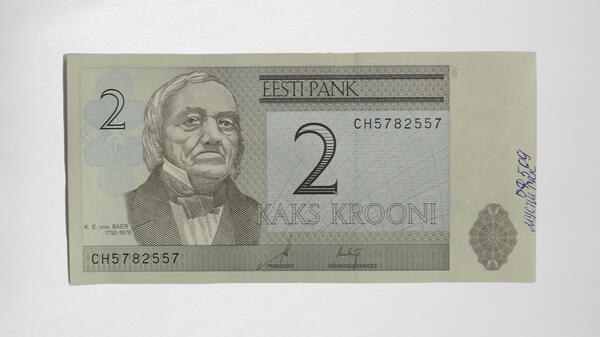
The museum’s collection includes a 2-krooni banknote with a portrait of one of the founders of the Russian Geographic Society, Karl Baer. The back side of the bill depicts the building of the University of Tartu. Karl von Baer was an outstanding geographer, traveler, anthropologist, and explorer. From 1835 to 1862 he was head of the Second Branch of the Library of the Imperial Academy of Sciences.
The scientist was born in Estlandia — the former name for the northern part of Estonia. He worked in Austria and Germany. In 1829 Baer was first invited to the St. Petersburg Academy of Sciences and moved to the Russian capital. Baer’s most valuable scientific discovery is considered to be the study of the mammalian ovum and the study of the similarities and differences between embryos in different animals.
In the summer of 1837 he made a trip to Novaya Zemlya, which none of the naturalists had visited before him. Two years later, Baer explored the islands of the Gulf of Finland, and in 1840 he visited the Kola Peninsula. At the same time, he began to publish a special journal at the Academy called ‘Materials for the Knowledge of the Russian Empire’.
Also, Baer was one of the founding fathers of the Imperial Russian Geographic Society, which was established in 1845. Geographer Pyotr Semyonov-Tyan-Shansky wrote that the idea ‘to gather and direct the best young forces for a comprehensive study of the native land, found sympathy in four circles’ — sailors, officers, academicians and scientists.
‘The idea of the necessity to establish the Geographical Society in our country had been in my mind for a long time… One evening we talked about it with Baer and Ferdinand Wrangel who was sitting at my place and de fIl en aiguille (thing led to another) we decided to make an attempt’, — wrote another founder of the society Admiral Fyodor Litke.
Karl von Baer’s major work of life was his two-volume ‘History of Animal Development’, a scientific work on embryology. The scientist also wrote many articles about the expeditions he undertook. His works also include anthropological works, such as his famous article ‘News of the Collection of Skulls of Various Peoples at the Imperial Academy of Sciences in St. Petersburg, ’ in which Baer describes the system for measuring skulls that he developed.
#37
Full name: 2 Krooni Banknote, Karl Baer
Date: 2007
Technique: typographic printing
Place: Estonia
Copyright: The Museum-Estate of P. P. Semyonov-Tyan-Shansky
Dimensions: 6,9×14 cm
Date: 2007
Technique: typographic printing
Place: Estonia
Copyright: The Museum-Estate of P. P. Semyonov-Tyan-Shansky
Dimensions: 6,9×14 cm
#38
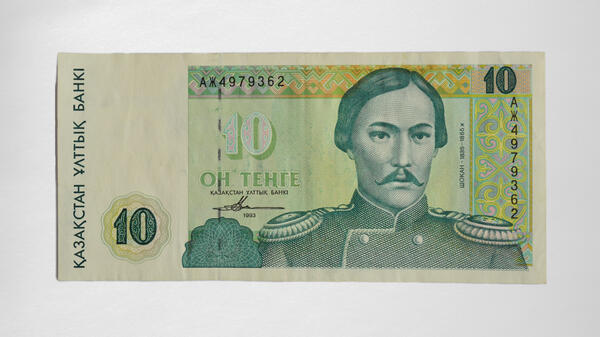
10 Tenge Banknote, Kazakhstan, Shoqan Walikhanov
#39
#40
The museum’s collection includes a 10 tenge banknote, the national currency of Kazakhstan, which was put into circulation in 1993. On the obverse there is a portrait of the traveler and scholar Shoqan Walikhanov (1835-1865). He was the first Kazakh historian, ethnographer, folklorist, orientalist, and educator.
Shoqan Walikhanov was born in 1835. At the age of 12 he enrolled in the Siberian Cadet Corps in the city of Omsk, where his main academic interests were developed. In Siberia, the young man communicated with such famous poets and writers as Fyodor Dostoevsky, Apollon Maykov, and Vasily Kurochkin. After graduation, Walikhanov served as adjutant to the governor-general of the General Government of the Steppe Region, continuing to study deeply literature, history, ethnography, and culture of the peoples of Central Asia.
In 1856-1857, Shoqan Walikhanov undertook a major research expedition to get to know the Kyrgyz people and see Issyk-Kul, the largest lake in Kyrgyzstan. During this trip, he wrote works that made him famous — ‘Essays on Dzungaria’, ‘Notes on the Kyrgyz’, ‘On the Genres of Kazakh Folk Poetry’, ‘Diary of a Trip to Issyk-Kul’, ‘Legends and Tales of the Great Kirghiz-Kaisat Horde’ and other works.
These and other texts by Walikhanov became the basis for modern understanding of Kazakh culture and literature. They were highly valued by many scientists and still have not lost their relevance. Besides, during the trip, the scientist recorded and for the first time translated into Russian fragments of the Kyrgyz epos ‘Manas, ’ which is considered an outstanding piece of folklore that is passed by word of mouth.
It is known that Pyotr Semyonov-Tyan-Shansky was acquainted with Shoqan Walikhanov. They met in Semirechye in Central Asia and discussed possible routes through that region. Also, on the recommendation of the traveler in 1857, Walikhanov became a full member of the Russian Geographical Society. Semyonov-Tyan-Shansky supported and promoted the geographical and historical research of the scientist. The flowering of scientific activity of Shoqan Walikhanov was in the late fifties and early sixties of the 19th century.
#41
Full name: 10 Tenge Banknote, Kazakhstan, Shoqan Walikhanov
Date: 1993
Technique: typographic printing
Place: Kazakhstan
Copyright: The Museum-Estate of P. P. Semyonov-Tyan-Shansky
Dimensions: 6,8×14,5 cm
Date: 1993
Technique: typographic printing
Place: Kazakhstan
Copyright: The Museum-Estate of P. P. Semyonov-Tyan-Shansky
Dimensions: 6,8×14,5 cm
#42
Ministry of Culture of the Russian Federation
read morehide
00:00
00:00
1x
Postcards, postal envelopes, medals, banknotes
Exhibition
0
 Point your smartphone camera to open in the app
Open in app
Share