Font
Color
Graphics
Изображение точки

To see AR mode in action:

1. Install ARTEFACT app for iOS or Android;

2. Find the exhibition «In the World of Fine Arts. The 20th Century»

3. Push the «Augmented reality» button and point your phone's camera at the exhibit;

Скрыть точки интересаПоказать точки интереса
Показать в высоком качестве

Autumn, Green May, Autumn Twilight

0
Open in app
#1

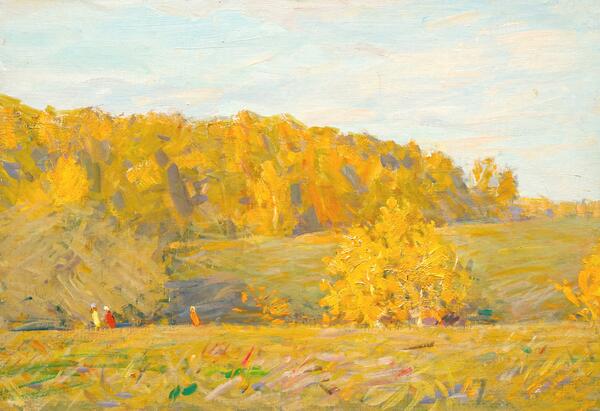
Autumn

#8

Viktor Grigorievich Tsyplakov (1915–1986) was born in the village of Burminka, now the Alexander Nevsky district of the Ryazan Oblast. He graduated from the Surikov Moscow State Art Institute. His teachers were Vasily Vasilyevich Pochitalov, Igor Emmanuilovich Grabar, Sergey Vasilyevich Gerasimov and Boris Vladimirovich Ioganson.

Later, Viktor Tsyplakov became a leading teacher and professor at this institute. He brought up several generations of painters, including Vyacheslav Nikolaevich Zabelin, Andrey Nikolaevich Makarov, Alexey Pavlovich Belykh, and Eduard Georgievich Bragovsky. Their works are also displayed at the Zavolzhsk Art Gallery.

Viktor Tsyplakov advised his students, “Surely, each of you should go and find your own themes, individual techniques, forms of expression, but remember: only that artist will find their worthy place in life who will be able to keep up with the times.”

The artist created several artistically and historically significant works: “Chapaev”, “Zoya Kosmodemyanskaya”, and “Sergey Yesenin”. Tsyplakov’s works are kept in the State Tretyakov Gallery, the State Russian Museum, and the State Historical Museum.

He entered the history of Soviet art as a master of large thematic paintings, for instance, “A.M. Gorky on the Volga” (1945) and “V.I. Lenin with the Peasants” (1959). The canvas “V.I. Lenin in Smolny” (1947) became a textbook Stalin-era example of a ceremonial portrait of a historical figure and revolutionary. He was one of the few painters who was allowed to make sketches at the funeral of Joseph Vissarionovich Stalin in 1953.

The latter period of Tsyplakov’s work is represented mainly by landscapes and portraits, a significant part of which are self-portraits. The landscape “Autumn” was painted at that time, in 1980.

In this work, lyrical intonations are combined with integrity and breadth of perception. The artist’s love of life is evident in the picture. It depicts autumn when it is especially beautiful. There is a plethora of joyful, bright yellow colors all over the canvas. Viktor Tsyplakov wrote,
#9

I love nature very much, I strive not simply to capture this or that motif, but rather to convey my own delight in it.

#4
Name: Autumn
Author: Viktor Tsyplakov
Date of creation: 1980
Place of creation: the USSR
Technique: canvas on cardboard, oil
Dimensions: 100×90 cm
№: 10500003
#2
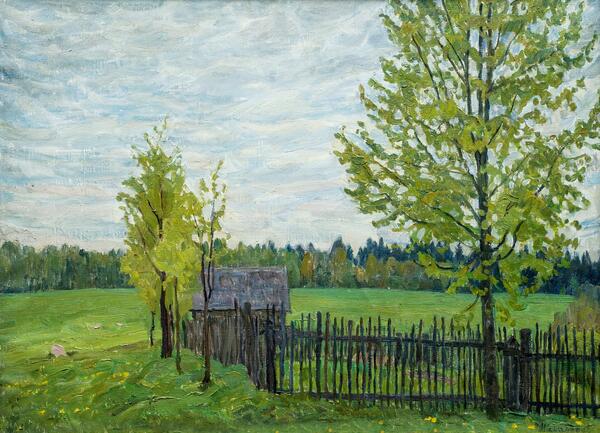
Green May
#10

Andrey Nikolaevich Makarov (1923–1987) was born in Prague, where his parents were on a business trip. In 1941, after finishing high school, he volunteered for the front. He was wounded four times and demobilized due to disability in 1945. He was awarded the Orders of the Red Star and Glory, 3rdclass, as well as other medals.

In 1946, Andrey Makarov began studying at an art studio for disabled war veterans in Moscow. However, already in 1947, he managed to enter the Surikov Moscow State Art Institute. In 1954, he took part in an exhibition of young artists.

In the 1960s, landscape became Andrey Makarov’s favorite genre. He painted mainly the Russian North, where he regularly traveled to find inspiration. The antithesis of the north was Suzdal, the views of which were much warmer.

In the 1970s and 1980s, Makarov worked a lot in other regions — near Tver and Yaroslavl. At the same time, he always retained interest in the changing states of nature, depicting a bright motif on a faded background and comprehending the formula and meaning of the Russian landscape.

In terms of his artistic principles, Andrey Makarov followed the traditions of the Moscow school of painting, which is characterized by a love of modest, unassuming subjects. Moscow painting, ever since the 19th-century landscapists and painters of the association “Union of Russian Artists”, has been distinguished by a profound psychological approach not only in the transmission of states of nature, but also in the expressions of human feelings.

Makarov’s communication of innermost feelings acquired social power. As other landscape artists of his generation who went through the Great Patriotic War in their youth, he understood the price of life.

In 1984, the landscape “Green May” was displayed at the Moscow spring exhibition. The artist loved painting this particular month. In this work, he managed to depict the dim, modest beauty of a day in May. Everything in Andrey Makarov’s canvas has fused into a single image, where human presence is invisible. The outskirts, the shed, the fence — everything speaks of the usual, measured life of people.

#5
Name: Green May
Author: Andrey Makarov
Date of creation: 1983
Place of creation: the USSR
Technique: canvas, oil
Dimensions: 60×80 cm
№: 10363789
#3
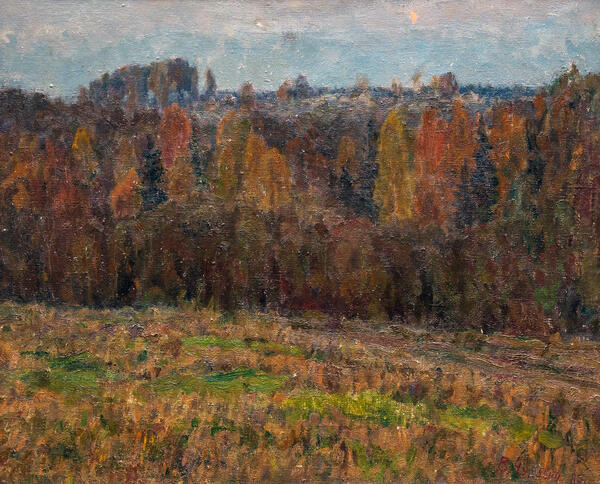
Autumn Twilight near Podol
#13

The Honored Artist of the RSFSR Viktor Nikolaevich Chulovich (1922–1994) was distinguished by the purity of his artistic vision and the ability to convey the poetry of the surrounding world through the most sophisticated shades. The artist was a prominent representative of the Moscow landscape school, an outstanding master of the “generation of the 60s”.

Viktor Chulovich had an expressive painting style. He gravitated to the so-called genre of “mood landscape”. In the pre-war period of the late 1930s, he studied in the workshop of Pyotr Ivanovich Petrovichev at the Moscow Regional Art School in Memory of 1905.

The artist Efrem Ivanovich Zverkov wrote,
#12

Viktor Nikolaevich Chulovich, as always, is extremely shy, his gaze is thoughtful. However, as you get acquainted with his works, an artist of great temperament, an intelligent person and a poet is revealed behind the external restraint.

#11

Viktor Chulovich was gravely wounded at the front. In 1943, he entered the All-Union State Institute of Cinematography (VGIK), where his teacher was Fyodor Semyonovich Bogorodsky, the founder of the local art faculty.

After graduating from VGIK, Chulovich worked as an artist’s assistant at Mosfilm, became a candidate in the Moscow Association of Artists and completely devoted himself to painting. He began traveling all around the Soviet Union.

The emotional range of his landscapes was quite wide — from thunderous tension to enlightened, peaceful poetry. In his art, Viktor Chulovich was an observer, rather than a creator.

For him, the creative process began by choosing the subject of the image and the point of view from which he was going to convey his message. Thus, he worked as if according to a ready-made sketch that was forming in his mind. His paintings organically combined the authenticity of images with compositional thoughtfulness.

The artist painted the landscape “Autumn Twilight near Podol” in 1983. The painting immerses the viewer in a closed space. One can feel the autumn season quietly coming up. In the last years of his life, Viktor Chulovich worked mainly in the Tver Oblast, near Vyshny Volochok, which inspired new themes in his work. However, in his lyrical and poetic motifs, the artist remained true to his ideals — to discover the complex in simplicity and to reveal the big world of nature through a small scene.
#6
Name: Autumn Twilight near Podol
Author: Viktor Chulovich
Date of creation: 1983
Place of creation: the USSR
Technique: canvas, oil
Dimensions: 53×64 cm
№: 10500000
#7
read morehide

Autumn, Green May, Autumn Twilight

0
Point your smartphone camera to open in the app
Share
VkontakteOdnoklassnikiTelegram
Share on my website
Copy linkCopied
Copy
Open in app
To see AR mode in action:
  1. Install ARTEFACT app for 
  2. iOS or Android;
  3. Find and download the «Paintings in Details» exhibition
  4. Push the «Augmented reality» button and point your phone's camera at the painting;
  5. Watch what happens on your phone screen whilst you flip through the pictures.
 
We use Cookies
Cookies on the Artefact Website. We use cookies to ensure that we give you the best experience on our website. If you continue without changing your settings, we'll assume that you are happy to receive all cookies on the Artefact website. However, if you would like to, you can change your cookie settings at any time.
Learn more about cookie useHide
Content is available only in Russian

X

Нашли опечатку?...

%title%%type%