#1
Weapon
#5
#6
#7
Since 1931, Soviet designers developed sniper devices mainly for semi-automatic rifles. They tested sniper versions of the Simonov automatic rifle (AVS-36), the 1930 self-loading Degtyaryov rifles, the 1938 Rukavishnikov rifle, and the Tokarev rifle (SVT-40). However, the most accurate and reliable was the 3-line Mosin rifle, model 1891/1930.
With the onset of the Great Patriotic War, the demand for sniper rifles increased. In February 1942, the production of the Mosin rifles was resumed in the USSR, while the production of the more complex and expensive SVT-40 was terminated. The all-purpose scope — the scope short-cut (PU), originally was developed for the SVT-40, and was redesigned for the 3-line rifle. The PU scope became the most mass-produced riflescope, and it was in production until the end of the war.
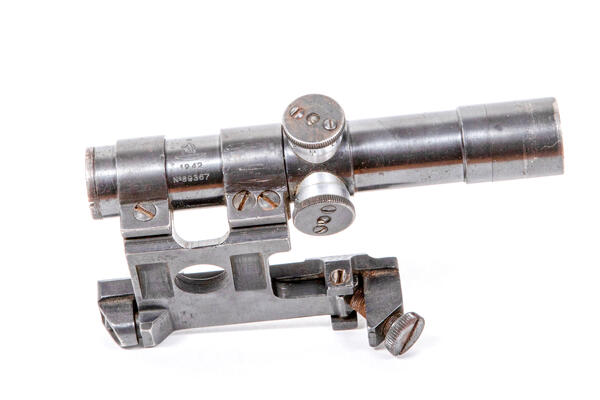
The all-purpose telescopic sight consisted of three parts: the objective lens, the body and the eyepiece. It was a black metal cylinder with the lenses inside. The main advantage of this sight over the mechanical one was that the sniper did not need to refocus one’s eye to see both the reticle and the target equally clearly.
The reticle consisted of three 0.2-millimeter crosshairs: two horizontal and one vertical. Such reticle was called the “Stump, ” or German post. To aim, one had to align the tip of the stump with the target.
The shooter measured the distance to the target with the help of the reference values — the thickness of the crosshairs and the distance between them. All measurements were made in milliradians, or mil: 10 centimeters per 100 meters. The line thickness in the all-purpose scope was 2 mil. This meant that if a 20-centimeter target in the scope aligned with the reticle line, it was 100 meters away. A man’s shoulders were conventionally taken as 70 centimeters. The gap between the side crosshairs was seven mil. If the man’s shoulders fit within this distance, then he was within 100 meters from the shooter.
By this base value, the sniper could calculate the distance to the target and aim better with the two knobs. The PU allowed the shooter to observe small and camouflaged targets at great distances and to aim in moonlight or when it was quite dark due to the great lens speed — the amount of light the optical system let in.
With the onset of the Great Patriotic War, the demand for sniper rifles increased. In February 1942, the production of the Mosin rifles was resumed in the USSR, while the production of the more complex and expensive SVT-40 was terminated. The all-purpose scope — the scope short-cut (PU), originally was developed for the SVT-40, and was redesigned for the 3-line rifle. The PU scope became the most mass-produced riflescope, and it was in production until the end of the war.
The all-purpose telescopic sight consisted of three parts: the objective lens, the body and the eyepiece. It was a black metal cylinder with the lenses inside. The main advantage of this sight over the mechanical one was that the sniper did not need to refocus one’s eye to see both the reticle and the target equally clearly.
The reticle consisted of three 0.2-millimeter crosshairs: two horizontal and one vertical. Such reticle was called the “Stump, ” or German post. To aim, one had to align the tip of the stump with the target.
The shooter measured the distance to the target with the help of the reference values — the thickness of the crosshairs and the distance between them. All measurements were made in milliradians, or mil: 10 centimeters per 100 meters. The line thickness in the all-purpose scope was 2 mil. This meant that if a 20-centimeter target in the scope aligned with the reticle line, it was 100 meters away. A man’s shoulders were conventionally taken as 70 centimeters. The gap between the side crosshairs was seven mil. If the man’s shoulders fit within this distance, then he was within 100 meters from the shooter.
By this base value, the sniper could calculate the distance to the target and aim better with the two knobs. The PU allowed the shooter to observe small and camouflaged targets at great distances and to aim in moonlight or when it was quite dark due to the great lens speed — the amount of light the optical system let in.
#8
Full name: All-Purpose 3.5×21 Scope on Kochetov Mount for Mosin Sniper Rifle Model 1891/30 Chambered in 7.62 mm
Date: 1942
Technique: factory-made
Place: USSR
Copyright: Museum Resource Center of Noyabrsk
Dimensions: 10,3×17×4 cm
Goskatalog Number: 16663706
Date: 1942
Technique: factory-made
Place: USSR
Copyright: Museum Resource Center of Noyabrsk
Dimensions: 10,3×17×4 cm
Goskatalog Number: 16663706
#9
Mosin’s Rifle
#10
#2
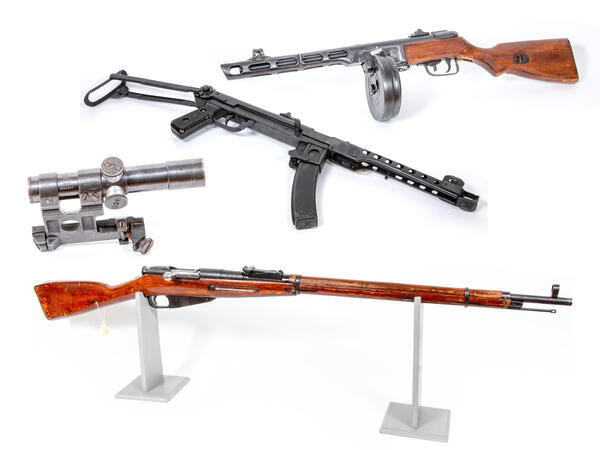
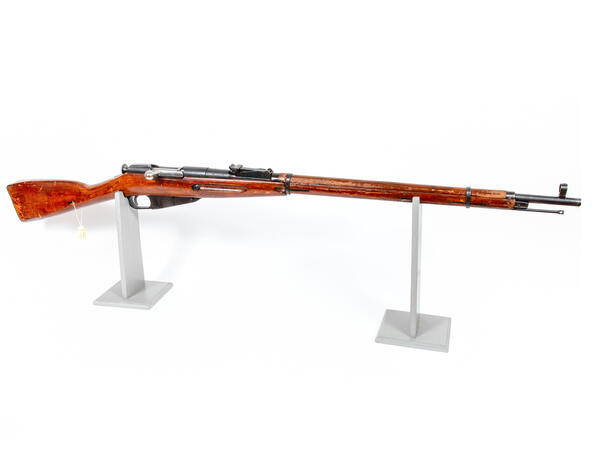
This 1891/1930 Mosin’s rifle was produced in 1943 at the Izhevsk Mechanical Plant. It was transferred to the Noyabrsk museum in 2014: it was acquired as part of the ‘Russian weaponry makers’ museum project. In order to become a museum exhibit, the service rifle had to be deactivated at a factory — a number of irreversible changes were made to all the main components of the rifle. Such weapon units are often called mass-dimensional models.
The Mosin’s Rifle was adopted by the Russian military in 1891. It is also known as the ‘3-line rifle’, as the caliber of the barrel is equal to three Russian lines. The (Russian) line is an old unit of length, equal to one tenth of an inch, or 2.54 millimeters. Thus, three lines are equal to 7.62 millimeters.
The 3-line rifle was very easy to use. Even those people who had not undergone any military training could fire this rifle. Besides, no special qualifications were required for its production. The main parts of this rifle are the barrel, the receiver, the magazine and the ejector, the trigger, the bolt, the stock, the handguard and iron sights.
Four up- and right-turning grooves are inside the barrel. They cause the bullet to spin, producing a more stable flight path. In the rear part of the barrel is a chamber where the cartridge is inserted before firing. The receiver and the bolt are screwed on tight in the back. The 4-round magazine with the feed system, the ejector and the trigger are attached to the receiver.
The interrupter separates the cartridges (that are fed from the magazine), prevents delay in feeding and expels the spent casings. The trigger mechanism of the rifle consists of a trigger blade, a trigger spring, a screw and a trigger pin. The spring also serves as the sear that holds the firearm at half-cock until the right amount of pressure is applied to fire the rifle. This rifle has a long heavy trigger pull without the ‘warning’: it does not perform in two stages, which differ in the applied pressure. With the help of the bolt, the cartridge is fed from the magazine into the chamber, and at the moment of firing, the bore closes, the rifle is fired, and then the spent shell (or a misfired cartridge) is removed.
The stock connects the parts of the weapon, it consists of a for-end, a grip and a butt. The stock was normally cut from a single piece of wood. In the early models of the rifle, the grip that was used by the rifleman to hold the weapon was straight and firm, which was more suitable for bayonet fighting rather than artillery fire. For the models produced in the 20th century, a semi-pistol grip was incorporated.
The Mosin’s Rifle was adopted by the Russian military in 1891. It is also known as the ‘3-line rifle’, as the caliber of the barrel is equal to three Russian lines. The (Russian) line is an old unit of length, equal to one tenth of an inch, or 2.54 millimeters. Thus, three lines are equal to 7.62 millimeters.
The 3-line rifle was very easy to use. Even those people who had not undergone any military training could fire this rifle. Besides, no special qualifications were required for its production. The main parts of this rifle are the barrel, the receiver, the magazine and the ejector, the trigger, the bolt, the stock, the handguard and iron sights.
Four up- and right-turning grooves are inside the barrel. They cause the bullet to spin, producing a more stable flight path. In the rear part of the barrel is a chamber where the cartridge is inserted before firing. The receiver and the bolt are screwed on tight in the back. The 4-round magazine with the feed system, the ejector and the trigger are attached to the receiver.
The interrupter separates the cartridges (that are fed from the magazine), prevents delay in feeding and expels the spent casings. The trigger mechanism of the rifle consists of a trigger blade, a trigger spring, a screw and a trigger pin. The spring also serves as the sear that holds the firearm at half-cock until the right amount of pressure is applied to fire the rifle. This rifle has a long heavy trigger pull without the ‘warning’: it does not perform in two stages, which differ in the applied pressure. With the help of the bolt, the cartridge is fed from the magazine into the chamber, and at the moment of firing, the bore closes, the rifle is fired, and then the spent shell (or a misfired cartridge) is removed.
The stock connects the parts of the weapon, it consists of a for-end, a grip and a butt. The stock was normally cut from a single piece of wood. In the early models of the rifle, the grip that was used by the rifleman to hold the weapon was straight and firm, which was more suitable for bayonet fighting rather than artillery fire. For the models produced in the 20th century, a semi-pistol grip was incorporated.
#11
Full name: Mass-Dimensional Model of M1891/30 rifle (the 3-line Mosin’s rifle)
Author: Sergey Mosin
Date: 1943
Technique: factory-made
Place: Izhevsk, Izhevsk Mechanical Plant
Copyright: Museum Resource Center of Noyabrsk
Dimensions: 10,5×123×8 cm
Date: 1943
Technique: factory-made
Place: Izhevsk, Izhevsk Mechanical Plant
Copyright: Museum Resource Center of Noyabrsk
Dimensions: 10,5×123×8 cm
Goskatalog Number: 16663685
#12
PPSh-41 Submachine Gun
#13
#3
In 1940, the People’s Commissariat of Armament of the USSR ordered a new submachine gun. It was supposed to surpass the existing machine pistol, designed by Degtyaryov and used by the Red Army, both for its advanced technical characteristics and easiness of production.
In the autumn of the same year, designers Georgy Shpagin and Boris Shpitalny submitted their designs to the commission. Both submachine guns successfully passed the field tests, but the Shpagin model had a technological advantage. It consisted of 87 parts compared to Shpitalny’s 95 parts. Most of them required the use of metal stamping for the production and no additional work, so it became five times faster to assemble the gun in the factory.
In the autumn of the same year, designers Georgy Shpagin and Boris Shpitalny submitted their designs to the commission. Both submachine guns successfully passed the field tests, but the Shpagin model had a technological advantage. It consisted of 87 parts compared to Shpitalny’s 95 parts. Most of them required the use of metal stamping for the production and no additional work, so it became five times faster to assemble the gun in the factory.
#19
The durability of the submachine gun was tested by firing 30 thousand shots. <…> At the end of the shooting, it was inspected. Its material part turned out to be in order. <…> The reliability of the automatic system under various operating conditions was checked by firing at elevation and declination angles of up to 85°, with thick lubrication of the moving parts, under dusty conditions and with its parts washed with kerosene and wiped with a rag. The ability to conduct continuous fire without cleaning the gun was determined by firing 5,000 shots…
David Bolotin. Soviet Small-Arms and Ammunition, 1995
#20
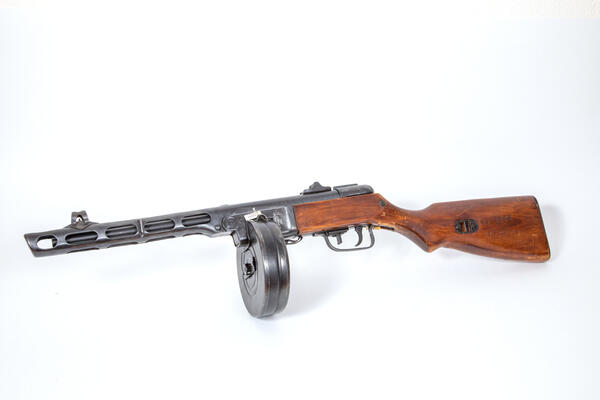
The Red Army adopted the Shpagin’s design in December 1940 under the name “Shpagin submachine gun of 1941”. The PPSh-41 became the most commonly mass-produced submachine gun of World War II.
The most common 7.62-millimeter ammunition was used for the PPSh-41. It had a 500 meters maximum range; however, the effective range was 200 meters when fired in burst, which was better than the German MP-40 submachine gun, the Finnish Suomi, and the American M3.
It had a 71-round drum magazine. For its rate of fire of 1000 rounds per minute, the PPSh-41 was nicknamed “ammunition eater”. Due to the high rate of fire, shooters quickly ran out of ammunition, which also caused severe overheating of the barrel, but the density of fire gave the shooter a significant advantage in close combat.
The Wehrmacht, the SS, and other paramilitary units of Germany adopted the Shpagin submachine gun under the name Maschinenpistole 717®, and in 1944 the Third Reich began to modify the PPSh-41 for the 9×19mm Parabellum cartridge and managed to produce about 10,000 units of this small arms.
The most common 7.62-millimeter ammunition was used for the PPSh-41. It had a 500 meters maximum range; however, the effective range was 200 meters when fired in burst, which was better than the German MP-40 submachine gun, the Finnish Suomi, and the American M3.
It had a 71-round drum magazine. For its rate of fire of 1000 rounds per minute, the PPSh-41 was nicknamed “ammunition eater”. Due to the high rate of fire, shooters quickly ran out of ammunition, which also caused severe overheating of the barrel, but the density of fire gave the shooter a significant advantage in close combat.
The Wehrmacht, the SS, and other paramilitary units of Germany adopted the Shpagin submachine gun under the name Maschinenpistole 717®, and in 1944 the Third Reich began to modify the PPSh-41 for the 9×19mm Parabellum cartridge and managed to produce about 10,000 units of this small arms.
#14
Full name: Mass-Dimensional Model of Shpagin Submachine Gun of the late 1941 Variant (PPSh-41). Deactivated
Date: 1944
Technique: factory-made
Place: USSR
Copyright: Museum Resource Center of Noyabrsk
Dimensions: 12×84×6,5 cm; caliber — 7,62 mm
Goskatalog Number: 16663696
Date: 1944
Technique: factory-made
Place: USSR
Copyright: Museum Resource Center of Noyabrsk
Dimensions: 12×84×6,5 cm; caliber — 7,62 mm
Goskatalog Number: 16663696
#15
Sudayev Submachine Gun
#16
#4
The history of the submachine gun as a type of weapon began during the Great Patriotic War. The Shpagin submachine gun (PPSh-41), effective in combat and very easy to produce, was in service with the Red Army since 1941. However, due to its large size and weight, soldiers in narrow trenches and small quarters during urban warfare could not effectively use it. The PPSh-41 was too cumbersome for scouts, paratroopers, and tank crews.
In 1942, the People’s Commissariat of Armament of the USSR announced a competition to design a lighter, more compact, and cheaper submachine gun, but with the same characteristics as the Shpagin one. The prototype designed by Alexey Sudayev won the contest. By the end of that year, it was accepted into service and put into production at the Sestroretsk weapons factory in Leningrad under the name ‘Sudayev submachine gun of 1942’ (the PPS-42). In 1943, an upgraded version — the PPS-43, lighter and more compact — went into production.
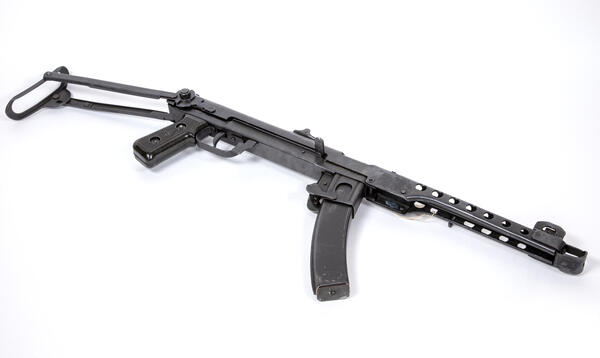
The Sudayev submachine gun consisted of a riffled barrel, a stamped steel receiver welded to the barrel shroud, a grip, and a shoulder stock. It came with a 35-cartridge box magazine. The weight of the PPS-43 with full ammunition — six loaded cartridge boxes — was 6.72 kilograms.
The Sudayev submachine gun is an automatic blowback-operated weapon that fires from an open bolt. The trigger was designed to fire in burst only, but at a low rate of fire, it was possible to fire single shots or in quick bursts of 2-3 shots in a row. The bullet fired from the PPS-43 was still lethal at ranges of up to 800 meters. It was possible to aim at a distance of up to 300 meters.
The Sudayev submachine gun was produced in the USSR from 1943 to 1945, but it was significantly inferior to the PPSh-41. Many factories had already set up mass production of the Shpagin submachine gun, and it was very expensive to change the technological processes. In just two years about 500,000 units of PPS-43 were produced.
The displayed PPS-43 was made in 1944. In 2014, the museum acquired its mass-dimensional model in 2014 as part of the ‘Russian weaponry makers’ museum project. It is deactivated.
In 1942, the People’s Commissariat of Armament of the USSR announced a competition to design a lighter, more compact, and cheaper submachine gun, but with the same characteristics as the Shpagin one. The prototype designed by Alexey Sudayev won the contest. By the end of that year, it was accepted into service and put into production at the Sestroretsk weapons factory in Leningrad under the name ‘Sudayev submachine gun of 1942’ (the PPS-42). In 1943, an upgraded version — the PPS-43, lighter and more compact — went into production.
The Sudayev submachine gun consisted of a riffled barrel, a stamped steel receiver welded to the barrel shroud, a grip, and a shoulder stock. It came with a 35-cartridge box magazine. The weight of the PPS-43 with full ammunition — six loaded cartridge boxes — was 6.72 kilograms.
The Sudayev submachine gun is an automatic blowback-operated weapon that fires from an open bolt. The trigger was designed to fire in burst only, but at a low rate of fire, it was possible to fire single shots or in quick bursts of 2-3 shots in a row. The bullet fired from the PPS-43 was still lethal at ranges of up to 800 meters. It was possible to aim at a distance of up to 300 meters.
The Sudayev submachine gun was produced in the USSR from 1943 to 1945, but it was significantly inferior to the PPSh-41. Many factories had already set up mass production of the Shpagin submachine gun, and it was very expensive to change the technological processes. In just two years about 500,000 units of PPS-43 were produced.
The displayed PPS-43 was made in 1944. In 2014, the museum acquired its mass-dimensional model in 2014 as part of the ‘Russian weaponry makers’ museum project. It is deactivated.
#17
Full name: Mass-Dimensional Model of Sudayev Submachine Gun of 1943 Variant (PPS-43). Deactivated
Date: 1944
Technique: factory-made
Place: USSR
Copyright: Museum Resource Center of Noyabrsk
Dimensions: 16,5×82×6,3 cm; caliber — 7,62 mm
Goskatalog Number: 16663670
Date: 1944
Technique: factory-made
Place: USSR
Copyright: Museum Resource Center of Noyabrsk
Dimensions: 16,5×82×6,3 cm; caliber — 7,62 mm
Goskatalog Number: 16663670
#18
Ministry of Culture of the Russian Federation
read morehide
00:00
00:00
1x
0
 Point your smartphone camera to open in the app
Open in app
Share