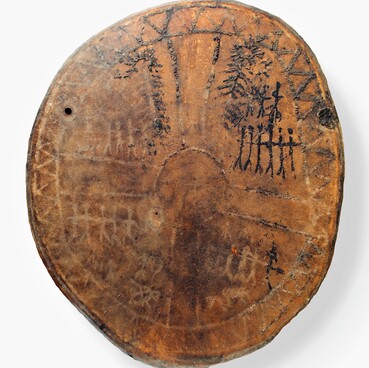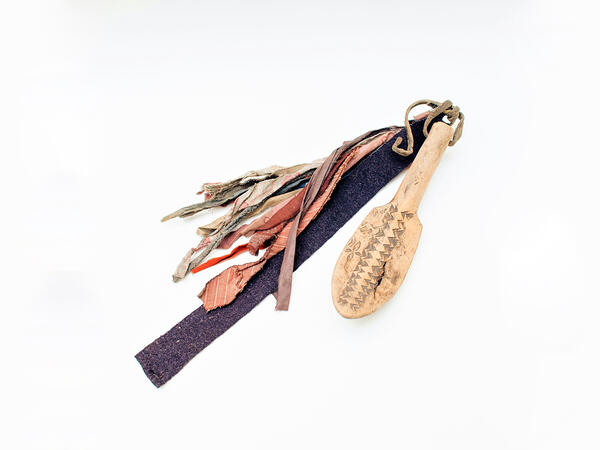
An orba is a beater for a shaman’s tambourine and is one of the important attributes of shamanism. It was usually made of birch or juniper. Its handle was covered with a hide of the same animal as the tambourine itself. As a rule, kamus, skin taken from the lower part of a horse leg, was used for this purpose.
Traditionally, the orba was made in the form of a spoon. A bear or a mountain goat hide was used for its front convex side (orbanyn arny).
The reverse side of the beater (orbanyn arty) was almost flat. Four rattling rings were fastened to it, and it was painted with ornaments. Sometimes the orba was decorated with coins instead of rings.
The beater’s handle (orbanyn tudazy) had an ildirge — a special loop of white material, which was put on a finger. Also braided laces and ribbons — chaloma — could be tied to the handle.
Each shaman had their own way of making the orba. It was believed that spirits told shamans how to make it. Therefore, shamans could choose from different types of wood — for example, bird cherry, pine, or cedar. Some of the beaters featured a schematic image of the world tree, and others depicted a bird with outstretched wings.
An ethnographer and language expert Elena Prokofyeva gave the most detailed description of the shamanic beater in her works,
Traditionally, the orba was made in the form of a spoon. A bear or a mountain goat hide was used for its front convex side (orbanyn arny).
The reverse side of the beater (orbanyn arty) was almost flat. Four rattling rings were fastened to it, and it was painted with ornaments. Sometimes the orba was decorated with coins instead of rings.
The beater’s handle (orbanyn tudazy) had an ildirge — a special loop of white material, which was put on a finger. Also braided laces and ribbons — chaloma — could be tied to the handle.
Each shaman had their own way of making the orba. It was believed that spirits told shamans how to make it. Therefore, shamans could choose from different types of wood — for example, bird cherry, pine, or cedar. Some of the beaters featured a schematic image of the world tree, and others depicted a bird with outstretched wings.
An ethnographer and language expert Elena Prokofyeva gave the most detailed description of the shamanic beater in her works,