Cordaites are a completely extinct group of fossil plants. Their lifetime, dating from the remains of giants in extinct forests, extends from the Carboniferous period to the end of the Permian period of the Paleozoic era. Their powerful foliage rustled as much as 250 million years ago.
At that time, the Earth’s atmosphere was rich in oxygen, its level reaching 35%. This is because outdated trees did not decompose or release carbon dioxide, but remained undecayed in warm marshes. Microorganisms did not yet produce enzymes that destroy wood without residue. Fossil plants turned into mineral coal which is now used for fuel.
The only chance for a plant to see sunlight again, even as a fossil, was to fall into water and lie in it without oxygen, completely immersed in silt, for millions of years, to be buried under volcanic ash.
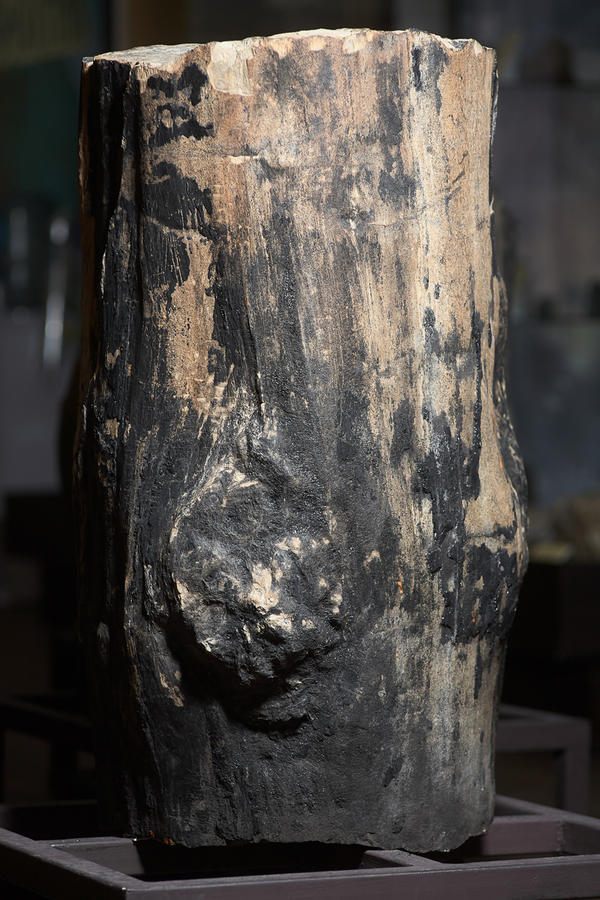
Cordaites got their name in honor of Czech paleobotanist A. Cord. Cordaite trunk reached 30 meters in length, although fossilized specimens are far less impressive. These plants were the highest trees of the Carbon and Perm period. They had a powerful core, which, like modern walnut, had constrictions. Such a structure contributed to the rapid destruction of the nucleus, and the formed cavity began to fill with rock.
The smooth cordaite bark is well developed; the branches bear traces of huge, spirally arranged leathery leaves of elliptical, linear, rhomboid or lanceolate shape with a solid edge. A leaf could reach 20 cm in thickness with a meter length.
Between the leaves, the tree’s reproductive organs were located, ament-shaped cones clustered together in loose brushes. Judging by them, cordaites belonged to wind-pollinated plants.
Cordaites were unpretentious and perfectly adapted to environmental conditions. Some species grew in moist marshy places, where the bulk of the foliage was buried, or in dry elevated areas, from where, at the time of intensification of erosion, their parts were carried away and deposited together with sedimentary material. These trees have much in common with ginkgo and conifers, but their development most likely went in parallel.
The laterally flattened heart-shaped seeds ranged in size from a few millimeters to two centimeters. In some species, they were winged.
Cordaites were widely distributed across Europe, Africa, Asia and Hindustan. In Russia, the most abundant deposits of fossil remains are located in the Kuzbass region: in the Permian period, plants reached the culmination of their heyday there. Entire layers are found that are completely composed of leaves stacked on top of each other.
Upon impact, this material splits into very thin plates with clear prints. Apparently, these clusters were formed on the site of the ancient cordaite taiga which covered large areas. Falling leaves and wood served the basis for the formation of coal for a long time.
At that time, the Earth’s atmosphere was rich in oxygen, its level reaching 35%. This is because outdated trees did not decompose or release carbon dioxide, but remained undecayed in warm marshes. Microorganisms did not yet produce enzymes that destroy wood without residue. Fossil plants turned into mineral coal which is now used for fuel.
The only chance for a plant to see sunlight again, even as a fossil, was to fall into water and lie in it without oxygen, completely immersed in silt, for millions of years, to be buried under volcanic ash.
Cordaites got their name in honor of Czech paleobotanist A. Cord. Cordaite trunk reached 30 meters in length, although fossilized specimens are far less impressive. These plants were the highest trees of the Carbon and Perm period. They had a powerful core, which, like modern walnut, had constrictions. Such a structure contributed to the rapid destruction of the nucleus, and the formed cavity began to fill with rock.
The smooth cordaite bark is well developed; the branches bear traces of huge, spirally arranged leathery leaves of elliptical, linear, rhomboid or lanceolate shape with a solid edge. A leaf could reach 20 cm in thickness with a meter length.
Between the leaves, the tree’s reproductive organs were located, ament-shaped cones clustered together in loose brushes. Judging by them, cordaites belonged to wind-pollinated plants.
Cordaites were unpretentious and perfectly adapted to environmental conditions. Some species grew in moist marshy places, where the bulk of the foliage was buried, or in dry elevated areas, from where, at the time of intensification of erosion, their parts were carried away and deposited together with sedimentary material. These trees have much in common with ginkgo and conifers, but their development most likely went in parallel.
The laterally flattened heart-shaped seeds ranged in size from a few millimeters to two centimeters. In some species, they were winged.
Cordaites were widely distributed across Europe, Africa, Asia and Hindustan. In Russia, the most abundant deposits of fossil remains are located in the Kuzbass region: in the Permian period, plants reached the culmination of their heyday there. Entire layers are found that are completely composed of leaves stacked on top of each other.
Upon impact, this material splits into very thin plates with clear prints. Apparently, these clusters were formed on the site of the ancient cordaite taiga which covered large areas. Falling leaves and wood served the basis for the formation of coal for a long time.