

#1
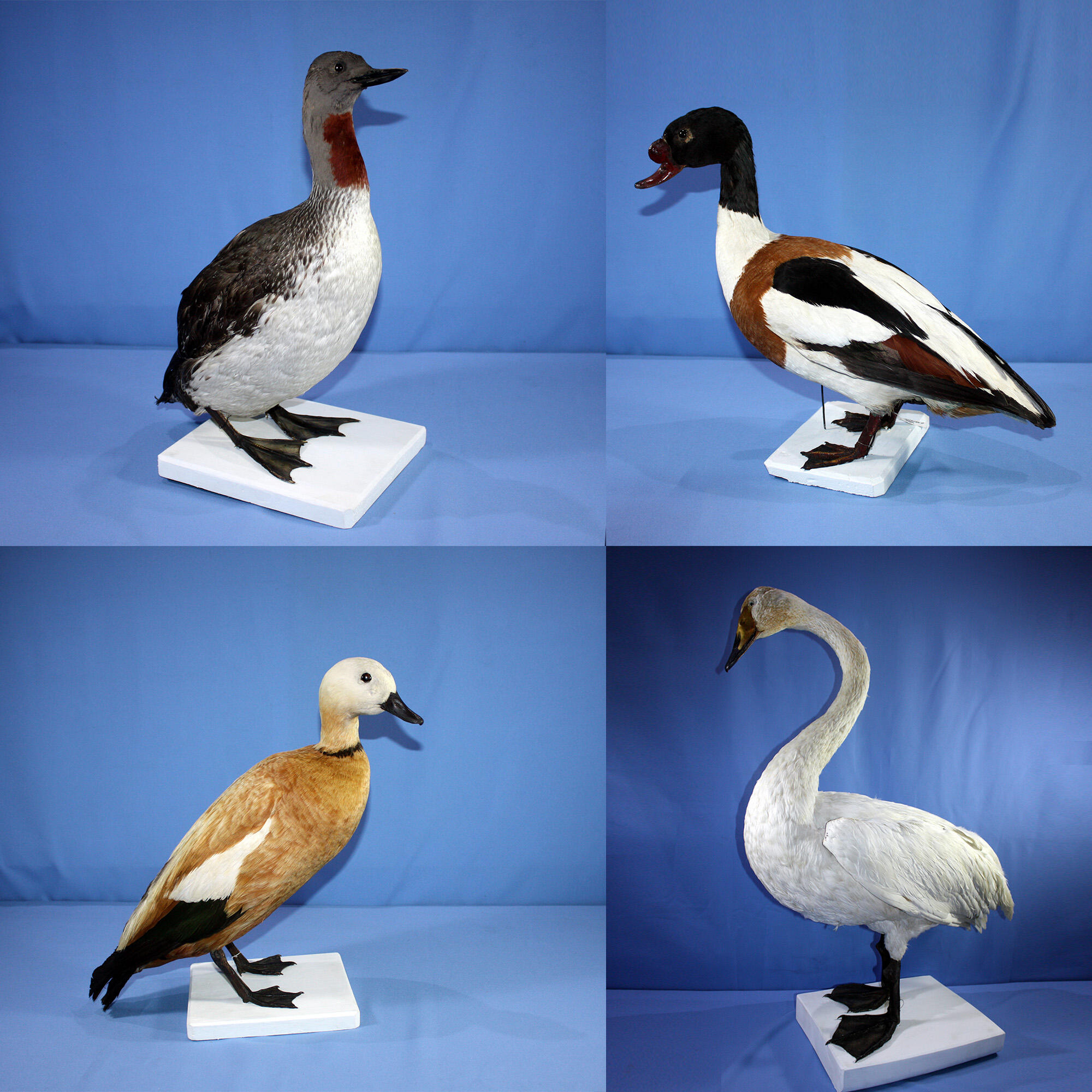
Ruddy shelduck, Shelduck, Red-throated loon, Swan
#2
#3
#4
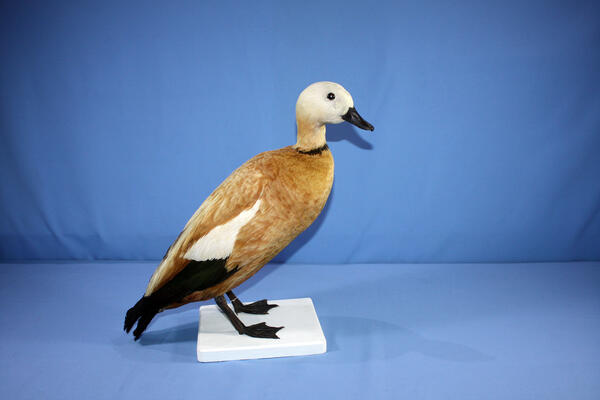
The ruddy shelduck is easily recognized by the characteristic bright red color of the plumage. It looks more like a goose than a duck. Its body length is over 60 centimeters, and its body weight is up to 1.5 kilograms. It settles near a variety of reservoirs, but for recreation and nesting, it can choose places far enough from the water. Nests of birds are arranged in burrows of steppe animals, cracks of banks, and hollows of trees.
Ruddy shelduck do not form large flocks, thus preferring to live in pairs or in small groups of 2-4 pairs. The birds are considered monogamous and are able to keep a pair for several years. Moreover, the female chooses the male attracting its attention with screams and peculiar dances with an open beak around the cock duck. The latter can only stand on one leg, thus stretching its neck, lowering its head and dragging the wings, or walking around the female.
In food, this duck is unpretentious. It is able to get food both in water and on land. The basis of its diet is greens, such as grass, shoots, seeds, and cereals. Ducks also eat large grasshoppers, locusts, small fish, frogs, shellfish, and crustaceans. However, in the absence of live food, they do very well with vegetation. In the fields at the end of summer, ducks pick up the grains left after harvesting. In the daytime, birds usually rest in the water or on the banks of reservoirs, and at dawn and in the evening they go out to eat. Ruddy shelduck can often be seen sleeping while standing on one leg and digesting the eaten food.
The bird is characterized by aggressive behavior in reservoirs, thus driving away other ducks, and females arrange squabbles with cock ducks of their own species. The aggressive nature of these birds is especially evident during the breeding season.
Mongol-speaking peoples especially revere the ruddy shelduck. The ancient ban on its hunting is considered indisputable. The bright plumage of the bird resembles the dress of Buddhist monks in color, which is why it is popularly called ‘lam shuvuu’, i.e. ‘lama bird’.
In Western Europe, ruddy shelduck are bred for decorative purposes. But this duck is valued not only for its elegance. Ruddy shelduck grown on a farmstead differs from wild relatives in its weight. It can reach 6 kg in males and up to 4 kg in females. In addition, the feathers and down of ruddy shelduck are of special value. Duck down stands out by its softness and has excellent thermal insulation qualities. Warm and weightless feathers are used for the production of blankets and winter clothing.
Ruddy shelduck do not form large flocks, thus preferring to live in pairs or in small groups of 2-4 pairs. The birds are considered monogamous and are able to keep a pair for several years. Moreover, the female chooses the male attracting its attention with screams and peculiar dances with an open beak around the cock duck. The latter can only stand on one leg, thus stretching its neck, lowering its head and dragging the wings, or walking around the female.
In food, this duck is unpretentious. It is able to get food both in water and on land. The basis of its diet is greens, such as grass, shoots, seeds, and cereals. Ducks also eat large grasshoppers, locusts, small fish, frogs, shellfish, and crustaceans. However, in the absence of live food, they do very well with vegetation. In the fields at the end of summer, ducks pick up the grains left after harvesting. In the daytime, birds usually rest in the water or on the banks of reservoirs, and at dawn and in the evening they go out to eat. Ruddy shelduck can often be seen sleeping while standing on one leg and digesting the eaten food.
The bird is characterized by aggressive behavior in reservoirs, thus driving away other ducks, and females arrange squabbles with cock ducks of their own species. The aggressive nature of these birds is especially evident during the breeding season.
Mongol-speaking peoples especially revere the ruddy shelduck. The ancient ban on its hunting is considered indisputable. The bright plumage of the bird resembles the dress of Buddhist monks in color, which is why it is popularly called ‘lam shuvuu’, i.e. ‘lama bird’.
In Western Europe, ruddy shelduck are bred for decorative purposes. But this duck is valued not only for its elegance. Ruddy shelduck grown on a farmstead differs from wild relatives in its weight. It can reach 6 kg in males and up to 4 kg in females. In addition, the feathers and down of ruddy shelduck are of special value. Duck down stands out by its softness and has excellent thermal insulation qualities. Warm and weightless feathers are used for the production of blankets and winter clothing.
#5
Полное наименование: Ruddy shelduck (Tadorna ferruginea Pall.)
Автор: Pilman Eduard Petrovich
Дата создания: 1939
Техника: Combined method
Место создания: Ulan-Ude
Размеры: 40×18×41.5 cm
Коллекция: Natural science
Автор: Pilman Eduard Petrovich
Дата создания: 1939
Техника: Combined method
Место создания: Ulan-Ude
Размеры: 40×18×41.5 cm
Коллекция: Natural science
#6
Shelduck
#7
#8
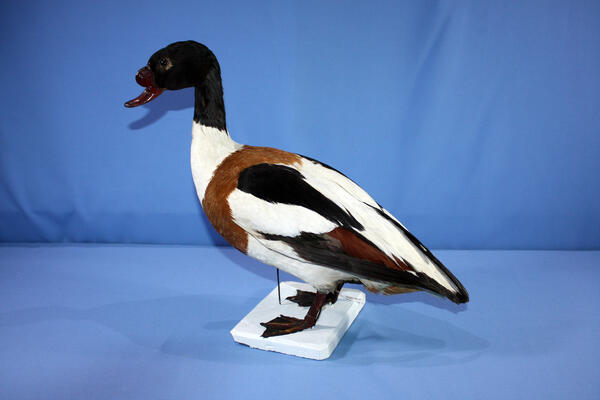
In the taxonomy, shelduck occupy an intermediate position between geese and ducks, and the appearance and behavior resemble both of these groups of birds. Shelduck are considered very ancient and primitive form of ducks. The first description of shelduck was made by the Swedish naturalist Carl Linnaeus in 1758. The common name of shelduck and similar ruddy shelduck, the so-called ‘earth ducks’, arose in connection with their tendency to nest in burrows, earthen niches, and rock crevices. In total, there are only 3 species of these birds in the world, namely: the common shelduck, the radjah shelduck, and the crested shelduck, while the latter is most likely already extinct.
Shelduck live in salty and slightly salty waters, such as river mouths and sea coasts. In the interior, they settle along the shores of lakes, most often salt - water, and less often - fresh.
Shelduck spend a lot of time on the shore. They move easily and quickly on the ground, unlike most ducks, and can even run. Their torso is held horizontally. The basis of the shelduck’s diet is animal feed, such as small crustaceans, mollusks, aquatic insects, and their larvae, sometimes small fish. The feed composition may vary depending on the habitat area.
The flight is direct, slower than that of other ducks, with occasional wing flaps. A flock of shelduck is usually held in a wedge or an expanded front. These birds are good swimmers, but they hardly dive, except for chicks or injured birds.
Shelduck live up to 15 years. In nature, their enemies are foxes, jackals, minks, otters, and wild cats, which hunt both adult birds and young ones. Kites, harriers, and hawks threaten shelduck in the sky. For small chicks, gulls and crows can be dangerous.
The shelduck is a “talkative” bird, with vocalization noticeably different in females and males. In spring, the cock-duck makes a high-pitched whistle, often on the fly in pursuit of the female. Another characteristic cry of the male is a muffled two-syllable “ga-ga” repeated several times. The female has a low, muffled quack made repeatedly, including in the air. In this case, the female can utter up to 12 syllables (“ga-ga”) per second, which creates a trill effect. The disturbed female shouts its “ga-ga” loudly and uproariously.
Shelduck live in salty and slightly salty waters, such as river mouths and sea coasts. In the interior, they settle along the shores of lakes, most often salt - water, and less often - fresh.
Shelduck spend a lot of time on the shore. They move easily and quickly on the ground, unlike most ducks, and can even run. Their torso is held horizontally. The basis of the shelduck’s diet is animal feed, such as small crustaceans, mollusks, aquatic insects, and their larvae, sometimes small fish. The feed composition may vary depending on the habitat area.
The flight is direct, slower than that of other ducks, with occasional wing flaps. A flock of shelduck is usually held in a wedge or an expanded front. These birds are good swimmers, but they hardly dive, except for chicks or injured birds.
Shelduck live up to 15 years. In nature, their enemies are foxes, jackals, minks, otters, and wild cats, which hunt both adult birds and young ones. Kites, harriers, and hawks threaten shelduck in the sky. For small chicks, gulls and crows can be dangerous.
The shelduck is a “talkative” bird, with vocalization noticeably different in females and males. In spring, the cock-duck makes a high-pitched whistle, often on the fly in pursuit of the female. Another characteristic cry of the male is a muffled two-syllable “ga-ga” repeated several times. The female has a low, muffled quack made repeatedly, including in the air. In this case, the female can utter up to 12 syllables (“ga-ga”) per second, which creates a trill effect. The disturbed female shouts its “ga-ga” loudly and uproariously.
#9
Полное наименование: Shelduck in spring dress (Tadorna tadorna L.)
Дата создания: 1950
Размеры: 42×17×36 cm
Коллекция: Natural science
Место создания: Buryatia
Техника: Combined method
Дата создания: 1950
Размеры: 42×17×36 cm
Коллекция: Natural science
Место создания: Buryatia
Техника: Combined method
#10
Red-throated loon
#11
#12
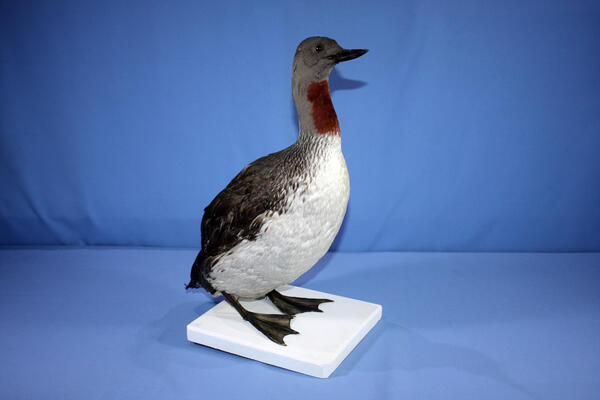
This is the smallest of the loons, which is slightly larger than the mallard. Its body length is up to 70 centimeters, wingspan is up to 116 centimeters, and body weight does not exceed 2.5 kilograms. On the front side of its neck, there is a large red spot, which gave the bird its name. It has a slender build with a small head and a thin, slightly upturned beak. As a rule, it usually nests on small lakes located mainly a few kilometers from large water spaces, where adult birds fly to feed and get food for chicks. In May or June, it lays 2 eggs of olive or brown color with dark spots. Both parents participate in incubation.
its voice is compared to a cat’s meow. Sometimes it makes sounds similar to the cries of a collared turtledove. Unlike other types of loons, the red-throated loon takes off quickly, almost without running, and in case of danger, it is often saved in this way.
In the myths of many Northern peoples, the loon is an important character. According to the legends of the Evenki people, in ancient times there was no land, and everything around was occupied by water. Then God asked the loon bird: “Dive under the water, and maybe you will find the earth!”. For three days, the bird has been under water, and when it came up, there was a small lump of earth in its beak. The bird flew up and put the piece on a high place so that the overflowing water could not flood it. Then it dived again, took out a rock, and pressed it against the ground to keep it from crumbling. The land began to grow and expand, thus getting bigger and bigger. Then the bird flapped its wing, and the sun appeared. The sun’s rays quickly dried up the land, and it became habitable. Therefore, the Evenks revere this bird and believe that it was the loon who created the world and the Earth. They often depict it on different subjects, for example, on kapturga being the pouch of tobacco, on their shoes, and other products.
It feeds mainly on fish, which it catches near the surface of the water or in the thickness by diving to a depth of 10 meters. At the same time, it can be under water for about a minute. It often stands upright on the surface of the water, thus flapping its wings, and willingly swims on its side and even belly up. Under water, it swims by working with their feet and sometimes helping itself with movements of the wings.
its voice is compared to a cat’s meow. Sometimes it makes sounds similar to the cries of a collared turtledove. Unlike other types of loons, the red-throated loon takes off quickly, almost without running, and in case of danger, it is often saved in this way.
In the myths of many Northern peoples, the loon is an important character. According to the legends of the Evenki people, in ancient times there was no land, and everything around was occupied by water. Then God asked the loon bird: “Dive under the water, and maybe you will find the earth!”. For three days, the bird has been under water, and when it came up, there was a small lump of earth in its beak. The bird flew up and put the piece on a high place so that the overflowing water could not flood it. Then it dived again, took out a rock, and pressed it against the ground to keep it from crumbling. The land began to grow and expand, thus getting bigger and bigger. Then the bird flapped its wing, and the sun appeared. The sun’s rays quickly dried up the land, and it became habitable. Therefore, the Evenks revere this bird and believe that it was the loon who created the world and the Earth. They often depict it on different subjects, for example, on kapturga being the pouch of tobacco, on their shoes, and other products.
#13
Полное наименование: Red-throated loon (Gavia stellata L.)
Автор: Pilman Eduard Petrovich
Дата создания: 1938
Техника: Soft padding
Место создания: Ulan-Ude
Размеры: 19.5×34×42 cm
Коллекция: Natural science
Автор: Pilman Eduard Petrovich
Дата создания: 1938
Техника: Soft padding
Место создания: Ulan-Ude
Размеры: 19.5×34×42 cm
Коллекция: Natural science
#14
Whooper swan
#15
#16
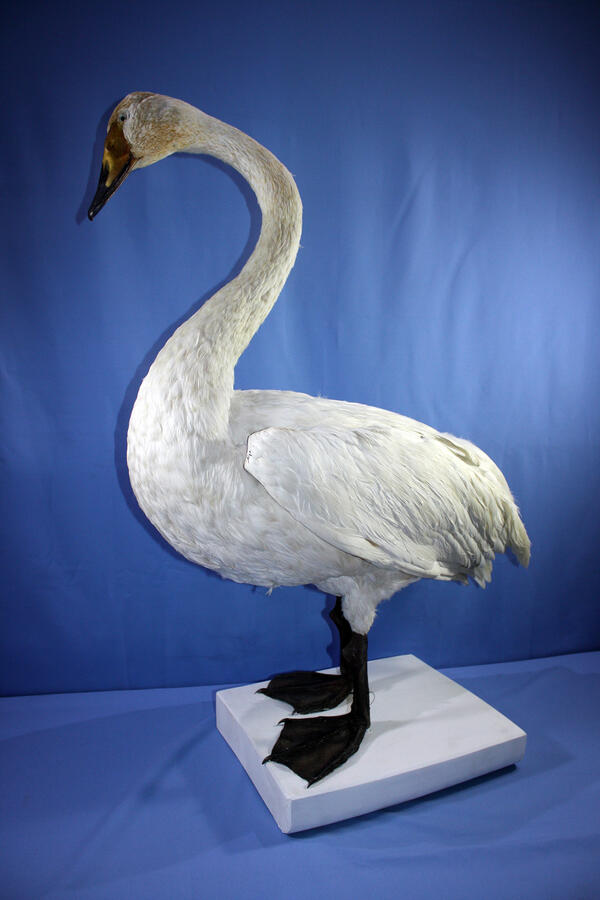
It is a rare, migratory, nesting bird. An adult can weigh up to 14 kilograms, and its wingspan reaches more than 2 meters. The swan got its name for its characteristic loud, trumpet calls, which it often emits in flight.
For nesting, the swan prefers large lakes overgrown with high vegetation, as well as remote forest lakes and river oxbow lakes. The whooper swan spends most of its life in the water. When swimming, it keeps the neck straight without bending it in the form of the letter S. They swim slowly and proudly, but in case of danger they can move very quickly.
If the whooper swan is startled, it begins to move away from the pursuer at a great speed, so that it is difficult to catch up even on a boat. From the water, the bird takes off with a long run by flapping its wings heavily and pushing its legs off the surface. Predators do not often attack whooper swans, since these birds are quite large and have great physical strength. Thus, one blow of their wings can break a child’s arm.
These graceful birds have always attracted the attention of people. Swans became heroes of legends and fairy tales, songs and poems were composed about them, and today the swan is considered a symbol of love and loyalty.
Indeed, the swan is a monogamous bird and, having found a partner, stays with it for the rest of its life. Swans do everything together, namely: get food, make flights, hatch, and raise chicks. These brave and strong birds will protect their offspring to the end using their beak and wings actively.
Whooper swans are almost omnivorous. They feed on aquatic plants, small fish, crustaceans, and mollusks. While on the ground, they eat herbs, cereals, seeds, berries, insects, and worms.
Unfortunately, swans have become a popular object of hunting and were almost on the verge of extinction. To preserve the population of swans, hunting them was officially banned, and they themselves were listed in the Red Books in many countries. In addition, swans were kept in city parks. Such measures have produced positive results.
Buryat tribes Hori and Khongodory derive their origin from this bird, thought it was their totem. According to the legend, a brave hunter Horiday took a wife of the heavenly swan maiden by a trick, thus hiding her clothes when she was bathing in the lake. When the children grew up, the heavenly wife still flew into the smoke hole of the yurt. They had 11 sons, from whom there were 11 Khoriny clans. Since then, the Buryats have revered the swan and considered it a sacred bird.
For nesting, the swan prefers large lakes overgrown with high vegetation, as well as remote forest lakes and river oxbow lakes. The whooper swan spends most of its life in the water. When swimming, it keeps the neck straight without bending it in the form of the letter S. They swim slowly and proudly, but in case of danger they can move very quickly.
If the whooper swan is startled, it begins to move away from the pursuer at a great speed, so that it is difficult to catch up even on a boat. From the water, the bird takes off with a long run by flapping its wings heavily and pushing its legs off the surface. Predators do not often attack whooper swans, since these birds are quite large and have great physical strength. Thus, one blow of their wings can break a child’s arm.
These graceful birds have always attracted the attention of people. Swans became heroes of legends and fairy tales, songs and poems were composed about them, and today the swan is considered a symbol of love and loyalty.
Indeed, the swan is a monogamous bird and, having found a partner, stays with it for the rest of its life. Swans do everything together, namely: get food, make flights, hatch, and raise chicks. These brave and strong birds will protect their offspring to the end using their beak and wings actively.
Whooper swans are almost omnivorous. They feed on aquatic plants, small fish, crustaceans, and mollusks. While on the ground, they eat herbs, cereals, seeds, berries, insects, and worms.
Unfortunately, swans have become a popular object of hunting and were almost on the verge of extinction. To preserve the population of swans, hunting them was officially banned, and they themselves were listed in the Red Books in many countries. In addition, swans were kept in city parks. Such measures have produced positive results.
Buryat tribes Hori and Khongodory derive their origin from this bird, thought it was their totem. According to the legend, a brave hunter Horiday took a wife of the heavenly swan maiden by a trick, thus hiding her clothes when she was bathing in the lake. When the children grew up, the heavenly wife still flew into the smoke hole of the yurt. They had 11 sons, from whom there were 11 Khoriny clans. Since then, the Buryats have revered the swan and considered it a sacred bird.
#17
Коллекция: Natural science
Место создания: Ulan-Ude
Полное наименование: Whooper swan (Cygnus cygnus L.)
Автор: Pilman Eduard Petrovich
Дата создания: 1939
Техника: Combined method
Размеры: 81×28×95 cm
Место создания: Ulan-Ude
Полное наименование: Whooper swan (Cygnus cygnus L.)
Автор: Pilman Eduard Petrovich
Дата создания: 1939
Техника: Combined method
Размеры: 81×28×95 cm
#18
National Museum of the Republic of Buryatia
read morehide
00:00
00:00
1x
Ruddy shelduck, Shelduck, Red-throated loon,Swan
Exhibition
1
 Point your smartphone camera to open in the app
Open in app
Share