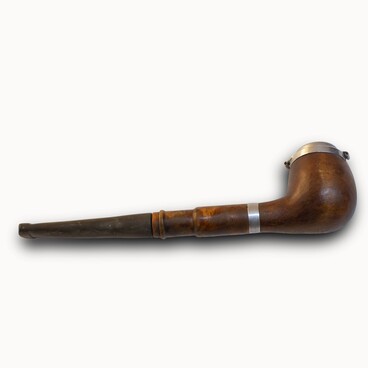
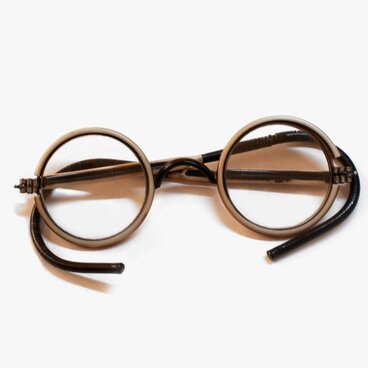
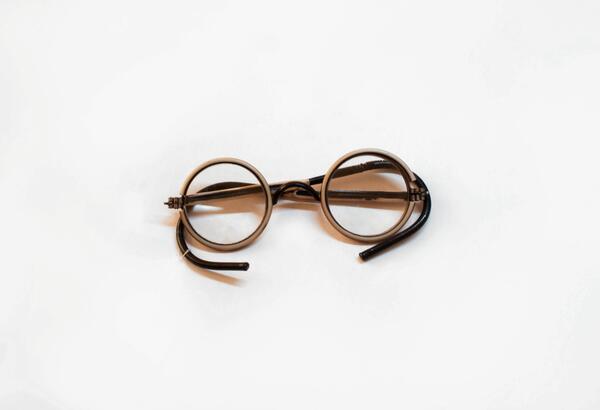
After turning 60, Pavel Petrovich Bazhov’s eyesight began to rapidly deteriorate. It was quite depressing for the writer, who received a lot of letters and was used to going on business trips, intensively reading and creating. Farsightedness and other diagnoses prevented Bazhov from working — both in the literary field and performing his duties as an elected deputy, which Pavel Petrovich took very seriously. In 1950, optometrists provided him with a complicated prescription for glasses — for +10.00 diopters.


#1
Glasses
#7
#8
I went to all the major doctors. There was little consolation. Everyone seems to conspire against me, they to found extensive damage to the central part of the retina. In other words, it means I am on a direct road to blindness… The eyesight situation is very, very disturbing. It got to the point that I can’t distinguish the closest people in two or three meters. This time I went to Moscow with a guide: I took Rida [his daughter, Ariadna] with me. Without her, it would be impossible to find the right addresses in the evenings.
Pavel Petrovich Bazhov
#9
Bazhov found it increasingly difficult to navigate in space, and he stopped sorting through his manuscripts. It was challenging for him to read printed texts. When he used a typewriter for a story, he complained that he did not always hit the right keys. As a result, “the wildest phrases, or rather, surprising combinations of letters” came out.
Poor eyesight was one of the reasons why the writer never managed to realize many creative ideas in the last decade of his life. Bazhov had a large number of various topics for research and ideas for new works. In almost every letter of that period, he would either provide excuses for himself or apologized for the work he had not done:
Poor eyesight was one of the reasons why the writer never managed to realize many creative ideas in the last decade of his life. Bazhov had a large number of various topics for research and ideas for new works. In almost every letter of that period, he would either provide excuses for himself or apologized for the work he had not done:
#10
The main explanation about the reasons for my silence is in the previous letter. And that, … unfortunately, is not a trick, not a loophole, but a very, very serious matter. I have not been writing at all for months now: the rapid decline in vision is depressing. Once again, be healthy. I tried, as you can see, to switch to dictating letters, but it still seems rather wild to me, since there is inevitably an intermediary between the two.
Pavel Petrovich Bazhov
#2
Name: Glasses
Date of creation: the 1930s–1940s
Place of creation: the USSR
Technique: glass, plastic, metal, assembly, grinding
Dimensions: 11,8×12,4 cm, lens diameter — 4.4 cm
Place of creation: the USSR
Technique: glass, plastic, metal, assembly, grinding
Dimensions: 11,8×12,4 cm, lens diameter — 4.4 cm
#11
Smoking pipe
#12
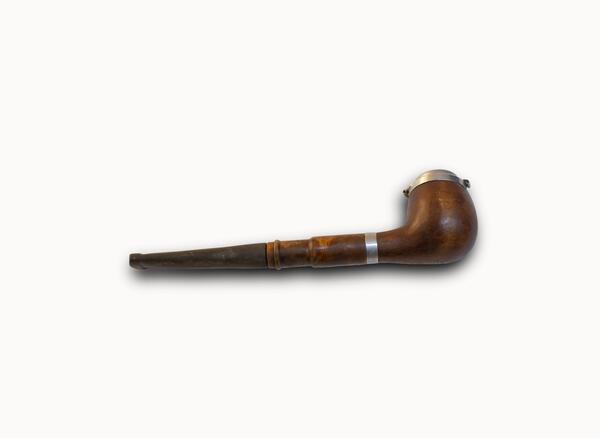
Despite the fact that Pavel Petrovich Bazhov repeatedly scolded himself for his addiction to tobacco, he never got rid of this bad habit. On the contrary, the smoking pipe was an integral part of his image.
Bazhov had several pipes throughout his life, he also smoked cigarettes and hand-rolled cigarettes. In most of the photographs and portraits of the writer created in the 1940s he is depicted with a pipe. It is worth noting that the author of famous tales did not always light it up.
Bazhov had several pipes throughout his life, he also smoked cigarettes and hand-rolled cigarettes. In most of the photographs and portraits of the writer created in the 1940s he is depicted with a pipe. It is worth noting that the author of famous tales did not always light it up.
#13
Our train was incredibly slow. All five days of the journey Pavel Petrovich was our companion and interlocutor… he spoke to us in a quiet, calm voice, even a little monotonously. But we listened to him with bated breath. It was surprising at that time that he did not smoke in the car, but simply held the pipe in his left hand. There were many smokers among the passengers. However, everyone gradually stopped smoking in their compartments and would go out into the gangway. Although he never even hinted to anyone that smoking was not allowed in the car.
An episode mentioned by his contemporaries
#14
In his house, the writer smoked without any restrictions, all family members were used to it. According to the memoirs of Pavel Petrovich’s youngest daughter, Ariadna, working at night on the tales from the “Malachite Box” collection, he strolled along the corridor and smoked a pipe. Bazhov also did not let it out of his hands while talking or thinking:
“Deep in his thought, he picked up the pipe, knocked the ashes out, packed the bowl with tobacco, and lit it… [He says] ‘Doctors tell me: Quit smoking! And I did quit cigarettes but took up the pipe. It is too late for me to quit smoking…’.”
The pipe was as recognizable a detail in Bazhov’s image as his beard.
“Deep in his thought, he picked up the pipe, knocked the ashes out, packed the bowl with tobacco, and lit it… [He says] ‘Doctors tell me: Quit smoking! And I did quit cigarettes but took up the pipe. It is too late for me to quit smoking…’.”
The pipe was as recognizable a detail in Bazhov’s image as his beard.
#16
Instead of a mighty, broad-shouldered bearded man, in the semi-darkness of the hallway we are met by a stooped old man with a sparse beard, in a worn cozy home jacket, with a pipe habitually clenched in his nicotine-stained fingers… Pavel Petrovich grins, sucking his pipe, which he smokes slowly, with a kind of cozy wheezing, spreading the smell of ordinary, mild tobacco, with which, as it seems, he himself has been saturated, as well as the manuscripts on the table, and this entire room where he lives and works, and even the flowers in the windows.
Boris Polevoy, “The Secret of Eternity”
#3
Name: Smoking pipe
Date of creation: the first half of the 20th century
Technique: wood, metal, turning
Dimensions: 3×10,5×2 cm
Technique: wood, metal, turning
Dimensions: 3×10,5×2 cm
#15
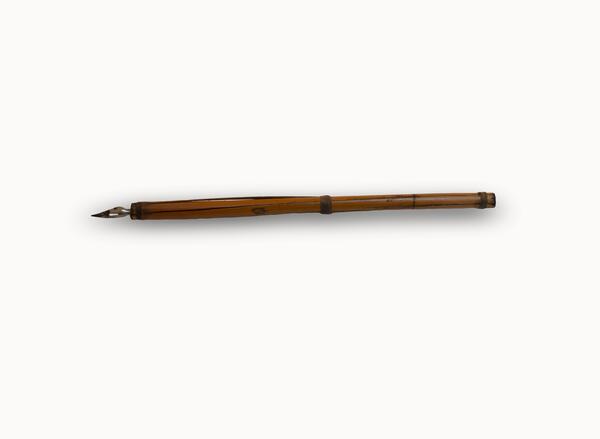
Dip pen
#17
Metal nibs for writing were used even by the ancient Romans and Greeks. At that time, bronze, copper and silver were the most popular materials for their manufacture. In the 18th century, the British and Germans, borrowing ideas from each other, came up with a steel nib, which was in widespread use until the invention of ballpoint pens. Steel nibs came to the Russian Empire in the middle of the 19th century: at first, they were imported from abroad, then they began to be produced within the country.
Pavel Petrovich Bazhov preferred to use a dip pen for writing, instead of a typewriter. It is known that in the 1930s, when his first and most famous tales were conceived and created, including “The Mistress of the Copper Mountain”, “The Malachite Casket”, “Stone Flower”, “Silver Hoof” and others, Bazhov wrote exclusively by hand. He started using a typewriter only in 1944. In addition, it was much closer to the traditional way of writing, which he often mentioned:
Pavel Petrovich Bazhov preferred to use a dip pen for writing, instead of a typewriter. It is known that in the 1930s, when his first and most famous tales were conceived and created, including “The Mistress of the Copper Mountain”, “The Malachite Casket”, “Stone Flower”, “Silver Hoof” and others, Bazhov wrote exclusively by hand. He started using a typewriter only in 1944. In addition, it was much closer to the traditional way of writing, which he often mentioned:
#18
Just imagine Alexander Sergeyevich [Pushkin] typing on a typewriter ‘I still recall the wondrous moment…’ or ‘Oh, do not sing to me, my beauty…’ And you will see how absurd it is. It is insulting to the manuscript, the lines not written by hand.
Pavel Petrovich Bazhov
#19
Pavel Petrovich worked on his writings at night, strolling along the corridor of a sleeping house. “Pavel Petrovich wrote most of the tales at his old standing desk, with a simple bamboo pen, using an ordinary non-spill inkwell, ” the Ural writer Elena Khorinskaya said in her work “Pioneer’s Tie”.
Bazhov had a great writing style, but he always worked diligently and carefully, choosing the right words. To write a short tale, he sometimes needed several months of painstaking night work.
It may seem that Pavel Petrovich wrote just as well as he spoke — using dialect words, syntax characteristic of oral folk speech, exclamations, and omissions. However, this is not correct. His tales are a kind of concentrated lexical assemblage, a complex cohesive text created by a true master of the word.
In his works, the writer tried, on the one hand, to convey to the greatest extent the features of oral speech of the ordinary Ural factory worker, on the other, to avoid using the same dialectisms from text to text. It was quite difficult to write about the same thing in different, strictly regional expressions, while ensuring the reader’s interest and understanding.
Bazhov had a great writing style, but he always worked diligently and carefully, choosing the right words. To write a short tale, he sometimes needed several months of painstaking night work.
It may seem that Pavel Petrovich wrote just as well as he spoke — using dialect words, syntax characteristic of oral folk speech, exclamations, and omissions. However, this is not correct. His tales are a kind of concentrated lexical assemblage, a complex cohesive text created by a true master of the word.
In his works, the writer tried, on the one hand, to convey to the greatest extent the features of oral speech of the ordinary Ural factory worker, on the other, to avoid using the same dialectisms from text to text. It was quite difficult to write about the same thing in different, strictly regional expressions, while ensuring the reader’s interest and understanding.
#4
Name: Dip pen
Author: Pavel Petrovich Bazhov
Date of creation: the early 20th century
Place of creation: The Russian Empire
Technique: reed, metal, thread, assembly
Dimensions: 17,5×0,9 cm
Date of creation: the early 20th century
Place of creation: The Russian Empire
Technique: reed, metal, thread, assembly
Dimensions: 17,5×0,9 cm
#20
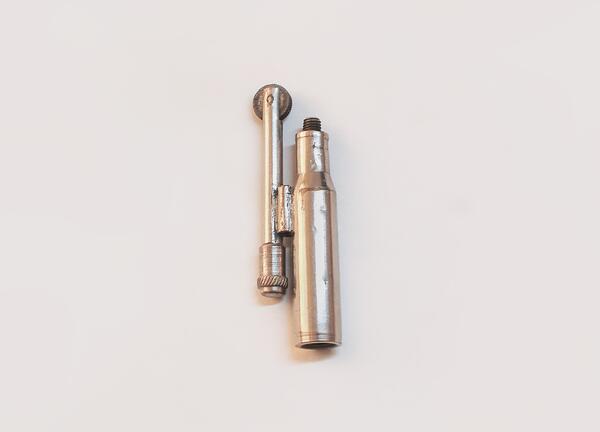
Lighter
#21
The lighter that Pavel Petrovich Bazhov used in the last years of his life is a Soviet copy of the famous Austrian IMCO lighter. Practically the oldest company in the world (the second oldest after the American one from New Jersey) for the production of these accessories was founded in 1907. At first, it produced buttons, and in 1918 it began to specialize in devices for making fire — the company has had more than 70 models. One model was especially popular in the USSR, and in the 1930s several Soviet factories produced similar ones.
Once, a friend of Bazhov’s, the novelist and screenwriter Boris Polevoy, called this lighter with a cylindrical body “extraordinary”. It really was of a rather unusual shape — according to the contemporaries of the Ural writer, it was made from a cartridge.
In a letter, Bazhov described his two lighters with his characteristic irony. The second lighter is displayed in the House-Museum:
Once, a friend of Bazhov’s, the novelist and screenwriter Boris Polevoy, called this lighter with a cylindrical body “extraordinary”. It really was of a rather unusual shape — according to the contemporaries of the Ural writer, it was made from a cartridge.
In a letter, Bazhov described his two lighters with his characteristic irony. The second lighter is displayed in the House-Museum:
#22
Take, for example, the Permyak lighter. I was never embarrassed showing it in public, because it had its own face — a straightforward purpose: you needed fire — it gave a flame, and nothing else was required. And indeed, there is no overabundance, no attempts to amaze: it did not pretend to be a small item, there were no straps or buttons, and it ignited sparks without panache. Such a lighter could serve until the wheel got broken, but this is quite natural. Everything gets old. My current lighter also has a face. It was made of a solid copper piece (the copper Urals!). It is impossible to bend the striker, because it is not soldered, but embedded in the main metal piece. It will also work, like the Permyak one, until the wheel is worn out. And even if I have to unscrew and screw things, it’s of little consequence, even a kid could do it.
Pavel Petrovich Bazhov
#23
Bazhov had lung problems since his youth: bronchitis, inflammatory conditions, and cancer at the end of his life. However, he could not quit smoking, which he complained about in his diaries:
“It is absolutely necessary to quit. Especially for people of my way of life, who in fact have not so much a life, but a smoking break. A perpetual, meaningless, not justified by any hint of pleasure smoking break, as this smoking habit has turned into a mechanical process: lighting a cigarette and breathing in smoke has become a habitual gesture that you can’t get rid of.”
“It is absolutely necessary to quit. Especially for people of my way of life, who in fact have not so much a life, but a smoking break. A perpetual, meaningless, not justified by any hint of pleasure smoking break, as this smoking habit has turned into a mechanical process: lighting a cigarette and breathing in smoke has become a habitual gesture that you can’t get rid of.”
#5
Name: Lighter
Date of creation: the 1940s
Place of creation: the USSR
Technique: metal, nickel plating
Dimensions: 7×2 cm
Place of creation: the USSR
Technique: metal, nickel plating
Dimensions: 7×2 cm
#6
Ministry of Culture of the Russian Federation
read morehide
00:00
00:00
1x
Glasses
Exhibition
0
 Point your smartphone camera to open in the app
Open in app
Share