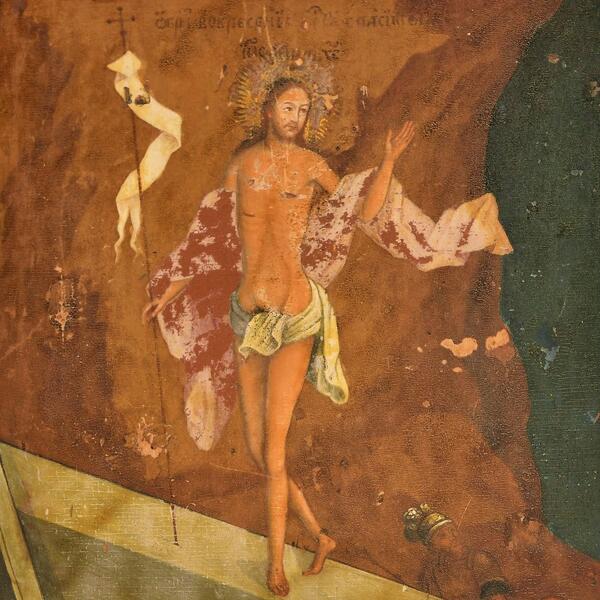
The icon depicting Jesus Christ is on display at the Bishop’s House exhibition. An unknown artist created it in 1759: the date is indicated on the plate in the lower right corner.
In the central part of the icon — the centerpiece — the icon painter depicted Christ in full-length, against the background of the ochre-brown mountain cave and the dark space to its right. The figure of the Savior towers over an open rectangular tomb painted in grey-green tones. There is a shining halo over Christ’s head.
Jesus wears a grey-blue loincloth and a red himation cape: in some places, the oil paint on the cape has not remained. The Savior stretched his left hand aside, and in his right hand, he grasps a long, thin flagpole with the image of a cross. The narrow white cloth is divided at the bottom into two triangular parts. To the left of the tomb, one can see the figures of reclined soldiers in armor. The centerpiece is framed in a monochrome rectangle of a green shade.
In the Orthodox iconographic tradition, the risen Christ was not depicted for a very long time. The clergy believed that it was impossible to depict on a board or canvas the miracle of the resurrection, a mysterious event that cannot be grasped by the human mind, which even the evangelists did not explain. Therefore, the church condemned any attempt to create such an image. It was replaced by the ‘Descent into Hell’, which was associated with Easter: it depicts Christ in hell, where he descended to announce God’s forgiveness to sinners.
According to the Gospel, the Savior returned to the world of the living on the third day after his execution. Christ was depicted either hovering over the tomb or leaving the cave where he was buried. The New Testament mentions that Jesus' body was watched by guards after the execution, and no one was allowed to come near it. It was customary to depict the soldiers as well: most often, the soldiers lie on the ground, shocked that Christ has risen, and sometimes they flee in terror. Sometimes the Savior was painted in a white robe, which symbolized purity and innocence, flanked by two angels who witnessed the miraculous resurrection.
In the central part of the icon — the centerpiece — the icon painter depicted Christ in full-length, against the background of the ochre-brown mountain cave and the dark space to its right. The figure of the Savior towers over an open rectangular tomb painted in grey-green tones. There is a shining halo over Christ’s head.
Jesus wears a grey-blue loincloth and a red himation cape: in some places, the oil paint on the cape has not remained. The Savior stretched his left hand aside, and in his right hand, he grasps a long, thin flagpole with the image of a cross. The narrow white cloth is divided at the bottom into two triangular parts. To the left of the tomb, one can see the figures of reclined soldiers in armor. The centerpiece is framed in a monochrome rectangle of a green shade.
In the Orthodox iconographic tradition, the risen Christ was not depicted for a very long time. The clergy believed that it was impossible to depict on a board or canvas the miracle of the resurrection, a mysterious event that cannot be grasped by the human mind, which even the evangelists did not explain. Therefore, the church condemned any attempt to create such an image. It was replaced by the ‘Descent into Hell’, which was associated with Easter: it depicts Christ in hell, where he descended to announce God’s forgiveness to sinners.
According to the Gospel, the Savior returned to the world of the living on the third day after his execution. Christ was depicted either hovering over the tomb or leaving the cave where he was buried. The New Testament mentions that Jesus' body was watched by guards after the execution, and no one was allowed to come near it. It was customary to depict the soldiers as well: most often, the soldiers lie on the ground, shocked that Christ has risen, and sometimes they flee in terror. Sometimes the Savior was painted in a white robe, which symbolized purity and innocence, flanked by two angels who witnessed the miraculous resurrection.