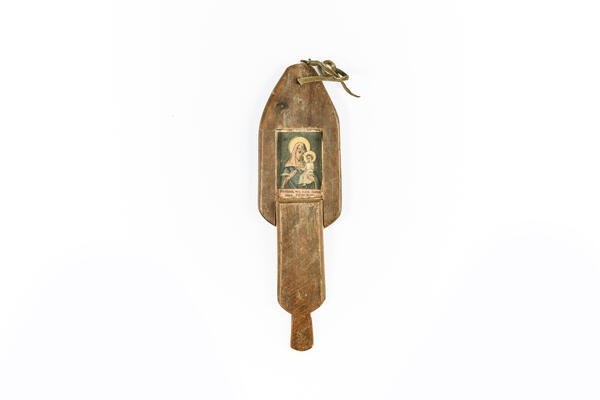
The Bishop’s House collection includes a small icon of the Mother of God of Rome. It was made in the second half of the 19th century. Such an icon was popular among Siberian indigenous peoples, especially with the Ostyak-Samoyeds — the name of the Selkups in bygone days.
The icon belongs to the Hodegetria type — the name is translated as “Our Lady of the Way” from Greek. Legend has it that Luke the Evangelist painted the first image of this type. The Virgin is depicted with the Christ Child in her left hand while pointing to him with her right hand. In his left hand, Jesus holds a scroll of the Holy Scripture, raising his right hand in the gesture of Christian blessing. In the museum’s icon, the Mother of God has slightly inclined her head toward Christ; while usually, she is depicted standing straight. The Hodegetria iconographic type includes many icons especially revered in Russia: the Kazan Icon of the Mother of God, the Tikhvin Icon of Mother of God, the Iviron Icon of the Mother of God, and Icon of the Three Hands. These icons have special celebration days in the Orthodox calendar.
The icon of the Mother of God of Rome from the Tobolsk Museum was printed on paper and attached to a flat wooden base with a rounded lower edge and pointed upper part. A round hole was drilled in the cover for inserting a deerskin chamois lace. This lace was used to hang the icon. The icon was placed in the recess and closed with a hinged wooden cover. The wooden parts had to fit tight: such a case protected the icon from moisture and damage during long journeys.
The icon belongs to the Hodegetria type — the name is translated as “Our Lady of the Way” from Greek. Legend has it that Luke the Evangelist painted the first image of this type. The Virgin is depicted with the Christ Child in her left hand while pointing to him with her right hand. In his left hand, Jesus holds a scroll of the Holy Scripture, raising his right hand in the gesture of Christian blessing. In the museum’s icon, the Mother of God has slightly inclined her head toward Christ; while usually, she is depicted standing straight. The Hodegetria iconographic type includes many icons especially revered in Russia: the Kazan Icon of the Mother of God, the Tikhvin Icon of Mother of God, the Iviron Icon of the Mother of God, and Icon of the Three Hands. These icons have special celebration days in the Orthodox calendar.
It is believed, that the first icon of the Mother of God of Rome, or Mother of God of Lydda, was not made by human hands. It appeared in the city of Lydda on the modern Israel territory. According to Christian legend, the Apostles Peter and Paul founded a church in this area, where the Mother of God with Christ’s image had appeared on a stone pillar. A replica of this icon was made for Hermogenes Patriarch of Constantinople According to legend, during Byzantine iconoclasm times, Hermogenes let out the icon Mother of God of Lydda into the sea. The icon sailed as far as Rome and remained there until those in Constantinople began to worship the holly images again.
The icon of the Mother of God of Rome from the Tobolsk Museum was printed on paper and attached to a flat wooden base with a rounded lower edge and pointed upper part. A round hole was drilled in the cover for inserting a deerskin chamois lace. This lace was used to hang the icon. The icon was placed in the recess and closed with a hinged wooden cover. The wooden parts had to fit tight: such a case protected the icon from moisture and damage during long journeys.