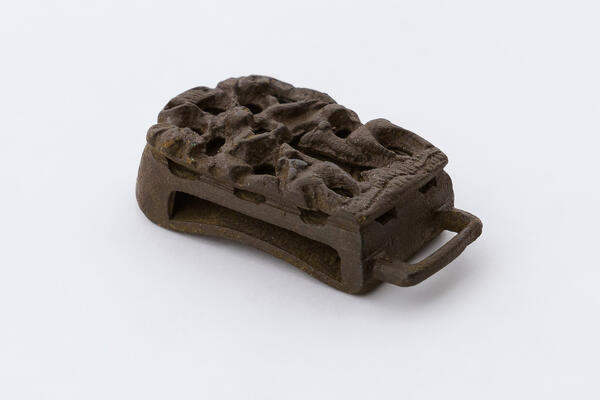
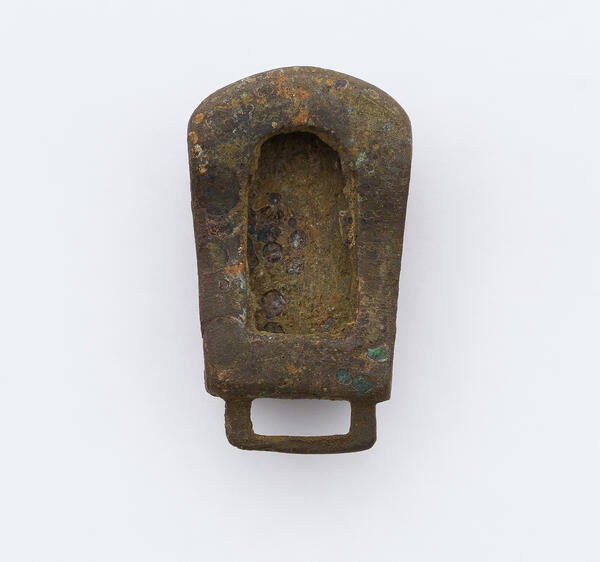
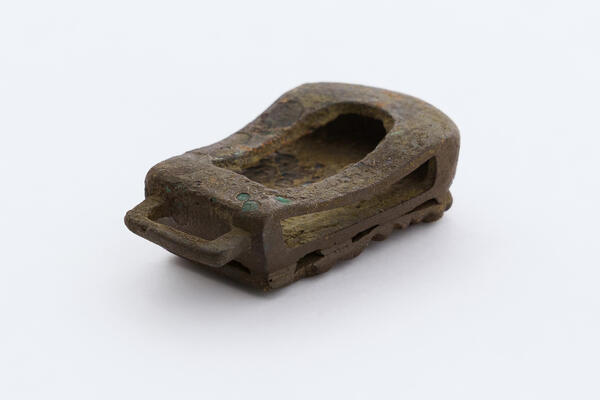
The movable belt ferrule with a hanging loop presented in the exhibition of the State Museum-Reserve “Kulikovo Field” in the hall “Rus and Horde: 14th Century Warfare” is a detail of a 14th century costume, specifically a waist belt. The base of the ferrule has an elongated trapezoidal shape with a rounded top and is cast of a copper alloy. A rectangular loop is soldered to the bottom of the base, and a thin ornamented strip is soldered onto the front of the base. This strip depicts two fallow deer, which are eating the leaves of a shrub, and is created using the die-stamping technique.
Belts were an important part of both men’s and women’s clothing in Ancient Rus, serving not only to keep garments in place but also as a status symbol for the wearer.
A type of belt characteristic of Ancient Rus is a decorated belt featuring metal parts such as a buckle, plates, ferrules, connecting rings, and belt tips (elongated plates decorating the end of the belt).
According to researchers, the popularity of belts with metal accessories originated among nomadic warriors, eventually reaching Rus in the 10th century.
The set on display at the museum-reserve is a belt designed to hold a saber or sword. Its ferrule is of a complex design: each of the three ferrules consists, in its turn, of three parts. In addition to the front and back plates, there is an inner plate that matches their shape. This was designed to protect the punched relief from accidental deformation and emphasize its depth.
In general, it should be noted that the entire belt set was made by a highly skilled craftsman with extensive experience in producing such items. This can be seen both in the skillful punching and in the accuracy of the subsequent assembly and treatment of components. As for the narrative depicted on the front plate, a doe or a deer symbolizes longevity and immortality in the Tatar-Mongol tradition.