#1
Outfit
#3
#4
#5
As a type of combat uniform, a gimnasterka was first worn by the soldiers of the Russian Imperial Army stationed in Turkestan in the 1870s. It was mandated to be worn by the soldiers of the lower ranks ‘during hot summers’ with fastened shoulder-boards.
The name of this uniform comes from the gymnastic shirt, a soldier’s piece of clothing for physical exercises, which was introduced in 1862. The cut of the shirt was simple — a piece of cotton cloth was folded in half and sewn on the sides. Then the neck was cut out and decorated with a low standing collar and a small front closure with hooks or buttons. Sleeves without cuffs were then sewn to the body of the shirt.
The gimnasterka was popular not only among the military but also with the civilian population. It was cheap and easy to produce, and easily hemmed according to the height and size of a person.
Initially, gimnasterkas were white. Its protective greenish-gray color was introduced during the military reforms of 1905-1912. During the First World War, officers and military doctors were allowed to replace their field jackets with wool gimnasterkas, which differed from the soldiers' gimnasterkas, as they had pockets.
After the October Revolution of 1917, the gimnasterka became part of the uniform of soldiers and commanders of the Workers' and Peasants' Red Army. Following the order of the Revolutionary Military Council of the USSR in 1929, it was a ‘summer shirt with elbow patches of the 1931 version for all branches of the armed forces’. Occasionally, the cut, the material, the shape of the collar, the location of pockets, the plackets, and other details were changed, but up until 1943, the gimnasterka remained a mandatory element of all types of uniforms: field, service, and parade uniforms.
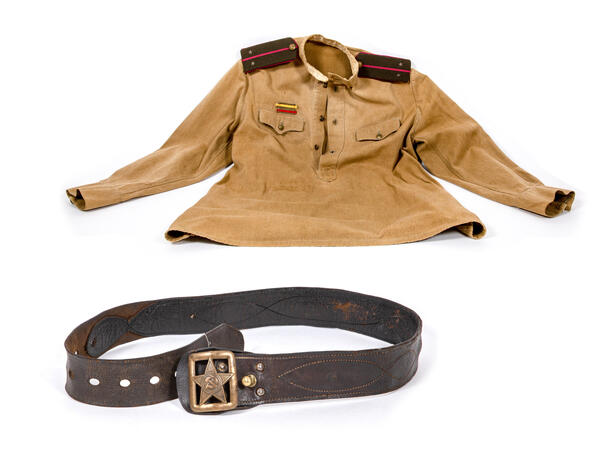
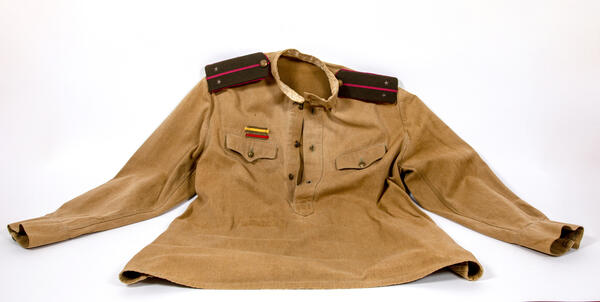
In 1943, the Red Army adopted a new uniform and changed the system of insignia. The gimnasterka was mandated for privates and sergeants as an element of the field and service uniforms, and it for senior and supreme commanders as an element of the field uniform. Instead of a detachable collar, the gimnasterka had a standing collar, which fitted better with shoulder-boards. It was fastened with two buttons. Sleeve insignias of gimnasterkas were canceled, and colored stripes, indicating wounds, were also introduced. The gimnasterkas of privates and sergeants still had no pockets, while the officers' pockets were replaced with attached pockets, covered with laps. The gimnasterka housed in the museum collection fits the military regulation description of the 1943 military uniform.
#6
Full name: Summer gimnasterka of commanders of Workers' and Peasants' Red Army, the 1943 version
Date: before 1945
Technique: factory-made
Place: USSR
Copyright: Museum Resource Center of Noyabrsk
Dimensions: overall length — 73 cm; shoulders — 46 cm, sleeves — 58,5 cm
Goskatalog Number: 16663716
Date: before 1945
Technique: factory-made
Place: USSR
Copyright: Museum Resource Center of Noyabrsk
Dimensions: overall length — 73 cm; shoulders — 46 cm, sleeves — 58,5 cm
Goskatalog Number: 16663716
#7
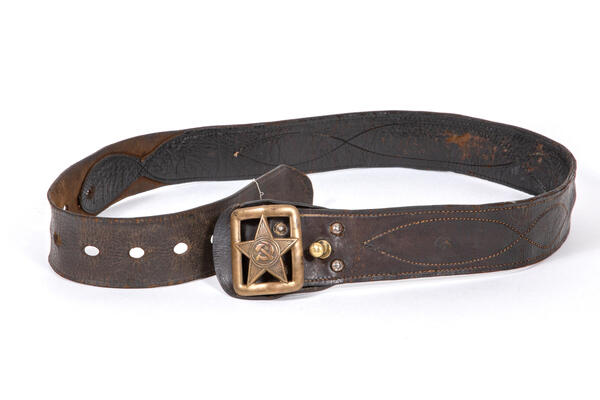
Red Army Belt
#8
#2
The officer’s belt, displayed in the collection, is made of two layers of dark brown leather with a thickness of four millimeters each. They are glued and sewn with silk threads along the edges. In the middle of the belt is a stitched pattern — it was made to ensure greater durability and to differ from soldiers' belts.
The belt buckle has no pins. It consists of a slightly curved outwards frame and a stamped five-pointed star (5 cm in length) with clear relief images. In the round medallion of the star, bordered by two rims, the hammer and sickle are pressed against the background of rays emerging from the center. The rays of the inner circle continue at the ends of the star. The star is firmly brazed to the frame.
Until the early 1930s, Red Army commanders often had to wear the old ‘Mikulin’ double-shoulder accoutrements of the 1912 model. It included a brown belt with a metal buckle and brass half-rings attached to the shoulder straps. On the back, they either crossed over or were connected by a diamond-shaped ring. A case for the commander’s whistle was hung on the left shoulder strap; while a holster, a canteen, and a small bag were attached to the belt.
In September 1923, the order No.936 of the Revolutionary Military Council of the USSR approved the equipment of the commanding staff of the Red Army infantry. It included a basic single pin brown leather belt with a width of 45 millimeters and a brass buckle. Later, they developed and introduced new hiking equipment and everyday uniforms for middle-level, senior and commanding officers of the army and air force. It included a 50 mm belt with a double pin metal buckle.
The buckle from the collection of the Noyabrsk Museum had no pins and was approved by the order of the People’s Commissar of Defense in December 1935. It was part of the uniform of the leading and commanding staff of the Red Army in 1935-1941. At the beginning of the Great Patriotic War, the style of the uniform and the way it was worn were determined by this order. These approved accoutrements with insignificant changes were used in the Soviet Army up until the collapse of the USSR.
#9
Full name: Belt with a buckle. Equipment of Leading and Commanding Staff of the Workers’ and Peasants' Red Army during the Great Patriotic War
Date: presumably before 1945
Technique: factory-made
Place: USSR
Copyright: Museum Resource Center of Noyabrsk
Dimensions: 5×113,2 cm; buckle — 4,8×5,8×1,9 cm
Goskatalog Number: 16663639
Date: presumably before 1945
Technique: factory-made
Place: USSR
Copyright: Museum Resource Center of Noyabrsk
Dimensions: 5×113,2 cm; buckle — 4,8×5,8×1,9 cm
Goskatalog Number: 16663639
#10
Ministry of Culture of the Russian Federation
read morehide
00:00
00:00
1x
0
 Point your smartphone camera to open in the app
Open in app
Share