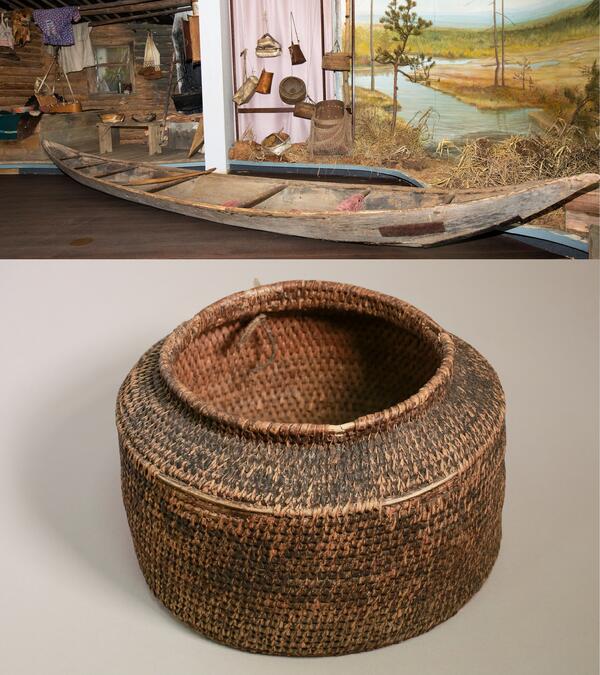
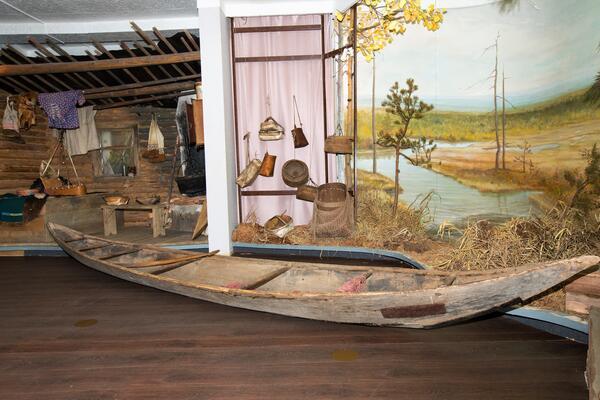
There are a lot of rivers, lakes, and swamps on the territory of the Salym District. In the summer, the Khanty moved along them in boats. The most common kind of a boat was a dugout boat made of a solid tree trunk called oblas.
Simple boats made of a single tree are considered the oldest type of boats in the taiga zone of Western Siberia: researchers suggest that the first boat of this type appeared in this region in the 9th century. Since then, the appearance of the oblas has remained practically unchanged. Today, the Khanty use a small oblas to sail quiet rivers, and a large one is used to sail high-water rivers or lakes. A wide oblas is more stable, but in an area with many shallow bodies of water, where from time to time one has to drag the boat, narrow and light boats are more convenient.
The technology for making the oblas was the same for all groups of the Khanty who lived on the banks of the Salym River. The Yugans usually used cedar and aspen; they looked for a suitable tree in the spring. First of all, the craftsmen paid attention to the color of the wood: they tried not to take the red wood as it split quickly.
The boats were made from early May up to early June. At this time, there are practically no mosquitoes, and the trees stand leafless.
The cut down trunk was cleared of bark and twigs and shaped into a cylinder. First, the ends of the log were cut with an ax, then an entire trunk was flattened, cutting off about half of it, and the inside was hollowed out. In order not to cut out too much, cedar nails were driven into the log using a bow drill. This simple yet effective tool was made from wood and metal. The drill was either made by hand, or steel fork teeth and other objects of suitable shape were taken instead. With the help of a handle of a special shape — a bow — the drill was unwound and holes were made in wood or bone items.
The marked workpiece was placed on two or three logs, and craftsmen started to hollow out the wood using adzes of different sizes. A large adze was used for the central part, while for the stern and bow part a small adze was applied. The insides were hollowed out until the appearance of cedar “indicators”, and then, the surface was cleaned.
The Yugan Khanty poured up to 12 liters of hot, but not boiling water into the workpiece so that the tree would soften and become more plastic. Sometimes, instead of that, craftsmen simply lowered the boat into the river. In the water, the cedar “indicators” expended and did not allow moisture to pass through.
After that, spacers were driven into the workpiece and craftsmen began to expand the middle of the boat. This process was called “opening the boards”. The more the boards expanded, the longer spacers were placed. If the weather was cloudy, then a fire was made under the workpiece so that the tree was simultaneously dried. In June, the boards were opened under the sun. Then, the boat was left to dry. It took an experienced craftsman three days to make a small two-meter oblas, and making a large one, which was about seven meters long, took four days.
Simple boats made of a single tree are considered the oldest type of boats in the taiga zone of Western Siberia: researchers suggest that the first boat of this type appeared in this region in the 9th century. Since then, the appearance of the oblas has remained practically unchanged. Today, the Khanty use a small oblas to sail quiet rivers, and a large one is used to sail high-water rivers or lakes. A wide oblas is more stable, but in an area with many shallow bodies of water, where from time to time one has to drag the boat, narrow and light boats are more convenient.
The technology for making the oblas was the same for all groups of the Khanty who lived on the banks of the Salym River. The Yugans usually used cedar and aspen; they looked for a suitable tree in the spring. First of all, the craftsmen paid attention to the color of the wood: they tried not to take the red wood as it split quickly.
The boats were made from early May up to early June. At this time, there are practically no mosquitoes, and the trees stand leafless.
The cut down trunk was cleared of bark and twigs and shaped into a cylinder. First, the ends of the log were cut with an ax, then an entire trunk was flattened, cutting off about half of it, and the inside was hollowed out. In order not to cut out too much, cedar nails were driven into the log using a bow drill. This simple yet effective tool was made from wood and metal. The drill was either made by hand, or steel fork teeth and other objects of suitable shape were taken instead. With the help of a handle of a special shape — a bow — the drill was unwound and holes were made in wood or bone items.
The marked workpiece was placed on two or three logs, and craftsmen started to hollow out the wood using adzes of different sizes. A large adze was used for the central part, while for the stern and bow part a small adze was applied. The insides were hollowed out until the appearance of cedar “indicators”, and then, the surface was cleaned.
The Yugan Khanty poured up to 12 liters of hot, but not boiling water into the workpiece so that the tree would soften and become more plastic. Sometimes, instead of that, craftsmen simply lowered the boat into the river. In the water, the cedar “indicators” expended and did not allow moisture to pass through.
After that, spacers were driven into the workpiece and craftsmen began to expand the middle of the boat. This process was called “opening the boards”. The more the boards expanded, the longer spacers were placed. If the weather was cloudy, then a fire was made under the workpiece so that the tree was simultaneously dried. In June, the boards were opened under the sun. Then, the boat was left to dry. It took an experienced craftsman three days to make a small two-meter oblas, and making a large one, which was about seven meters long, took four days.