Font
Color
Graphics
Изображение точки

To see AR mode in action:

1. Install ARTEFACT app for iOS or Android;

2. Find the exhibition «The fascinating natural world of Kuzbas»

3. Push the «Augmented reality» button and point your phone's camera at the exhibit;

Скрыть точки интересаПоказать точки интереса
Показать в высоком качестве
#1
Inhabitants of the forest world
#10
Author unknown
The Bohemian or common waxwing
#9
The Bohemian or common waxwing is a passerine bird. It is fairly small in size with bright plumage. Its unusual name in Russian comes from the word ‘svirel’, a folk flute-type wind instrument, which produces sounds that resemble the bird’s unique songs. 
 
Bohemian waxwings move through the air quite quickly and their flight paths are direct. Adults, on average, reach up to 20 centimeters in length and weigh approximately 60 grams. Another distinguishing characteristic of this bird is the fairly noticeable tuft of feathers on the crown of its head. The common waxwing’s tail, neck and area around the eyes are black. The ends of its wings’ secondary lift feathers are varied shades of bright red in color and are especially noticeable from a short distance. The edge of the tail is bright yellow. 
 
The bird has strong feet armed with curved claws meant for gripping branches tightly. Bohemian waxwings are viewed as fairly inactive birds that gather into numerous flocks during the mating season and move around energetically in search of food. The replacement of feathers (molt) takes place once a year, in October to November. 
 
Common waxwings are considered to be the closest relatives of sparrows. In their natural habitats, they can live for approximately 12 years. These birds are often held captive but they are never truly tamed. If conditions in captivity are sufficiently comfortable, their lifespans can increase to about 15 years. 

Typically, Bohemian waxwings have a plant-based diet — they eat fruit and berries. In spring time, these birds consume buds of various plants, and in summers, the food available to them is much more varied and includes insects. Since common waxwings travel in groups, they easily catch their prey while in flight. The birds also consume larvae and young shoots. 
 
Bohemian waxwings prefer to build their nests on tall trees in sparse woods. Its nest is bowl-shaped and located right at the top of a tree. The birds use grass, animal fur, dry moss as well as small twigs of trees or bushes in its construction. The bottom part of the nest is typically lined with softer materials. These abodes are most often located at the edges of a forest near water bodies. 
 
Every year, common waxwings find themselves a new partner. During courtship, a male feeds his partner berries. Bohemian waxwings migrate south as soon as it gets really cold or it snows for the first time. 
#8
Date: The end of the 20th century
Technique a stuffed bird
Collection: Natural science
Copyright: Promyshlennovsky District Museum of History and Regional Studies
Dimensions: 25*7*12
Goskatalog Number: 24245804
#13
Author unknown
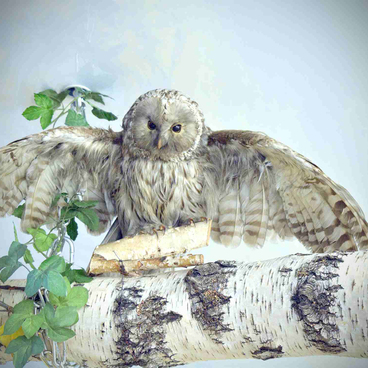
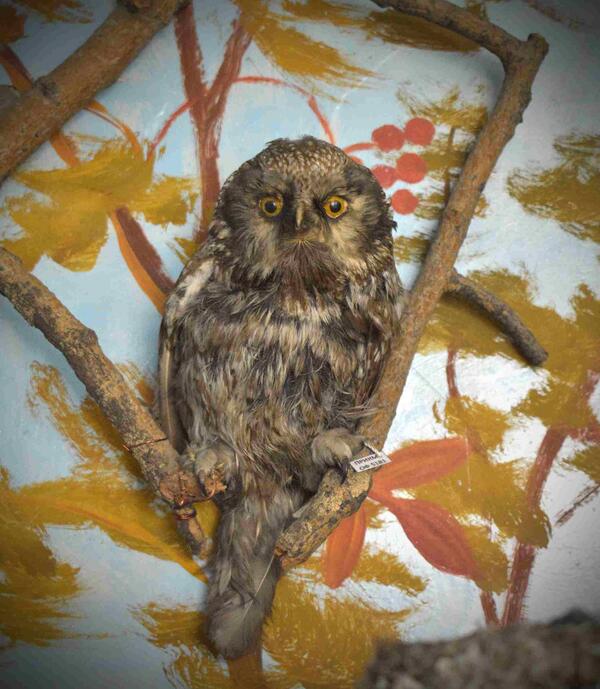
The Eurasian pygmy owl
#12
The Eurasian pygmy owl is a very small owl with an attractive appearance. These birds are much smaller in comparison to other owls. They are approximately 20 centimeters in length and weigh no more than 80 grams. On average, a normal-sized owl can reach a weight of 700 grams and length of 65 centimeters. The head of the Eurasian pygmy owl looks somewhat flattened, while that of other types of owls is more rounded in shape. The plumage of pygmy owls is flecked with white. The feathers of bigger owls, in contrast, are covered with noticeable stripes. The Eurasian pygmy owl does not have ear tufts unlike many of its larger “relatives”. Still, in many other ways these two bird types are similar. 
 
The gaze of the pygmy owl’s enormous unmoving eyes is truly impressive. In order to look sideways, these birds have to turn their heads. Their irises can be deep or light yellow as well as golden depending on the sub-type. Large round pupils framed by such bright colors stand out in contrast to the bird’s feathers. Its gaze looks stern on account of the protrusions above the eyes that resemble eyebrows. Therefore, it is not surprising that a person who appears to be frowning is quite often asked in Russian “Why are you looking at me like a pygmy owl?”. 

Their black claws, which can be referred to as weapons of these avian predators, are long and sharp.
One can come across Eurasian pygmy owls in woodlands as well as mountainous areas and plains. These birds can live alongside humans. Typically, they build their nests in tree hollows but decrepit or old abandoned buildings as well as wall cavities can also serve as their homes. 
 
The Eurasian pygmy owl is, first and foremost, a predator. Hence, it has an animal-based diet consisting of voles, bats, dipodids, hamsters, insects and earthworms. When hunting large prey, these birds pair up and cooperate with one another. These species prefer eating small birds and rodents. Eurasian pygmy owls do not swallow their prey whole, instead they carefully strip off its fur or feathers and eat the best parts. They store their autumn stocks in tree hollows. 
 
The birds are active at night. Pygmy owls are exceptionally good at blending into their surroundings, it is often much easier to hear them rather than see them. Their calls at night can sound quite frightening. 

On account of their hunting methods and a tendency to store food, Eurasian pygmy owls can be described as very intelligent, practical and prudent birds. They live for around 15 years. People prefer to keep Eurasian pygmy owls rather than their bigger relatives at home because the former are smaller in size and easier to take care of.
#11
Date: The end of the 20th century
Technique a stuffed bird
Collection: Natural science
Copyright: Promyshlennovsky District Museum of History and Regional Studies
Dimensions: 28*10*7
Goskatalog Number: 24245806
#14
Author unknown
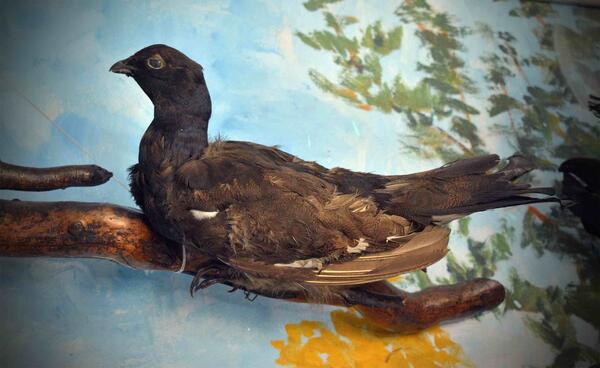
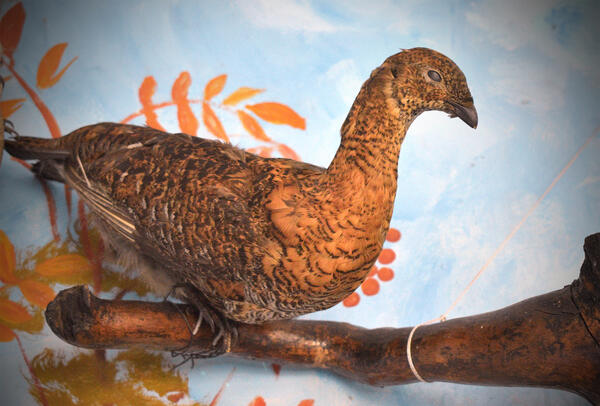
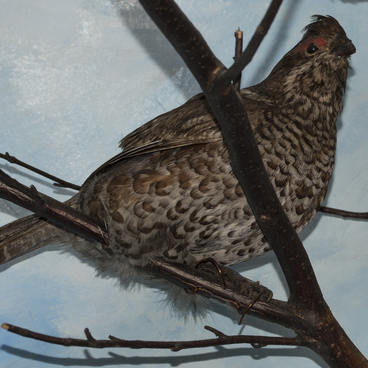
The Eurasian capercaillie or wood grouse
#16
The female Eurasian capercaillie is half the weight of the male. The length of its body from the end of its beak to the tail is approximately 54 to 64 centimeters, its wingspan is 70 cm and weight is, on average, 1.8 kg. The feathers on its upper parts are brown in color with black and silver stripes, while those on the lower section are lighter — bright yellow. Such plumage is essential for the female so that it can easily blend into its surroundings during the nesting season. Females, particularly the ones with hatchlings, need food and a suitable location. They require edible plants and small insects for their young, as well as shelter in the form of dense thickets of young trees or glades covered by tall plants plus old trees with horizontal branches where they can sleep. Such places can most often be found in virgin forest stands with firs and pines. In general, Eurasian capercaillie live within their territories but they can migrate from mountains to valleys during changes in season. Approximately three days after mating, the female starts laying eggs. The clutch is complete ten days later. On average, it lays 8 eggs, although the number can reach 12. The bird incubates them from 26 to 28 days depending on the weather and the height above sea level. 

At the start of the incubation period, females are very sensitive to noise and leave their nests hastily. Before their eggs hatch, they persevere harder and remain in place in spite of danger cowering in their nests, which are normally hidden under lower branches of young trees. Practically all the eggs hatch at the same time. Afterwards, the female and its offspring leave their nest where they would otherwise be more vulnerable. Upon hatching, the baby birds are covered in their entirety with downy feathers. They cannot maintain their body temperatures, which is 41° C, on their won. Hence, on cold and rainy days, their mother keeps them warm all night long. The youngsters search for food themselves and typically hunt insects. They grow quickly, and most of the calories they consume are used to build up muscle mass. At the age of 3 to 4 weeks, the fledglings go on their first short flights. Afterwards, they begin sleeping in trees. In the first weeks of their lives, these young birds depend on food rich in protein. Hence, they primarily hunt insects and spiders during this period. The weather has a significant impact on the number of insects available. Dry and warm conditions encourage the baby birds to grow quickly, while cold and rainy weather results in a high death rate among them.
#15
Date: The end of the 20th century
Technique a stuffed bird
Collection: Natural science
Copyright: Promyshlennovsky District Museum of History and Regional Studies
Dimensions: 28*10*13
Goskatalog Number: 24245801
#17
Author unknown
The grey partridge
#18
The grey partridge is a fairly small wild bird similar in size to a common domestic hen. Its plumage is flecked and dull greyish-blue in color with characteristic bright spots. This species is very wide-spread and has a range of natural habitats. The grey partridge rarely lands on trees, which is why it is viewed as a terrestrial bird. It has only two weapons against its enemies: its flecked plumage, which enables it to blend into the surrounding vegetation, and its ability to run fast. Only on rare occasions does this bird fly up in order to save itself from a predator. The grey partridge’s body is not very large, ranging from 28 to 31 centimeters in length, its wingspan is 45-48 cm and the weight — from 300 to 450 grams. Its characteristics include a rounded light grey stomach with a bright horse-shoe shaped spot; a small head with a dark beak, and a relatively muscular grey back with typical flecks of brown. The plumage of the female grey partridge is not as colorful as that of the male, and often the former is smaller in size than the latter. Due to frequent molting and its dense feathers, these birds can even live in the snow when it is relatively cold. 
 
Most grey partridges in the wild do not migrate to warmer regions annually for the winter and remain in their usual habitats. In search of food, they dig tunnels in the snow, which can reach up to 50 meters in length. When it is particularly cold, they gather in groups in them in order to keep each other warm. Adult grey partridges have a primarily plant-based diet consisting of grass, plant seeds and berries. Their growing offspring, however, are fed only insects, worms, various larvae and spiders. As they increase in size, these young birds switch to a diet similar to that of adults. Grey partridges often partner for life. 
 
Both parents take equal responsibility for feeding and protecting their offspring. The female lays 15 to 25 eggs in one go once a year, at the very beginning of May. Grey partridges build their nests right on the ground and hide them in grass, under bushes or trees. During the incubation period, which lasts approximately 23 days, the female rarely leaves her clutch even to eat. In its absence, the male remains near the nest carefully monitoring the surroundings. The baby birds hatch practically simultaneously and immediately afterwards, they are ready to follow their parents around the territory they inhabit, venturing several hundred meters away from their home. These hatchlings already have feathers on their bodies. They can also see and hear well, and learn fast. Grey partridges are sociable birds that are constantly interacting with one another. There are approximately 25 to 30 of these birds in a flock. If one of the parents dies, the other assumes full responsibility for the well-being of their young. If both partners die, the youngsters are then taken care of by other partridge families living nearby. 
#19
Date: The end of the 20th century
Technique a stuffed bird
Collection: Natural science
Copyright: Promyshlennovsky District Museum of History and Regional Studies
Dimensions: 31*14*24
Goskatalog Number: 24245806
#22
Author unknown
The common starling
#21
European starlings can reach up to 22 centimeters in length and weigh from 50 to 100 grams. Both males and females have iridescent green plumage, and black wings with a greenish-purple hue. In winter time, white and cream-colored spots appear, first and foremost, on their chests. Their feathers are rounded at the base and sharper at the edges. Young starlings are light brown in color until their post-juvenile molt. During the breeding season, the beaks of the birds are yellow, while at other times, they are black. 
 
The species are found in all the biogeographical regions of the world with the exception of the Antarctic. Common starlings are migratory birds. From northern and eastern parts they migrate, for the winter, to western and southern Europe; Africa, north of the Sahara Desert, e.g Egypt; northern Arabian Peninsula and Iran, as well as the plains of northern India. Common starlings build their nests in natural and artificial cavities of trees and buildings. They are more aggressive than other birds and can kill a rival in order to gain access to a nesting spot. These birds build their nests out of grass, branches and moss, and line them with fresh leaves. The latter have antibiotic and antifungal properties, thus common starlings periodically replace them. 

They find food in open areas, such as fields and pastures. Young starlings have a primarily animal-based diet, for example, they eat invertebrates. Adult birds prefer consuming plants. In fact, they often gather on tress with ripe fruit. Since European starlings typically travel and hunt for food in flocks, all of their members watch out for any predators nearby and try to scare them away. 
 
Their mating season starts in spring. All the females lay from 4 to 7 shimmering blue or greenish-white eggs within a week. Both parents take turns sitting on the eggs but, overall, female birds spend more time in their nests than males do. 
 
European starlings make loud noises the whole year around with the exception of the molting season. The songs sung by male species are varied and include many elements in them. These birds can warble, chirp, whistle, squawk and chatter. Starlings can also imitate other birds and animals and even produce mechanical sounds. In captivity, the birds learn to imitate human voices.
#20
Date: The end of the 20th century
Technique a stuffed bird
Collection: Natural science
Copyright: Promyshlennovsky District Museum of History and Regional Studies
Dimensions: 17*7*4
Goskatalog Number: 24265884
#25
Author unknown
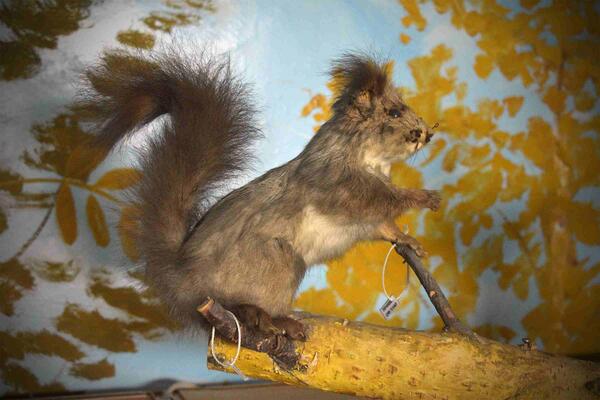
The red or Eurasian red squirrel
#24
This rodent is called the red or Eurasian red squirrel. Worldwide, there are up to 30 species in the squirrel family, which are spread out throughout our planet, but only the red squirrel inhabits our region. It is an agile animal with a slim, well-proportioned body. Its tail is long and fluffy. It can reach 19 centimeters in length and accounts for two thirds of the entire length of this animal’s body. The rodent weighs no more than 400 grams and grows to up to 30 centimeters in length. 
 
The red squirrel has a round head with dark-colored eyes that resemble beads, as well as long ears adorned with tufts, which point upwards. 
 
It lives in trees. These animals search for trees with hollows that they subsequently make into their homes. Red squirrels then stuff them with lichen, grass and leaves. Their nests can be located at a height of 15 meters above ground among dense tree branches. They are spherical in shape and reach a diameter of 30 centimeters. 

Before winter starts, Eurasian red squirrels acquire a thicker coat. In summers, their fur is short, sparse and coarse. Just as many others furry creatures, this animal sheds its coat twice a year, while its tail molts only once annually. In spring, the shedding starts with its head and in autumn with the tail. 
 
Red squirrels do not mark their territory, hence several animals can live in the same space. They spend most of their time up in the trees and are especially active in the mornings and evenings. During these hours, Eurasian red squirrels are busy searching for food. If a threat arises, they hide in the crowns of trees. These animals jump from one branch to another with ease. They can cover up to 4 meters when jumping between two spots located at a similar height or up to 15 meters when traveling along a downward arc. Their tails help them navigate. In winter time, red squirrels most often use trees to move around. However, during the breeding season and also in the absence of snow, they can travel on the ground with their long hops. 

Whenever it gets extremely cold or during powerful blizzards with lots of snow, Eurasian red squirrels remain in their shelters and leave them only if they are very hungry. 
 
In August through September, young squirrels move away from their homes in large numbers. They leave their nests and travel from 70 to 300 kilometers away. In the wild, only 10% of these animals live to reach the age of 4. In captivity, lifespans of these rodents increase to at least 10 years. 
#23
Date: The end of the 20th century
Technique a stuffed 
Collection: Natural science
Copyright: Promyshlennovsky District Museum of History and Regional Studies
Dimensions: 35*6*11
Goskatalog Number: 24200898
read morehide

Inhabitants of the forest world

0
Point your smartphone camera to open in the app
Share
VkontakteOdnoklassnikiTelegram
Share on my website
Copy linkCopied
Copy
Open in app
To see AR mode in action:
  1. Install ARTEFACT app for 
  2. iOS or Android;
  3. Find and download the «Paintings in Details» exhibition
  4. Push the «Augmented reality» button and point your phone's camera at the painting;
  5. Watch what happens on your phone screen whilst you flip through the pictures.
 
We use Cookies
Cookies on the Artefact Website. We use cookies to ensure that we give you the best experience on our website. If you continue without changing your settings, we'll assume that you are happy to receive all cookies on the Artefact website. However, if you would like to, you can change your cookie settings at any time.
Learn more about useHide
Content is available only in Russian

X

Нашли опечатку?...

%title%%type%