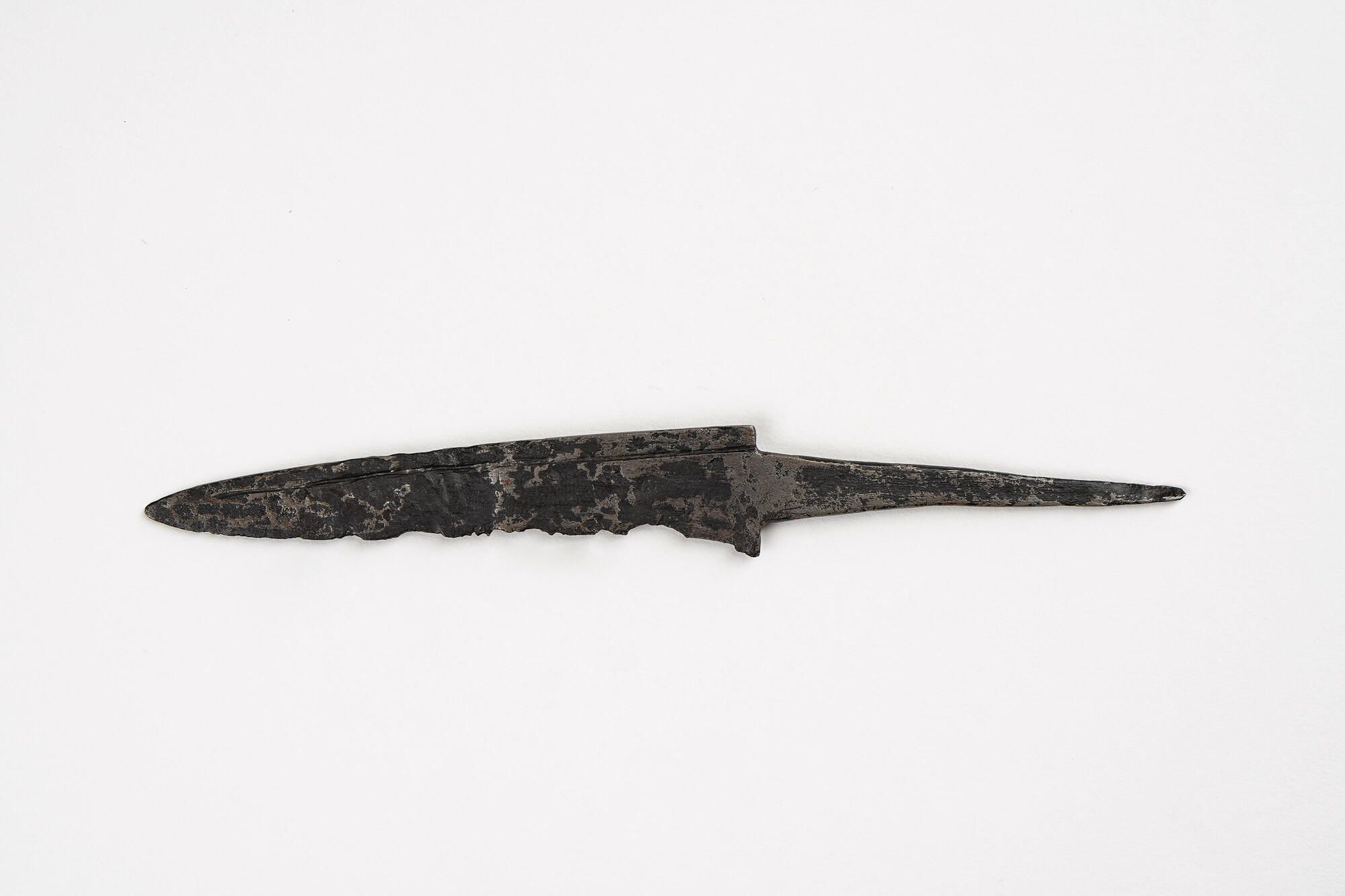


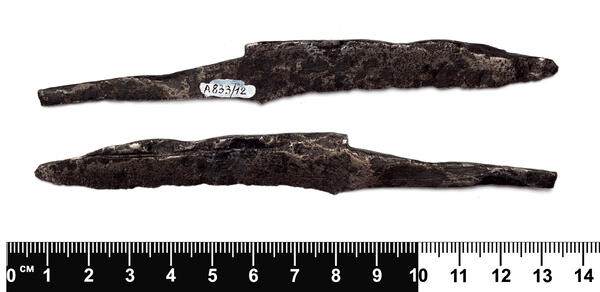
The permanent exhibition “Relics from the Battle of Kulikovo” features an iron knife — a common household tool used from the 12th to the 17th century. The knife has a tang, a narrow blade which is triangular in cross section and has a slightly curved spine, and a flange on the side of the spine. The tang is long, wedge-shaped and rectangular in cross section. The total preserved length of the item is 12.8 cm. The blade of the knife is narrow, its length is 7.6 cm, its width is 1.5 cm, the width of the tang at the base is 0.9 cm. The tip of the tang is lost.
This knife was discovered in 2003 during excavations conducted by the military-historical unit of the Upper-Don archaeological expedition of the State Historical Museum and the State Military-Historical and Natural Museum-Reserve “Kulikovo Field” on the watershed of the Verkhodub and Orzhevik ravines, to the south of the Monastyrshchino village, Kimovsky District, Tula Oblast. The knife is currently housed by the State Museum-Reserve “Kulikovo Field”. In terms of proportions and dimensions, the knife is similar to the find made in 2000 and belongs to a group of universal items.
Knives — the most common tools in Old Rus — were very widely used in everyday life, trades, crafts and military campaigns. From the 10th to the 14th century, there were knives for various purposes: for cooking, dining, shoemaking, bone-cutting, making barrels, and fighting, there were foldable knives, penknives and razors. Each type had its own design.
The knife was an indispensable accessory of a warrior — a common household and camping tool. Judging by the burials, in most cases, military knives did not differ from ordinary household ones. Special combat knives were made, apparently, quite rarely and were much more expensive. Perhaps this category should include some knives with a massive elongated blade and, as a rule, with large bone handles. The end of the blade of a combat knife had a double-sided piercing and cutting blade — this part was about 20–40 mm long. Combat knives were carried in hard leather cases either at the waist or behind the top of the boot.
This knife was discovered in 2003 during excavations conducted by the military-historical unit of the Upper-Don archaeological expedition of the State Historical Museum and the State Military-Historical and Natural Museum-Reserve “Kulikovo Field” on the watershed of the Verkhodub and Orzhevik ravines, to the south of the Monastyrshchino village, Kimovsky District, Tula Oblast. The knife is currently housed by the State Museum-Reserve “Kulikovo Field”. In terms of proportions and dimensions, the knife is similar to the find made in 2000 and belongs to a group of universal items.
Knives — the most common tools in Old Rus — were very widely used in everyday life, trades, crafts and military campaigns. From the 10th to the 14th century, there were knives for various purposes: for cooking, dining, shoemaking, bone-cutting, making barrels, and fighting, there were foldable knives, penknives and razors. Each type had its own design.
The knife was an indispensable accessory of a warrior — a common household and camping tool. Judging by the burials, in most cases, military knives did not differ from ordinary household ones. Special combat knives were made, apparently, quite rarely and were much more expensive. Perhaps this category should include some knives with a massive elongated blade and, as a rule, with large bone handles. The end of the blade of a combat knife had a double-sided piercing and cutting blade — this part was about 20–40 mm long. Combat knives were carried in hard leather cases either at the waist or behind the top of the boot.

