


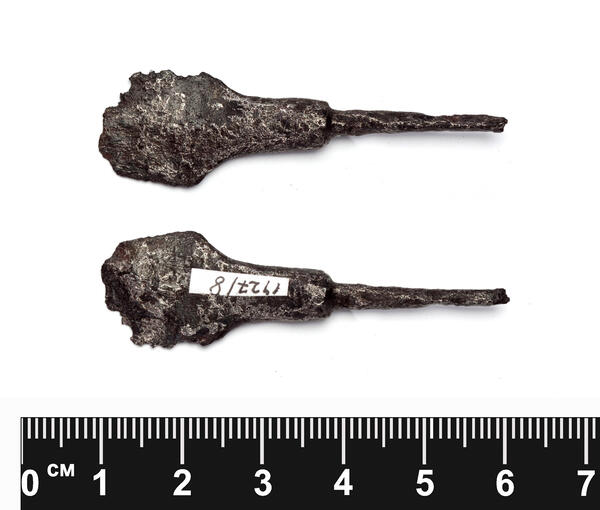
The arrowhead from the permanent exhibition “Relics from the Battle of Kulikovo” was discovered in 2009 in excavations conducted by the military-historical unit of the Upper-Don archaeological expedition of the State Historical Museum and the State Museum-Reserve “Kulikovo Field” at the watershed of Verkhodub and Orzhevik ravines, to the south of the Monastyrshchino village, Kimovsky District, Tula Oblast.
This iron tip has a tang. Its body has an elongated triangular shape and a flange. The tang has a round cross section (its diameter at the base is 0.4 cm), the body has the shape of an oval rhombus. The item has been partially preserved: the upper part of the arrow body and the tip of the tang are missing. The reconstructed length of the tip is about 6 cm, the preserved length is 5.2 cm.
Similar Old Russian arrowheads date from the 9th century to the end of the 14th century. They were also in use later and belong to the most common type of arrowheads in Muscovite Russia: such arrowheads were used in combat until the second half of the 17th century.
The wedge-shaped arrowheads had an estimated length of 65–145 mm, the body length of 45–100 mm, and the body width of 15–30 mm. The type of wedge-shaped tips with straight sides and concave shoulders, with body proportions of 1:3–1:4, was used from the 9th century to the end of the 14th century. Such arrowheads were found during archaeological excavations at various sites: the Novotroitsk settlement, in the Lyadinsky burial ground, in the Gnezdovsky burial ground, in Drutsk in the layer of the 12th–13th centuries, near the village of Kulikovka.
The arrow had to be flexible in order to withstand the launch acceleration after the bowstring had been pulled with a certain force. According to modern research, after an arrow has been released, the shaft bends because of the bowstring, and then, in the first seconds of the flight, straightens and begins to make oscillatory movements. To put it simple, an arrow wobbles when deviating from the main trajectory in the direction of shooting. Accuracy was absolutely dependent on the stable properties of wood that had been used to make the arrow.
When an archer was shooting an arrow, his position was stable so he was able to use a shield during the battle.
This iron tip has a tang. Its body has an elongated triangular shape and a flange. The tang has a round cross section (its diameter at the base is 0.4 cm), the body has the shape of an oval rhombus. The item has been partially preserved: the upper part of the arrow body and the tip of the tang are missing. The reconstructed length of the tip is about 6 cm, the preserved length is 5.2 cm.
Similar Old Russian arrowheads date from the 9th century to the end of the 14th century. They were also in use later and belong to the most common type of arrowheads in Muscovite Russia: such arrowheads were used in combat until the second half of the 17th century.
The wedge-shaped arrowheads had an estimated length of 65–145 mm, the body length of 45–100 mm, and the body width of 15–30 mm. The type of wedge-shaped tips with straight sides and concave shoulders, with body proportions of 1:3–1:4, was used from the 9th century to the end of the 14th century. Such arrowheads were found during archaeological excavations at various sites: the Novotroitsk settlement, in the Lyadinsky burial ground, in the Gnezdovsky burial ground, in Drutsk in the layer of the 12th–13th centuries, near the village of Kulikovka.
The arrow had to be flexible in order to withstand the launch acceleration after the bowstring had been pulled with a certain force. According to modern research, after an arrow has been released, the shaft bends because of the bowstring, and then, in the first seconds of the flight, straightens and begins to make oscillatory movements. To put it simple, an arrow wobbles when deviating from the main trajectory in the direction of shooting. Accuracy was absolutely dependent on the stable properties of wood that had been used to make the arrow.
When an archer was shooting an arrow, his position was stable so he was able to use a shield during the battle.


