The flintlock gun from the Gatchina Palace and Estate Museum collection was made in Russia. It arrived to the Palace armoury at the time of Grand Duke Pavel Pertovich before September 15, 1793, and was kept here after his death. From 1823 till 1941 the gun was kept in the Arms Gallery, and then it was evacuated to the city of Sarapul. It returned to Gatchina 47 years later from the Tsarskoe Selo State Museum and Heritage Site. There are several more Russian guns decorated in the same style which are kept in the State Hermitage, the Armoury Chamber of the Moscow Kremlin, the Tøjhus museum in Copenhagen and the Royal Armouries Museum in Leeds, Great Britain. But unlike the gun from the Gatchina collection they all have monograms of Empress Elizabeth of Russia on their stock wrists. Only one of these guns, the gun in the Hermitage collection, is signed by Ivan Salishchev, the famous gunsmith of Tula. That is why all the other guns are believed to have also been made in his workshop in the middle of the 18th century. The buttstock of the flintlock gun is inlaid with figures made of silver foil in the form of animals, a horse rider, the flying goddess of Glory and various grotesque creatures. All the figures were taken from the album of the French painter Nicolas Gegard ‘Diverses Pieces d’Arquebuserie’, issued in 1720. The album suggested various options for weapons decoration. Such albums were very popular among gunsmiths, who could use painters’ suggestions instead of inventing new fashionable patterns themselves. Quite often such albums had numerous ‘pirate’ editions, for example issued in Holland. It is possible that such ‘pirate’ copies were brought to Tula in the middle of the 18th century. In the 18th century Russian gunsmiths began to follow the style of guns typical for European countries, especially for Germany and France. This trend was supported by the arrival to Tula and other gun manufacturing centres of many foreign gunsmiths, first of all from Germany and Sweden. Yet Russian hunting weapons of the 18th century retained a number of original features that help scholars to distinguish them.
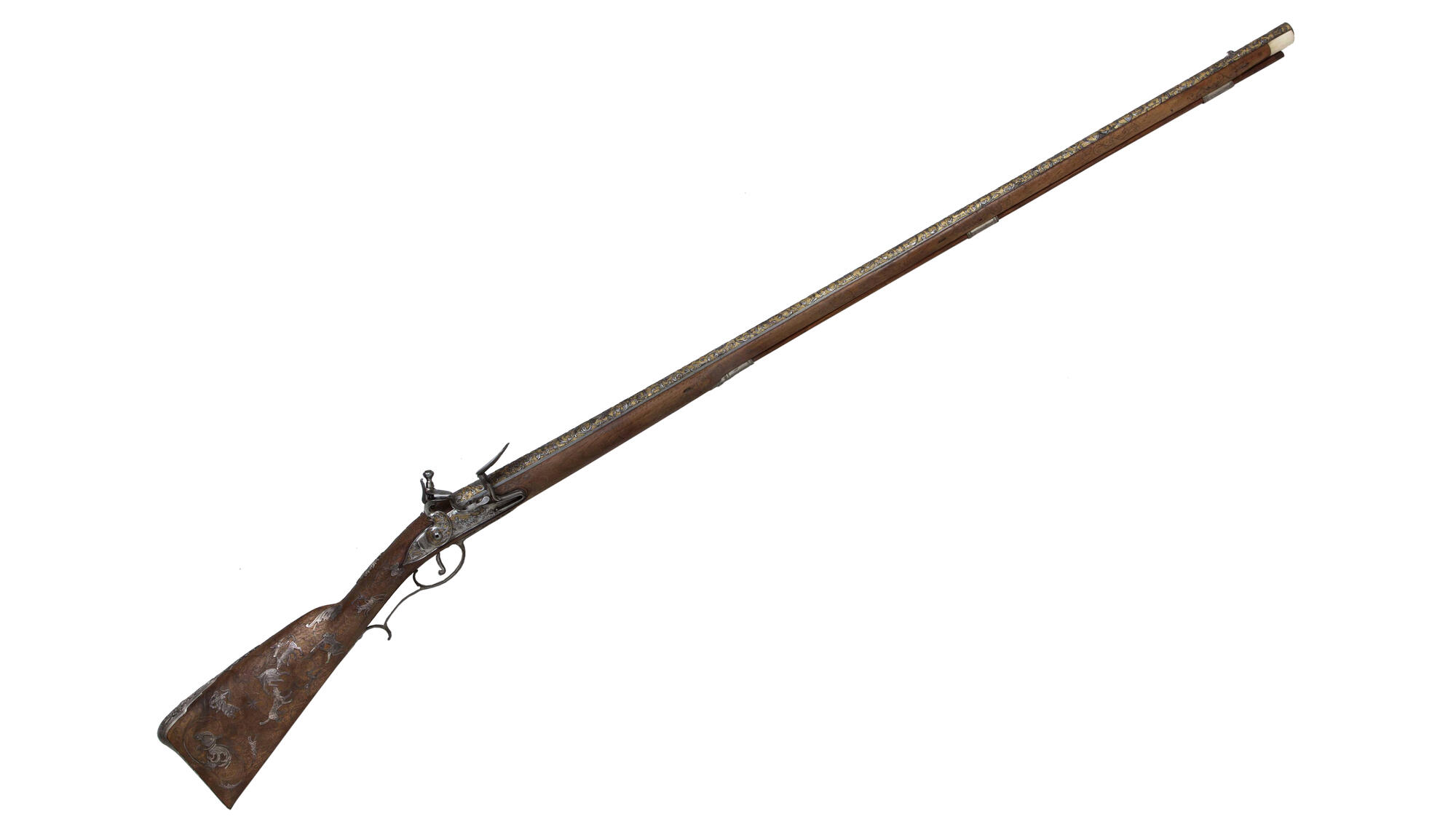


№37 Flintlock gun
Creation period
1750–1755s
Place of сreation
Tula, Russia
Dimensions
overall length — 144.4 cm, barrel length — 107.4 cm, calibre — 14.5 mm
Technique
forging, wood and bone carving, chasing, engraving, casting, repoussé, wood inlaid with silver
Collection
0
Open in app#1
Unknown Author
№37 Flintlock gun
#2
#3
Ministry of Culture of the Russian Federation
read morehide
00:00
00:00
1x
№37 Flintlock gun
Creation period
1750–1755s
Place of сreation
Tula, Russia
Dimensions
overall length — 144.4 cm, barrel length — 107.4 cm, calibre — 14.5 mm
Technique
forging, wood and bone carving, chasing, engraving, casting, repoussé, wood inlaid with silver
Collection
0
 Point your smartphone camera to open in the app
Open in app
Share

