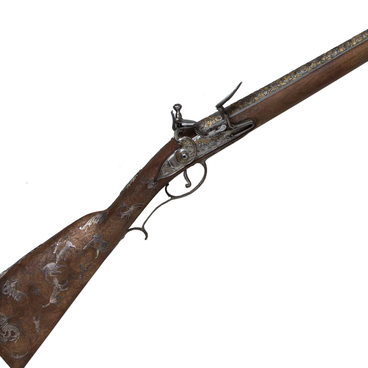
When it comes to decoration, this flintlock carbine can be considered one of the most interesting items of the Gatchina Palace and Estate Museum collection. Its construction as well as the form and decoration of the stock and lock are typical for the works of Tula gunsmiths of the middle of the 18th century. What is peculiar about this carbine is its unusual barrel. It looks as if it was made 100 years earlier, in the middle of the 17th century in the workshops of the Moscow Armoury. The thickness of the barrel walls considerably increases at the muzzle end to withstand the pressure — this feature was typical for the 17th century but not for the 18th century. Different parts of the barrel have alternating decorations in different techniques: images of a double-headed eagle under a crown, a crown and a griffin in the chasing technique or floral patterns inlaid with gold. Similarly, the elements of the furniture are also decorated in two different techniques. Their form is typical for the 18th century, but the floral pattern on them reminds of the 17th century. How can such an unusual combination of styles from different centuries be explained? Most likely, gunsmiths of Tula who made the carbine in the 18th century tried to reconstruct the decoration typical for the works of Moscow gunsmiths of the previous century. They must have used a real weapon manufactured at the Moscow Armoury as a sample. Probably, it was a pistol made by one of the best gunsmiths. Tula gunmakers did an excellent job imitating the patterns but they also introduced their own features. For example, on the parts of the barrel decorated in the chasing technique the reliefs were not gilded as it had been done in Moscow the century before, but were just polished against the gilded background, as it was typical for Tula. In the funds of the Gatchina Museum there is another carbine of the same design. But apart from this pair there are no other known samples of weapons made in Tula in such ‘vintage’ style in Russian museums. The barrel made of forged iron is octagonal at the breech end and round at the muzzle. The bore has eight semi-circular grooves. The muzzle is reinforced with protruding gilded band. The end of the tang is marked with a ball. The carbine arrived to the Gatchina Palace at the time of Grand Duke Pavel Petrovich and remained here until September 15, 1793. From 1823 till 1941 the rifle was kept in the Arms Gallery. In 1941 it was evacuated to the city of Sarapul and it returned to Gatchina only 47 years later.
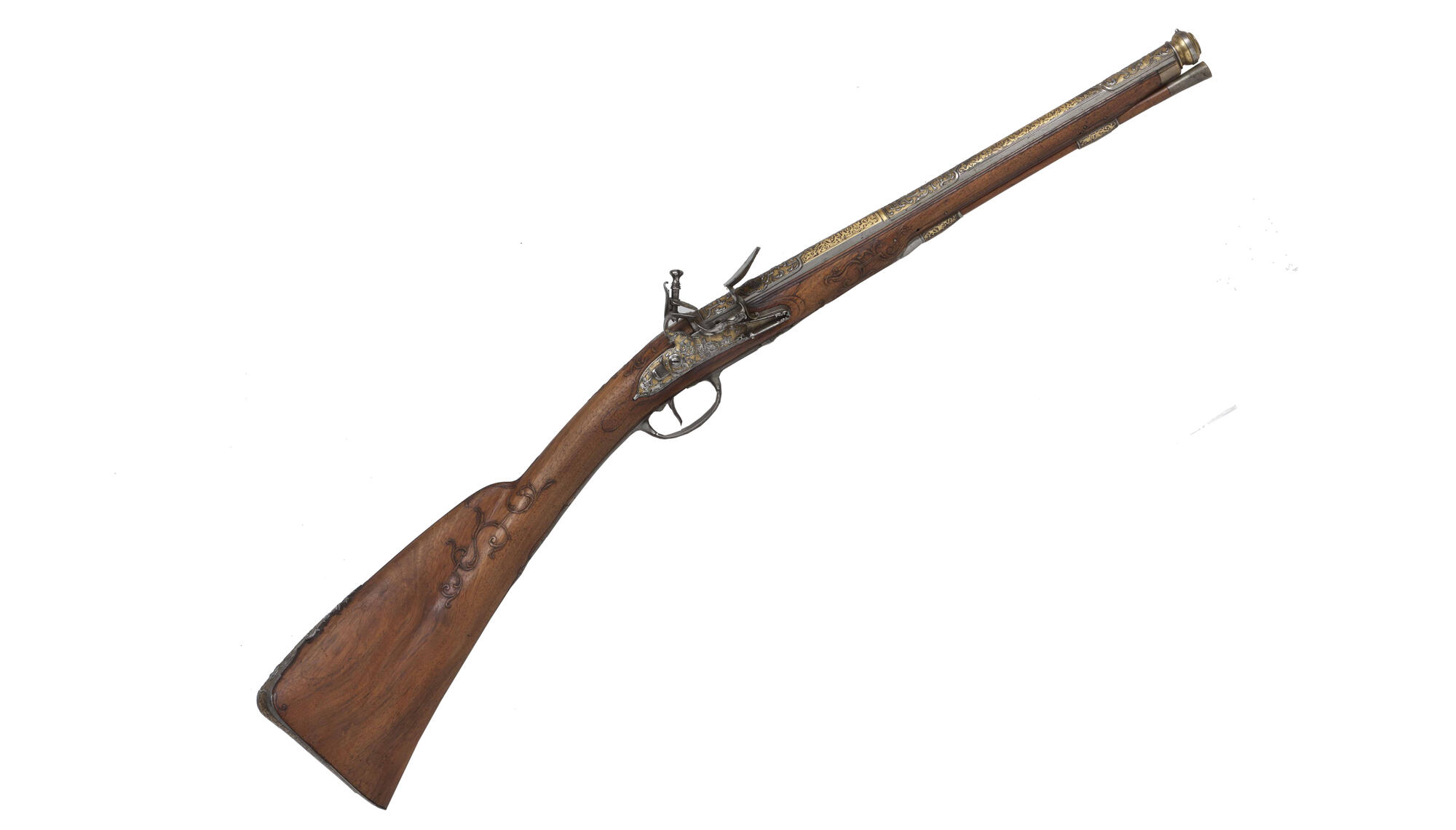


№36 Flintlock carbine
Creation period
the barrel — mid-17th century (?), the lock and stock — mid-18th century
Place of сreation
Russia, the barrel — Moscow (?), the lock and stock — Tula
Dimensions
overall length — 81 cm, barrel length — 41.2 cm, calibre — 15 mm
Technique
forging, wood and horn carving, chasing, inlay with gold, gilding
Collection
2
Open in app#3

№36 Flintlock carbine
#2
#4
Ministry of Culture of the Russian Federation
read morehide
00:00
00:00
1x
№36 Flintlock carbine
Creation period
the barrel — mid-17th century (?), the lock and stock — mid-18th century
Place of сreation
Russia, the barrel — Moscow (?), the lock and stock — Tula
Dimensions
overall length — 81 cm, barrel length — 41.2 cm, calibre — 15 mm
Technique
forging, wood and horn carving, chasing, inlay with gold, gilding
Collection
2
 Point your smartphone camera to open in the app
Open in app
Share