The dagger with a scabbard and an awl from the Gatchina Palace and Estate Museum was made in 1888. Most likely it was made in Chechnya. The theory is confirmed by the signature ‘Chilla’ engraved on the blade. It belonged to one of the most famous Chechen gunsmiths and bladesmiths of the second half of the 19th century called Chilli. He was the son of the famous gunsmith and bladesmith Murtaza Ali Bazalai and according to the legend gained his nickname from the name of the coldest winter month (‘chilli’) in which he was born in 1820. He followed in the footsteps of his father and became just as famous. His blades were highly valued. Often their surface was blued except for a stripe in the centre of the blade running along its length. To honour the memory of his father, the bladesmith often signed his blades not only with his name, but also with the name of his father — ‘Bazalai Chilli’. People called his steel ‘Chilli buolat’, which means ‘the best steel of Chilli’. However, the bladesmith did not make the steel himself. He received it from Damascus and then forged and quenched it to make its quality even higher. Along with blades Chilli also made silver handles and scabbards. Around 1890–1893 he moved to Vladikavkaz where he opened his own workshop. The weapons he manufactured were expensive. Yet they were popular among officers of the Russian army and civilians both in St.Petersburg and Tiflis. There is evidence that Chilli presented a shashka and a dagger to lieutenant general Semyon Kakhanov, the Head of the Terek Oblast. Similar sets were made for Count Illarion Vorontsov-Dashkov, the Governor General of the Caucasus Viceroyalty, and even for Emperor Nicholas II himself. As a reward Chilli received from the Head of the Terek Oblast a gilded tea service and the right to bear firearms, from Vorontsov-Dashkov — a gold medallion with a chain, and from Nicholas II — a golden Swiss watch with a presentation inscription: ‘To Chilli Murtazaliev, the famous bladesmith of the Caucasus’. It is possible that the dagger was brought to the Gatchina Palace after the journey of Emperor Alexander III with his family around the Caucasus in 1888, since the same date is written on the blade. But there are no reliable documents confirming this theory. Before the World War II the dagger with its scabbard was hung on the wall above the sofa in the First Dressing Room of Alexander III in the Arsenal Wing. The straight blade is made of steel and has two sharp edges. The sharp point is long and quadrilateral, rhomboid in section. The blade is blued. On the right side of the blade there is an engraved pattern with symbols of Arabic script. On the left side there is an inscription in two lines reading ‘Chilla 1888’. The hilt consists only of a grip which is made of two black horn plates fastened with studs with conical heads.
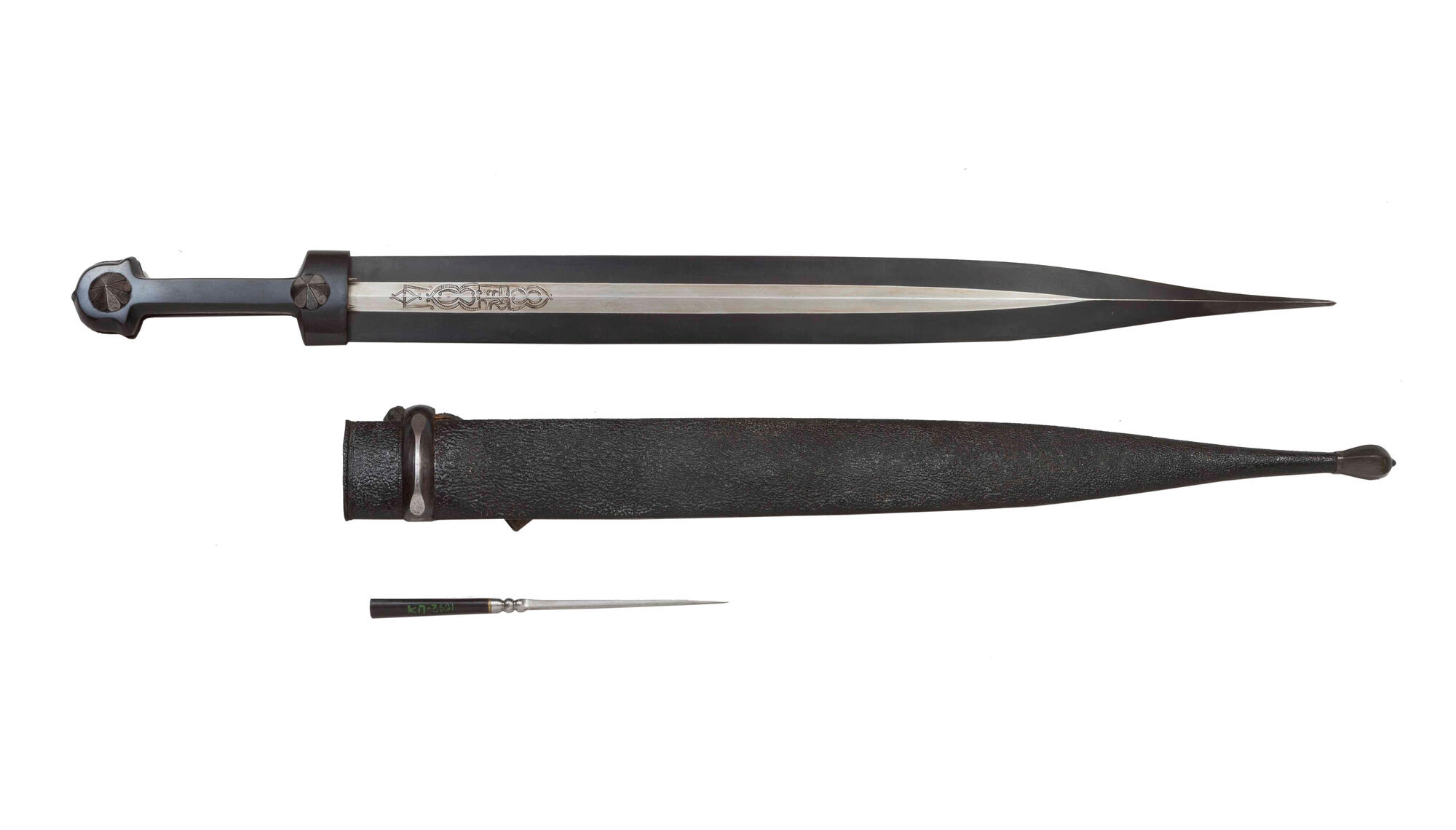


№34 Dagger with scabbard and awl
Creation period
1888
Place of сreation
Chechnya, North Caucasus, Russia
Dimensions
overall length — 58.1 cm, blade length — 45.5 cm, blade width — 4.1 cm
Technique
forging, horn carving, bluing, engraving
Collection
0
Open in app#1
Chilly Murtazaliev
№34 Dagger with scabbard and awl
#2
#3
Ministry of Culture of the Russian Federation
read morehide
00:00
00:00
1x
№34 Dagger with scabbard and awl
Creation period
1888
Place of сreation
Chechnya, North Caucasus, Russia
Dimensions
overall length — 58.1 cm, blade length — 45.5 cm, blade width — 4.1 cm
Technique
forging, horn carving, bluing, engraving
Collection
0
 Point your smartphone camera to open in the app
Open in app
Share