The gunsmith who made the flintlock rifle from the Gatchina Palace and Estate Museum collection is unknown. However, the places where main parts of the rifle were manufactured have been determined — the villages of Miskir-Yurt and Bachi-Yurt in Chechnya. The construction of the rifle is similar to Turkish rifles, but it is not so heavy, the stock is thinner and more refined and local traditions are more evident in the decoration. In 1888 Emperor Alexander III with his family travelled in southern regions of Russia and around the Caucasus. His arrival was luxuriously celebrated wherever he went and local people prepared valuable memorable gifts for him. On September 20 in Vladikavkaz the Tsar received a delegation from the Terek Oblast and representatives of the mountain peoples including the Chechens. They made to the Tsar a present of a flintlock rifle as well as a shashka and a burka, a sleeveless coat. It is not known what happened to the burka, but the rifle and the shashka were sent to the Gatchina Palace and placed in the Arms Gallery. They were kept in Gatchina till the 1920s. At that time the government sold a lot of museum exhibits abroad. Most likely, in the late 1927 or early 1928 the Gatchina museum learned about the plans to sell abroad a number of Caucasian and Central Asian weapons from the museum collection, including the Chechen shashka given to Alexander III as a present. To prevent the sell, employees of the Gatchina Palace-Museum sent a letter to the Department of Ethnography of the Russian Museum (now the Russian Museum of Ethnography) asking to examine the items which were expected to be sold and to admit them into their collection. Thus the weapons were preserved — they remained in the country even if they had to be transferred to another museum. On March 7, 1928, Alexander Miller, the famous ethnographer specializing in the Caucasus region culture, came to Gatchina and selected 23 items of Caucasian, Persian and Uzbek origin from the weapons meant for be transferred to the State Fund. After considering the petition from the Department of Ethnography, the People’s Commissariat for Education decided to refrain from selling most of the selected items. So the parts of the present from Chechens to Alexander III were separated: the rifle remained in Gatchina while the shashka was sent to St.Petersburg to the Special Storage of the Russian Museum of Ethnography. At the beginning of the World War II the rifle was evacuated to the city of Sarapul. In 1988 it returned to the Gatchina Palace from the Tsarskoe Selo State Museum and Heritage Site. Sometimes the shashka and the rifle are demonstrated together at temporary exhibitions.


№33 Flintlock rifle
Creation period
1888
Place of сreation
Chechnya, North Caucasus, Russia, barrel — village of Miskir-Yurt, furniture — village of Bachi-Yurt
Dimensions
overall length — 137,1 cm; barrel length — 105,2 cm; calibre — 12 mm
Technique
wood and bone carving, casting, forging, repoussé, gilding, niello
Collection
0
Open in app#1
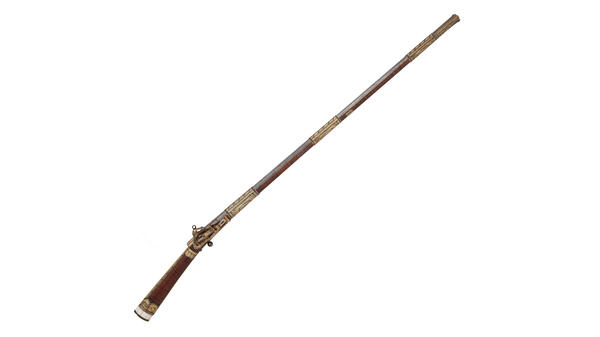
№33 Flintlock rifle
#2
#3
Ministry of Culture of the Russian Federation
read morehide
00:00
00:00
1x
№33 Flintlock rifle
Creation period
1888
Place of сreation
Chechnya, North Caucasus, Russia, barrel — village of Miskir-Yurt, furniture — village of Bachi-Yurt
Dimensions
overall length — 137,1 cm; barrel length — 105,2 cm; calibre — 12 mm
Technique
wood and bone carving, casting, forging, repoussé, gilding, niello
Collection
0
 Point your smartphone camera to open in the app
Open in app
Share

