


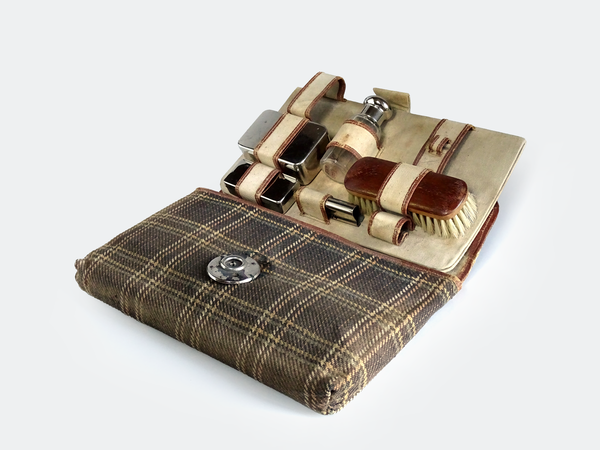
In the funds of the Volgograd Regional Museum of Local History there is an officer’s toiletry kit from the period of the World War I of 1914-1917.
In Russian the word “несессер” denoting a toiletry kit was borrowed from the French language, from which it is translated as “necessary”.
The first toiletry kit appeared at the end of XVII century exclusively as a man’s compact travelling suitcase, which should always be at hand. It contained hygiene supplies, cosmetic accessories and stationery, without which no self-respecting gentleman went on a long journey. And each thing in the bag had its own place, where it was held by cloth loops. If it were not for such fastenings, all the contents of the kit would certainly be mixed up during the ride in a jolting carriage. The birth of the toiletry kit was dictated by the necessity of life. After all, in those distant years travelling from city to city took more than one day, and during stops at roadside inns it was very troublesome to look for razors or quills in bales and trunks. But the owner could extract all the essentials from a toiletry kit within a minute.
Initially, toiletry kits were made exclusively of wood. However, the material was exotic, namely the mahogany imported from Africa or bog wood. Inside the cherished coffers were upholstered in silk or velvet.
Back in the seventeenth century in the arsenal of the Russian warrior had something similar. Then a travelling handbag for personal belongings of a new recruit was called “recruit’s reticule”.
Although, its contents were quite modest: powder for wigs, combs for moustaches and shag. However, at the end of the XVIII century, on the initiative of the famous commander Alexander Suvorov, army toiletry kit went to a well-deserved rest, but after a few decades they were again “called to service”. They were small metal boxes in which military men kept razors, scissors, spoons and other necessary items.
In 1918, the cherished coffers turned out to be unnecessary for the Soviet soldier as a “bourgeois relic”, and now a hundred years later they are back in the Russian army.


